
Quick Answer: Risk management is a system for deciding how much capital to risk per trade to protect your account from catastrophic losses. The professional standard: never risk more than 1-2% of your total account balance on any single trade. If your account is ₹1,00,000, you risk a maximum ₹1,000-₹2,000 per trade — no exceptions.
Published March 7, 2026 · Last refreshed April 27, 2026. Prices and data are compiled with reasonable care but — always confirm against your broker before trading.
Risk Management: Why Most Traders Lose and How to Stop

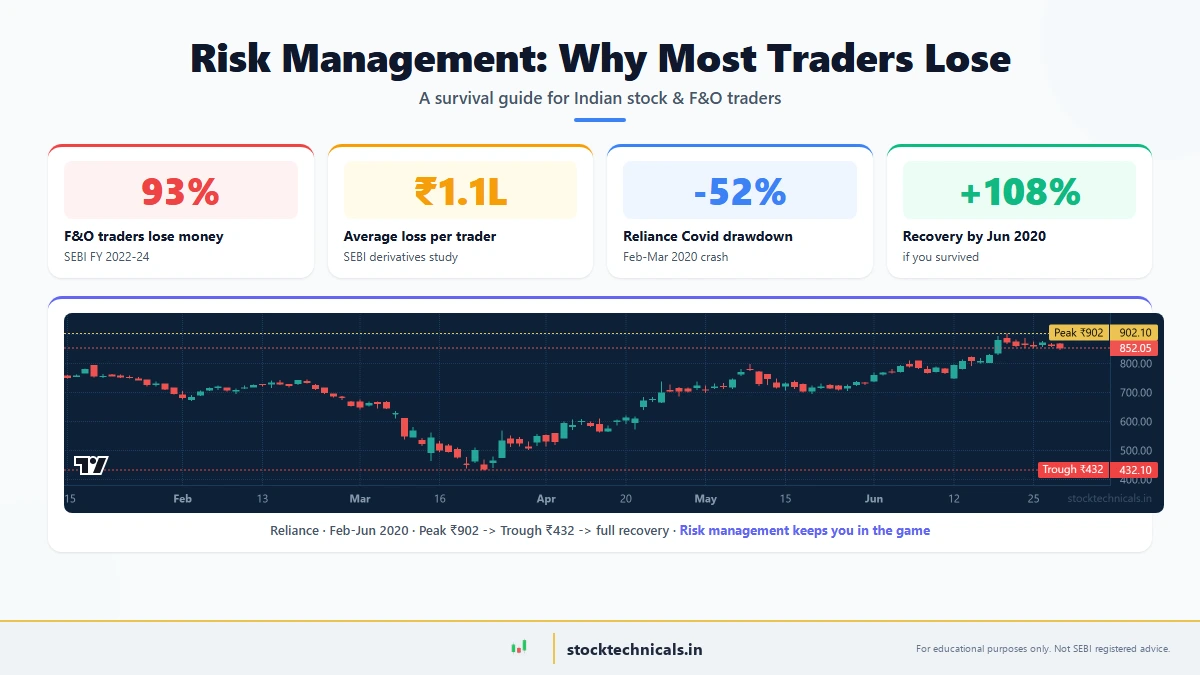
Chart window: Feb 2020 – Jun 2020 · Data refreshed Apr 19, 2026 · Source: NSE (daily OHLC)
Introduction
You've learned about candlestick patterns, support and resistance, moving averages, and oscillators like RSI. You know how to spot entries. You can read a chart. You feel ready to trade.
Then one bad trade wipes out two weeks of profits.
This is the story of 93% of intraday traders who lose money, according to a SEBI study. Not because they can't read charts. Not because they don't understand technical analysis. They lose because they never learned the one thing that matters more than any entry signal: how to protect their money.
Key Takeaways
- The 1% Rule: Never risk more than 1% of your account on any single trade — this keeps any loss survivable
- Position Sizing Formula: Shares to buy = (Account × 1%) ÷ (Entry Price − Stop Loss Price)
- Stop losses must be placed before you enter a trade, based on chart structure — not emotions
- Only take trades where potential reward is at least 1.5× your risk (minimum 1:1.5 R:R ratio)
- Cluster Risk Rule: Never have more than 5% of account at risk across all open positions simultaneously
- A 50% loss requires a 100% gain to recover — risk management prevents you from digging that hole
That thing is risk management.
Here's the hard truth: your entry is only 10% of a winning trade. Your exit timing is maybe 30%. But your risk management? That's the 60% that decides whether you're trading or bankrupt in six months.
Most beginners focus obsessively on entries. They backtest patterns. They study indicators. They watch YouTube tutorials on spotting the perfect setup. But they spend zero time on the question that determines their survival: How much money can I afford to lose on this single trade?
It's like building a house without a foundation. No matter how beautiful the walls, the whole structure collapses.
This article is different. We're not teaching you a new indicator or pattern. We're teaching you the invisible force that every profitable trader has mastered: the systematic way to risk capital so you can trade for 20 years instead of 20 months.
By the end of this guide, you'll understand:
- Why risking just 1-2% per trade is the foundation of professional trading
- How to calculate the exact position size for any trade setup
- Why your stop loss is not an exit — it's a risk container
- How the 1:2 risk-reward ratio separates winners from gamblers
- The exact rules professional traders use to manage capital
- How to set up risk management on Zerodha Kite, TradingView, Angel One, and Groww
Let's start with the definition that will change how you think about trading forever.
Core Definition: What Is Risk Management in Trading?
Risk management is the systematic process of deciding how much money you can afford to lose on each trade, and protecting that decision through rules.
It's not about avoiding losses. Losses are part of trading. It's not about never being wrong. Even the best traders are wrong 40-50% of the time. Risk management is about controlling how much you lose when you're wrong.
Think of it like this: a traffic light doesn't prevent car accidents. But it gives drivers a system to navigate intersections safely. Risk management is your traffic light. It gives your trading a structure so you don't crash into bankruptcy at the first red light.
Key Principle: "If you want to trade for 20 years, you need to survive the next 20 trades. Risk management is how you do that." — Professional traders' golden rule
Here's why this matters:
Reason 1: Survival Over Profit
A 50% loss requires a 100% gain to recover. A 75% loss requires a 300% gain. The deeper the hole, the harder it is to climb out. Risk management keeps you from digging.
Reason 2: Psychology Protection
When you know you can only lose ₹1,000 per trade, a loss hurts but doesn't destroy. You can take the next trade with a clear head. When you've gambled ₹50,000 and lost it, rage and desperation take over. You start revenge trading, which leads to more losses.
Reason 3: Compounding Works in Both Directions
Small consistent wins compound into massive wealth over years. But small careless losses also compound — into zero. Risk management ensures you're compounding the right direction.
Reason 4: It Levels the Playing Field
You don't need to be right 80% of the time to be profitable. With proper risk management, even a 40% win rate makes money. This shifts the game from "Can I predict the market?" to "Can I protect my capital while finding edges?"
The 1% Rule: The Foundation of All Professional Trading

Walk into any trading firm in Mumbai, Singapore, or London, and you'll hear the same number: 1% to 2%.
This is the maximum percentage of your total capital you should risk on any single trade. Not hope to risk. Not try to risk. Must risk.
What Does This Mean?
If your trading account has ₹1,00,000, then 1% = ₹1,000. This means: if this trade hits your stop loss and you lose, the maximum loss should be ₹1,000. Not ₹2,000. Not ₹5,000. ₹1,000.
That's it. That's the rule. Everything else flows from this number.
How to Identify and Use the 1% Rule
The math is simple:
Risk per Trade = 1% of Account × Account Size
For a ₹1,00,000 account: Risk = 0.01 × 1,00,000 = ₹1,000
Now, here's what beginner traders get confused about: this isn't your position size. This is your risk. Your position size depends on where you place your stop loss.
Position Size = Risk ÷ (Entry Price − Stop Loss Price)
This formula is the key. It links your stop loss distance directly to how many shares you can buy.
Example: Reliance at ₹2,850
Let's say you want to buy Reliance Industries (NSE: RELIANCE) at ₹2,850. Your stop loss is at ₹2,800 (a 50 paisa difference seems tiny, so let's say ₹2,780 for an example — that's a ₹70 stop loss distance).
Your account: ₹1,00,000. Risk per trade: ₹1,000.
Position Size = ₹1,000 ÷ (₹2,850 − ₹2,780) = ₹1,000 ÷ ₹70 = 14.28 shares
So you buy 14 shares of Reliance at ₹2,850 = ₹39,900 invested. If the stop loss hits at ₹2,780, you lose ₹980 (14 × 70). That's your 1% risk, protected.
If Reliance instead rises to ₹2,950 (+₹100), you make ₹1,400 (14 × 100). Risk ₹1,000, make ₹1,400. That's a 1:1.4 risk-reward ratio. Good trade setup.
What This Tells You
The 1% rule forces you to make a choice: Where do I put my stop loss? Because that stop loss distance determines your position size. Tighter stop loss = smaller loss per point = more shares you can buy = leverage without leverage.
This is elegant. Professional traders don't ask "How many shares should I buy?" They ask "Where is my stop loss?" The answer to that question automatically tells them position size.
Trading Rule: The 1% Hard Stop
"No trade is ever worth more than 1% of your account. Ever. If a setup requires risking 5%, then it's not a setup worth taking — no matter how beautiful the chart looks."
Capital Allocation and Position Sizing Basics


The 1% rule gives you maximum risk. But allocation is the art of deciding how to divide your capital across multiple trades.
Think of your account like a budget. You wouldn't spend your entire month's salary on groceries and have nothing for rent. Traders shouldn't put their entire capital at risk in one trade either.
What Does This Mean?
Capital allocation = the process of dividing your trading account into slices, so you can run multiple trades simultaneously without risking too much in any single direction.
For example, if you have ₹1,00,000, you might allocate:
- 40% for swing trades (₹40,000 reserved)
- 30% for intraday trades (₹30,000 reserved)
- 20% for learning/experiments (₹20,000 reserved)
- 10% for cash buffer (₹10,000 reserved, never touch)
Within the swing trade allocation, if you take two simultaneous positions at 1% risk each, you're risking 2% of total capital, which is acceptable. But if you take 10 simultaneous trades at 1% each, you're risking 10% — catastrophic if the market reverses.
How to Identify and Use Position Sizing Basics
There are three approaches:
Approach 1: Fixed Fractional (Best for beginners)
Risk the same amount on every trade, regardless of account size. Example: Always risk ₹1,000, always risk ₹500, always risk ₹2,000. Simple. Consistent. No surprises.
Approach 2: Percentage-Based (Best for growth)
Risk a fixed percentage of your account. At ₹1,00,000, risk 1% (₹1,000). As account grows to ₹2,00,000, now risk 1% (₹2,000). The risk grows with your account.
Approach 3: Kelly Criterion (Professional level)
A mathematical formula that calculates optimal position size based on your win rate and average win-loss ratio. Beyond scope here, but know it exists.
For beginners: use Approach 1 or 2. Pick one and stick with it for 100 trades.
Example: HDFC Bank at ₹1,720
You want to trade HDFC Bank (NSE: HDFCBANK). You have ₹2,00,000 in your account.
Setup 1 (Intraday): Buy at ₹1,720, stop loss at ₹1,705 (₹15 difference)
- Risk per trade: ₹2,000 (1%)
- Position size = ₹2,000 ÷ ₹15 = 133 shares
- Capital deployed: 133 × ₹1,720 = ₹2,28,760 — wait, this is >100% of account. Problem!
This is where traders fail. They calculate position size and then realize they don't have enough capital. The stop loss is too far away relative to account size.
Solution: Either (a) move stop loss tighter (less room for noise), (b) increase account size first, or (c) reduce risk percentage.
Let's reduce risk to 0.5% instead:
- Risk per trade: ₹1,000 (0.5%)
- Position size = ₹1,000 ÷ ₹15 = 66 shares
- Capital deployed: 66 × ₹1,720 = ₹1,13,520 (56% of account). Good.
Now you can take multiple trades without blowing up.
What This Tells You
Position sizing forces discipline. It shows you: Can I actually afford this setup with real capital? It separates fantasy analysis (charting moves you "could have made") from real trading (positions you can actually take).
Trading Rule: The Allocation Rule
"Before taking a trade, know: (1) total capital at risk if all current open positions hit stop losses simultaneously, (2) maximum simultaneous positions you'll allow, (3) which market direction you're biased toward."
Stop Loss as Risk Management Tool: Not Just an Exit Strategy

Most beginners see a stop loss as a safety net. If the trade goes badly, the stop loss catches them. That's true, but it's only half the story.
Professional traders see the stop loss as something more: a risk container. A way to convert "I hope this doesn't go down too much" into "I know exactly how much this will cost me if it goes down."
What Does This Mean?
A stop loss is not an exit. It's a definition of wrongness.
Before you enter a trade, you must answer: "At what price will I know I'm wrong?" Not "At what price will I exit for profit." Not "At what price will I take some gains." But "At what price will I admit this setup isn't working and leave?"
Example: You buy Nifty 50 index at 22,500 because you see a bullish engulfing pattern on the 4H chart. You're betting the trend will continue. Your stop loss is 22,400. Why? Because if Nifty closes below 22,400, the pattern has failed, and your thesis is wrong. You exit because the reason you entered is gone.
This is fundamentally different from "I'll exit when I'm down 1% to protect capital." That's reactive. The first approach is proactive.
How to Identify and Use Stop Loss Placement
There are three main strategies:
Strategy 1: Support-Based Stop Loss (Most logical)
Place your stop loss just below recent support level. If support breaks, your thesis breaks. Example: Nifty is trading around 22,500 with support at 22,400. Buy above 22,500, stop loss at 22,380. Clean, simple, thesis-based.
Strategy 2: Volatility-Based Stop Loss (Using ATR)**
Use ATR (Average True Range) to place stops. If volatility is high, place stops further away (so random noise doesn't trigger it). If volatility is low, place stops tighter. This adapts your risk to market conditions.
Strategy 3: Time-Based Stop Loss (For swing traders)
Give the trade a time frame. If the setup hasn't worked in 3 days, exit. Time decay becomes your stop loss, not price. Useful for pattern trades.
Example: TCS at ₹3,600
Technical setup: TCS (NSE: TCS) bounced off ₹3,550 support three times in the last week. Now trading at ₹3,600. You expect it to move to ₹3,700 (resistance).
Support-based stop loss: Place stop at ₹3,540 (below support, so if support cracks, you're out). Risk = ₹60 per share.
If your account is ₹2,00,000, and you risk ₹2,000:
- Position size = ₹2,000 ÷ ₹60 = 33 shares
- Capital deployed: 33 × ₹3,600 = ₹1,18,800
If TCS reaches ₹3,700 (target), you make ₹3,300 (33 × 100). Risk ₹2,000, make ₹3,300. That's a 1:1.65 risk-reward ratio.
What This Tells You
A proper stop loss is the foundation of all risk management. Without it, you're managing hope, not risk. Every professional trader can tell you exactly where their stop loss is the moment they enter. Every losing trader says "I'll figure out where to exit when it happens."
Trading Rule: The Stop Loss Rule
"Your stop loss should be based on the chart, not your account size. Ask: 'At what price is my technical thesis wrong?' That's your stop loss. Then calculate position size from that distance."
Risk-Reward Ratio Fundamentals: The 1:2 Minimum

Here's a question that divides amateurs from professionals: How much should I make if I'm right versus how much I lose if I'm wrong?
The answer is: risk-reward ratio.
What Does This Mean?
Risk-Reward Ratio = Target Profit ÷ Stop Loss Loss
If you risk ₹1,000 to make ₹2,000, your ratio is 1:2. You're risking one unit to make two units.
Here's why this matters: even if you're only right 50% of the time, you can still be profitable with a 1:2 ratio.
Let's prove it:
- 10 trades, 5 wins, 5 losses
- Each trade: risk ₹1,000
- Winners: 5 × ₹2,000 = ₹10,000
- Losers: 5 × ₹1,000 = ₹5,000
- Net profit: ₹5,000
You were right half the time, but you made money. Why? Because when you were right, you made twice as much as when you were wrong.
Now compare to a trader with 1:1 ratio (risk ₹1,000 to make ₹1,000):
- Same 10 trades, 5 wins, 5 losses
- Winners: 5 × ₹1,000 = ₹5,000
- Losers: 5 × ₹1,000 = ₹5,000
- Net profit: ₹0
Same win rate, zero profit. The only difference is the ratio.
This is the secret that changes everything. Professional traders don't focus on having a high win rate. They focus on having a positive risk-reward ratio. High win rate is nice but optional.
How to Identify and Use Risk-Reward Ratios
Step 1: Identify support and resistance. Nifty is at 22,500. Support at 22,400, resistance at 22,600. If you go long at 22,500, target is 22,600, stop loss is 22,400.
- Risk: 22,500 − 22,400 = 100 points
- Reward: 22,600 − 22,500 = 100 points
- Ratio: 1:1
This trade barely qualifies as professional (minimum is 1:1.5 or 1:2). But it works if your win rate is 55%+.
Step 2: Look for setups with wider targets. Candlestick pattern at ₹2,850 with stop loss at ₹2,780 (₹70 risk) and target at ₹2,950 (₹100 reward)?
- Ratio: 1:1.43
Still okay, but search for better. Wait for a setup where you risk ₹70 and target is ₹140 (1:2 ratio).
Example: Bank Nifty at 47,500
Bank Nifty (NSE: BANKNIFTY) just broke above ₹47,500 resistance. Old resistance becomes support. Your setup:
- Entry: ₹47,500 (breakout)
- Stop loss: ₹47,200 (₹300 risk)
- Target: ₹48,100 (₹600 profit, or 1:2 ratio)
Margin required for one Bank Nifty lot (30 contracts post Jan 2026 rebaseline; verify current NSE circular contracts): ~₹1,00,000-₹1,50,000 (check your broker). Let's say ₹1,00,000.
If your account is ₹2,00,000, this trade = 50% of your capital. That's too much. Reduce to half a lot (12 contracts), which requires ~₹50,000 and scales your P&L down proportionally.
At 1:2 ratio, if you're right, you make significant profit. If you're wrong, you lose controlled amount.
What This Tells You
Risk-reward ratio is the mathematical foundation of trading profitability. It tells you: Is this trade worth the math? Before you even enter, you know the odds. A trader who never takes a trade with worse than 1:1.5 ratio will be profitable over 100+ trades, even with a mediocre win rate.
Trading Rule: The Reward Rule
"Never take a trade where the target is closer to entry than the stop loss is. If you risk to 22,400 from 22,500, your target must be at least 22,600 or further. Preferably 22,700+ for a 1:2 ratio."
Platform Setup: How to Configure Risk Management on Your Broker

All this theory is useless if you can't implement it. Let's walk through the exact steps on India's most popular platforms.
Zerodha Kite (Most Popular in India)
- Place your buy/sell order, but don't confirm yet
- In the order panel, scroll down to "GTT - Good-Till-Triggered" (optional, used for automated stops)
- For manual stop loss, set a second order (sell order if you're long): enter quantity, trigger price (your stop loss), limit price (same as trigger or slightly lower)
- Check that the trigger price gives you the risk you calculated
- Place both orders (entry + stop loss)
Pro tip: Use "Basket Orders" if you're taking multiple trades. Enter all positions with their stop losses at once, so you can see total capital at risk before confirming.
TradingView (Best for Charting + Risk Visibility)
- Open the Alerts panel (or Trading Panel if connected to Zerodha)
- Set entry, stop loss, and target levels as "horizontal lines" on the chart
- Mark the risk distance (from entry to stop loss) in points or rupees
- Use the built-in position size calculator: Trading → Position Size Calculator
- Enter entry, stop loss, account size, and risk % — it auto-calculates position size
Pro tip: TradingView's "Risk/Reward" label shows your ratio in real-time. If it's less than 1:1.5, the label glows red as a warning.
Angel One (Mobile-First Broker)
- Open Chart, identify entry point
- Place order, but tap "Advanced" (not quick order)
- In the Advanced panel, set stop loss as "SL order" (stop loss order, activated when price touches trigger)
- Set target as a separate "target order" (optional, but useful)
- Review total margin used and confirm
Pro tip: Angel One's mobile app shows your "Risk" in ₹ directly, saving you the mental math.
Groww (Beginner-Friendly Interface)
- Enter the stock, click "Trade"
- In the order panel, select "Stop Loss" order type
- Set regular price (entry) and stop-loss price
- Confirm — Groww calculates margin needed
Drawback: Groww's risk calculator is less detailed than Angel One or TradingView. For serious position sizing, use a spreadsheet alongside.
Comparison Table: Risk Management Setup by Platform
| Broker | Risk Visibility | Position Size Calculator | GTT/Automated Stop | Best For |
|---|---|---|---|---|
| Zerodha Kite | Good (need to math) | Manual (via spreadsheet) | Yes (GTT) | Intraday + Swing, experienced traders |
| TradingView | Excellent (built-in ratio) | Yes, excellent | Yes (Alerts) | Technical analysis, planning |
| Angel One | Very Good (shows ₹ risk) | Yes (mobile) | Yes (Stop Loss) | Mobile trading, clarity |
| Groww | Moderate | Basic | Limited | Beginners, web trading |
| Dhan | Good | No | Yes | F&O traders, low brokerage |
Recommendation for beginners: Use TradingView to plan your risk (visually), then execute on Zerodha or Angel One (which have reliable order execution).
Advanced Context: Professional Risk Management Beyond the Basics
Once you've mastered 1% per trade and 1:2 ratios, professionals layer in three more concepts:
Multi-Trade Risk (Cluster Risk)
Imagine you take 5 simultaneous trades, each at 1% risk. If the market reverses against all of them, you lose 5% total. This is your cluster risk. Professionals limit simultaneous positions: typically 3-5 trades max in the same direction.
Correlation Risk
If all your trades are in the same sector (e.g., all Nifty 50 components), they'll all lose together if that sector crashes. Spread your risk across uncorrelated assets: stocks, indices, options, F&O. This is beyond beginner scope but know it exists.
Drawdown Management
Your account will have losing streaks. A professional calculates maximum acceptable drawdown (typically 15-20%) and stops trading if drawdown exceeds that. Example: ₹1,00,000 account, max drawdown is 15% = ₹15,000. If losses hit ₹15,000, stop trading and review strategy.
Five Core Risk Management Rules for Everyday Trading

Here are the five rules that separate professionals from gamblers. Memorize these.
Rule 1: Risk Maximum 1-2% Per Trade
Every single trade, every single day. 1% minimum, 2% maximum on aggressive days. No exceptions. If a trade requires more risk, the setup isn't worth it.
Rule 2: Never Risk More Than 5% Across All Open Positions
If you have 4 open trades at 1% each, you're at 4% total risk. This is acceptable. If you add a 5th at 1%, you're at 5% — maximum limit. No 6th trade.
Rule 3: Have a Stop Loss Before You Enter, Not After
Emotional traders set stop losses after entering ("if I'm down ₹2,000, I'll exit"). This doesn't work. You must know your stop loss before clicking buy/sell. The chart tells you, not your emotions.
Rule 4: Only Take Trades with 1:1.5 or Better Risk-Reward
If your target is only ₹50 profit for a ₹100 risk, skip it. Wait for setups where profit target is 1.5x or 2x the risk. These setups come every week; don't rush.
Rule 5: Scale Position Size as Account Grows
If you always risk ₹1,000, your profits will stagnate. As account grows from ₹1,00,000 to ₹2,00,000, scale up to ₹2,000 risk. Let your profit compound.
Risk Management Checklist: Before Every Trade
Use this checklist before entering any trade. If you can't check all boxes, don't trade.
[ ] Account Balance Confirmed — Do I know my exact account balance right now?
[ ] Risk Amount Calculated — Have I calculated exactly how much I'll lose if this hits the stop loss?
[ ] Stop Loss Identified — Do I know my stop loss price? Is it based on the chart, not my comfort?
[ ] Position Size Calculated — Have I calculated exact shares/contracts using the formula?
[ ] Capital Deployed Reviewed — Is the capital required less than my total account? (Should be 20-60%)
[ ] Cluster Risk Checked — How many trades are currently open? Is this 5th trade acceptable?
[ ] Risk-Reward Ratio Confirmed — Is my reward at least 1.5x my risk? Or better?
[ ] Broker Platform Ready — Do I have both entry and stop loss orders queued, not placed?
[ ] Emotions Neutral — Am I entering because the chart says yes, or because I'm frustrated/greedy?
[ ] Chart Pattern Valid — Have I triple-checked the entry signal? Does it still look good?
Print this checklist. Use it daily. After 50 trades, it becomes automatic.
Five Common Risk Management Mistakes (And How to Avoid Them)

Every trader makes these mistakes. Professionals make them once, then never again.
Mistake 1: Averaging Down (Adding to Losing Trades)
You buy Reliance at ₹2,850, stops goes to ₹2,800. Instead of exiting, you buy more at ₹2,800, thinking "I'm getting a better price." Now you're down ₹(2×100) = ₹200 instead of ₹50. This is revenge trading masked as strategy.
How to avoid: Set a rule: "I never add to a losing position. Ever." Period.
Mistake 2: Moving Stop Loss to Preserve a Trade
Your stop is at 22,400. Nifty touches 22,410, threatening your stop. You move it to 22,350 to give it "more room." Now your risk is ₹100 instead of ₹100. You've just abandoned your thesis and replaced it with hope.
How to avoid: Your stop loss is based on the chart, not emotions. If you're tempted to move it, exit instead. The trade isn't working.
Mistake 3: Ignoring Cluster Risk ("One More Trade Won't Hurt")
You have 4 trades open at 1% each. Your brain says "I've got room for one more." You take a 5th. Market crashes. All 5 hit stop losses. You're down 5%, not 4%. Blowout.
How to avoid: Use a table. Track every open trade in a spreadsheet. Before entering trade #N, calculate total cluster risk. If it exceeds 5%, wait.
Mistake 4: Risking Too Much Too Soon ("I'll Be Careful This Time")
You just had three losses. Now you see a "sure thing" setup. You risk 3% instead of 1%. It's a loss. Down 3%. Now you risk 5% to recover. Down 8%. Spiral.
How to avoid: The 1% rule has no exceptions. Winners, losers, whatever. Always 1%.
Mistake 5: Not Adjusting for Volatility
You risk 1% every day. On high-volatility days (Fed announcement, earnings), your stop losses are hit more often by random noise. But you're still risking 1%. You end up with 5+ losses in one day.
How to avoid: On high-volatility days, either reduce position size by half or increase stop loss distance (maintaining same 1% risk).
Comparison Table: Risk Management Approaches Across Trading Styles

Different trading styles have different risk profiles. Here's how pros adapt:
| Trading Style | Typical Risk % | Stop Loss Distance | Position Size | Best Risk Approach |
|---|---|---|---|---|
| Scalping (5-15 min) | 0.5% | Very tight (10-20 pts) | Large | Tight stops, smaller size, use 1:1 ratio |
| Intraday (15m-1H) | 1% | Medium (30-50 pts) | Medium | Standard 1% rule, aim for 1:1.5 ratio |
| Swing Trading (2-5 days) | 1.5-2% | Wider (50-100 pts) | Smaller | Can afford bigger stops, demand 1:2+ ratio |
| Position Trading (weeks) | 2% | Very wide (100+ pts) | Smallest | Accept larger stops, 1:2+ mandatory |
| Options Trading | 2% | Defined by premium | Via Greeks | Higher leverage, strict 1% limit essential |
Key insight: Swing traders can afford to risk 2% because they take fewer trades. Scalpers must stick to 0.5-1% because they take many. More trades = lower risk per trade.
I learnt risk management the way most traders do — by ignoring it for two years and paying the price. I now sized positions before I planned entries. The order matters.
What if my account is very small (₹10,000 or less)?
The 1% rule still applies. ₹10,000 account, 1% = ₹100 per trade. This sounds tiny, but it forces discipline. Once your account hits ₹25,000+, you'll have more flexibility. For now, focus on learning, not earning. Use the small account as your "practice account" to master position sizing.
Is 1% rule a hard rule, or can I go to 3% on "sure thing" trades?
It's a hard rule. There's no such thing as a "sure thing" in trading. The best professional setups have maybe 60-70% win rates. The "sure things" are the overconfident plays that blow accounts. Stick to 1%.
Should I use stop losses on all trades, or only on risky ones?
All trades. 100%. Even a swing trade held for a week needs a stop loss. It's not about fear; it's about math. Without a stop loss, your risk is unlimited. Your maximum loss isn't defined. Professional trading requires defined risk.
What if my stop loss is constantly hit by whipsaw (random noise), but then price goes to target?
This means your stop loss is too tight relative to volatility. Widen it by 5-10 points (so you need to adjust position size down accordingly, maintaining 1% risk). Or switch to a "time stop loss" — give the trade 3 days, then exit regardless of price. Whipsaws mean your setup wasn't clean.
How do I handle risk management on multi-leg options trades (spreads)?
The risk is the maximum loss of the spread (usually the credit/debit paid). Calculate this maximum loss as your "risk." If max loss is ₹1,500 on a ₹1,00,000 account, that's 1.5% risk, acceptable. Don't add more spreads.
Should I risk more if my win rate is high (e.g., 70%)?
No. The 1% rule is non-negotiable. BUT — if your win rate is consistently above 60%, you can maximize the other side: demand higher risk-reward ratios (1:3, 1:4) to maximize profit per trade. Higher win rate means you can wait for better setups.
What if the market is in a strong trend — should I risk more?
No. A strong trend actually means wider stop losses (to avoid whipsaw), which means smaller position sizes. Your actual rupee risk stays at 1%, but you're holding fewer shares/contracts. Paradoxically, trending markets should push risk management *more* strictly, not less. ---
Continue the Risk Management Cluster
Risk management is a four-part discipline. If this piece helped, work through the companion guides:
- Position Sizing — the exact formula for shares/lots per trade given your stop width.
- Stop Loss Strategies — fixed %, support-based, ATR, trailing, hybrid — pick the right one per setup.
- Risk-Reward Ratio — why 1:2 is the minimum and how expectancy math actually works.
- Trading Journal — the cheapest edge in trading; without it, risk management is guesswork.
Risk Management Quiz — Test Yourself
Five questions. No hand-holding. If you get below 3/5, re-read the article before you trade live.
The Bottom Line
Risk management isn't the exciting part of trading. But it's the part that determines whether you're trading in 5 years or bankrupt in 5 months. The 1% rule is simple. Position sizing is math. Stop losses are non-negotiable. Start applying these rules on your next trade. Do it for 100 trades. You'll be in the top 7% of traders who actually survive long enough to get good.
RISK NOTICE
Technical analysis is a skill, not a guarantee. Every trade carries risk of loss. The SEBI study shows 93% of intraday traders lose money — most without a systematic risk management framework. Never trade money you cannot afford to lose. Stop losses and position sizing are not optional safety nets; they are the foundation of professional trading. This content is for educational purposes only and is not investment advice. Consult a SEBI-registered investment advisor before trading.