
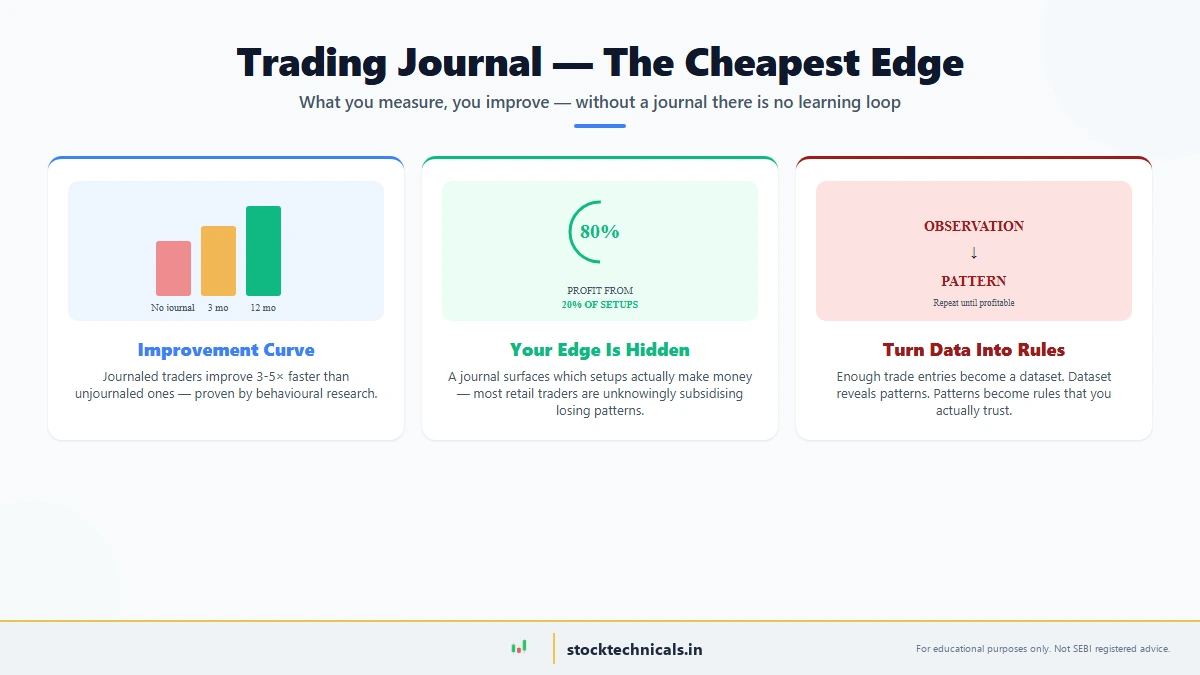
Quick Answer: A trading journal is a structured log of every trade you take — entry, exit, stop loss, rationale, emotion, and outcome. It turns your trading from guesswork into data. Most traders lose for years without realising they repeat the same three mistakes; a journal surfaces them in weeks. Record pre-trade plan, post-trade outcome, and a weekly review — that is 80% of the edge.
Published March 11, 2026 · Last refreshed April 27, 2026. Prices and data are compiled with reasonable care but — always confirm against your broker before trading.
Trading Journal: How to Track and Improve Your Trades
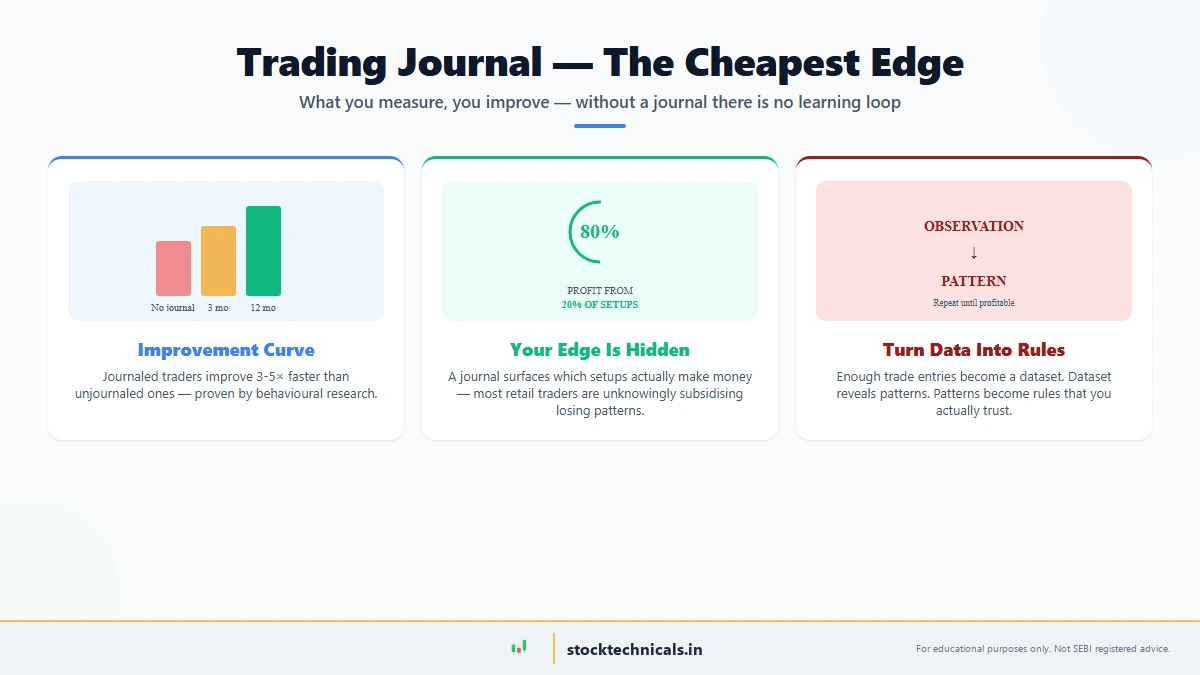
Introduction
You've now learned risk management basics, understand position sizing, know where to place stop losses, and can calculate your risk-reward ratio on every trade.
But here's what separates the 7% of traders who consistently make money from the 93% who lose it: they keep a trading journal.
This isn't optional. It's not a "nice to have." It's the single most powerful tool you can use to identify why you fail and how to fix it.
Key Takeaways
- Journaling converts trading from gambling into a learnable skill — you cannot improve what you do not measure.
- Record both the plan (before entry) and the outcome (after exit) — the gap between them is where your edge lives.
- Weekly and monthly reviews matter more than daily ones — you need a sample size of trades, not just noise.
- Track win rate, R:R ratio, best time-of-day, and setup-by-setup performance — these four numbers reveal your true edge.
- Google Sheets or Notion is enough — fancy tools do not compensate for skipped entries.
A SEBI study confirmed that 93% of Indian intraday traders lose money. But ask yourself: did they lose money because the strategy was bad? Or because they couldn't execute it consistently? Or because they were taking trades with terrible risk-reward ratios? Or because they panicked and exited winners too early?
Without a trading journal, you'll never know. And if you don't know what went wrong, you can't fix it.
Most traders skip journaling because it feels like admin work. They think, "I'll just remember the important trades." That's the mistake. The human brain is terrible at remembering data accurately. You'll remember the one massive win but forget the seven small losses that gave it back. You'll convince yourself you "always" exit winners early, but your journal might show you actually hold winners longer than losers. You're biased. Your journal is not.
This article teaches you exactly how to build a trading journal, what to record, how to review it, and how to use it to find your personal edge.
Who is this article for? Any trader serious about improving — whether you're trading stocks, F&O, or crypto.
What Is a Trading Journal and Why You Need One
A trading journal is a detailed record of every trade you take—entry, exit, reasoning, result, and emotional state.
Think of it like a laboratory notebook for your trading. Scientists don't remember experiments by gut feel. They record everything: conditions, observations, outcomes, and what they learned. That's how they refine their work. Your trading journal does the same.
Without one, you're flying blind.
Core Truth: A trading journal is not about logging profits. It's about building a system of self-improvement through accurate data.
Here's what separates traders who improve from those who stagnate:
Traders who improve ask themselves: "What patterns do I see in my losing trades? When do I break my rules? What's my actual win rate vs. my perceived win rate? Which strategies work best for me?"
Traders who stagnate say: "I was right on that trade but got stopped out unluckily. That market was too volatile. I would have won if I held longer."
Your journal forces you to be honest. It shows you exactly where your edge is—and where it isn't.
Why the Brain Fails Without a Journal
Your memory is selective. It's not malicious — it's just how the brain works. Research shows that humans naturally remember positive events more vividly than negative ones. This is called positivity bias.
Applied to trading, this means:
- You'll remember the one ₹50,000 win but forget the three ₹15,000 losses
- You'll "remember" exiting winners early, even if your actual trades show the opposite
- You'll convince yourself "if I'd held longer, I would have made more," without checking if that's actually true
- You'll blame losses on bad luck, ignoring the pattern of losses on certain setups
A journal removes bias. Numbers don't lie. Your journal becomes your truth.
The Real Reason Traders Fail
Here's the uncomfortable reality: Most traders don't fail because their strategy is bad. They fail because they don't know if their strategy is working.
Without a journal, you trade blindly, making the same mistakes repeatedly. You take a breakout trade that loses ₹500. You take the same setup again next week, it loses ₹700. You take it a third time, it loses ₹400. After the third loss, you decide "breakout trading doesn't work."
But what if the breakout strategy actually had a 55% win rate and was profitable? You wouldn't know because you only remember the three losses in a row.
With a journal, you'd see: 100 breakout trades, 55 wins, 45 losses, ₹45,000 total profit. Now you know the strategy works. You trust it. You take the next breakout trade with confidence instead of doubt.
This confidence translates into discipline. Discipline translates into profits.
What to Record in Every Trade

Here's exactly what you must log for every single trade—win or loss:
Entry Date and Time
When did you enter? 9:30 AM IST? 2:15 PM? This matters because certain trading patterns work better at certain times of day. Morning breakouts might have higher win rates than afternoon reversals.
Example: March 5, 2026, 10:45 AM IST
Stock Ticker and Quantity
Which stock? How many shares (or contracts if F&O)? This helps you analyze whether certain stocks are more profitable for you than others.
Example: TCS (NSE: TCS) (Tata Consultancy Services), 10 shares
Trade Direction: Long or Short
Are you buying or shorting? You might notice you're better at shorting reversals than catching breakouts, or vice versa.
Example: Long (buying)
Entry Price
At exactly what price did you enter? This is critical for calculating actual P&L later. Never use "approximately" — be precise.
Example: ₹3,545.50
Stop Loss Price
Where did you place your stop loss? Calculate your exact risk in rupees. This keeps you accountable to your position sizing rules.
Example: ₹3,535.00 (₹10.50 risk × 10 shares = ₹105 total risk)
Target/Exit Price
What's your profit target? This forces you to calculate your risk-reward ratio BEFORE you trade, not after. Pre-planning = discipline.
Example: ₹3,570.00 (₹24.50 × 10 shares = ₹245 potential profit)
Risk-Reward Ratio
Calculate it explicitly: ₹245 profit ÷ ₹105 risk = 2.33:1 R:R. This is the most important metric for long-term profitability. Over time, even a 40% win rate is profitable if your average winner is 2x your average loser.
Example: 2.33:1
Trading Strategy Used
What was your setup? Was it a support bounce? A breakout? A moving average crossover? This matters because you might realize one strategy is profitable and another isn't.
Example: Support bounce on daily chart + volume confirmation on 15-minute chart
Setup Screenshot or Chart Image
Capture the exact chart at entry. Tag it with entry price marked. This is crucial when you review later — you can see exactly what the price action looked like.
Example: TCS-March5-10-45AM-entry.png
Exit Date, Time, and Price
When and at what price did you exit? Was it a clean exit at target, or did you get stopped out?
Example: March 5, 2026, 2:30 PM IST at ₹3,568.75
Actual Profit/Loss in Rupees
Your journal should tell you exactly how much you made or lost in real money. (₹3,568.75 - ₹3,545.50) × 10 = ₹232.50 profit, minus ₹15 brokerage = ₹217.50 net profit.
Example: +₹217.50
Emotional State During Trade
Were you confident? Anxious? Greedy? Did you break your rules because of FOMO? This is often where the real insights hide. Over months, you'll notice: "I always exit early when I'm nervous, and I always hold losers too long when I'm overconfident."
Example: Confident at entry, anxious at 1% drawdown, happy to exit at partial profit
What You Learned
After every trade, write one sentence about what you observed. Did support hold better than expected? Did the breakout fail despite high volume? Did you get too emotional? This forces reflection.
Example: "Volume confirmed the bounce. Exited at 95% of target — good discipline instead of being greedy."
Sample Real Trading Journal Entry
Let's look at a complete example — a real Reliance (NSE: RELIANCE) intraday trade:
```
===== TRADE LOG ENTRY #247 =====
Date: March 3, 2026
Time of Entry: 10:15 AM IST
Stock: Reliance Industries (RIL)
Quantity: 15 shares
Direction: LONG (Buying)
Entry Price: ₹2,485.50
Stop Loss: ₹2,475.00 (₹10.50 risk)
Target: ₹2,510.00 (₹24.50 potential profit)
Risk-Reward Ratio: 2.33:1
Strategy Used:
Gap-up open + break above previous day's high on 15-minute volume.
4-hour chart shows intact uptrend. Confirmed with EMA close above 20 EMA.
Setup Screenshot: RIL-March3-1015AM-entry.png [marked with entry price]
Exit Time: 2:05 PM IST
Exit Price: ₹2,507.25 (partial exit), ₹2,502.00 (final exit)
Actual Profit: (₹2,507.25 - ₹2,485.50) × 10 shares = ₹217.50
(₹2,502.00 - ₹2,485.50) × 5 shares = ₹82.50
Total P&L: ₹300.00 - ₹20 brokerage = ₹280 NET
Emotional State Before Trade: Confident (setup was textbook)
Emotional State During Trade: Anxious (held through 1% pullback, wanted to exit early)
Emotional State at Exit: Happy (got 95% of target, didn't get greedy)
What I Learned:
"Breakout trading works better in morning session. Held through the pullback
successfully instead of panic selling. This stock (RIL) + this setup seems
highly profitable. Consider focusing more on gap-up breakouts in first hour."
```
This is what a thorough journal entry looks like. Notice:
- Precise prices (not "around ₹2,485")
- Exact timing (10:15 AM, not "morning")
- Emotional honesty (felt anxious, wanted to exit early)
- Actionable learning (morning breakouts work, focus on RIL)
Pre-Trade Journal Entries: The Plan Before the Trade

Most traders skip this, and it's a massive mistake. You must write your plan BEFORE you execute the trade.
This is called a pre-trade journal entry, and it takes 30 seconds.
Example pre-trade entry (written BEFORE clicking buy):
```
Date/Time: March 6, 2026, 9:45 AM IST
Stock: Reliance Industries (RIL)
Direction: Long
Why: Gap-up open + break above previous day's high at ₹2,485
on volume. 4-hour uptrend intact.
Entry Price: ₹2,487.50 (at breakout)
Stop Loss: ₹2,475.00 (₹12.50 risk)
Target: ₹2,510.00 (₹22.50 profit)
Risk-Reward: 1.8:1
Capital at Risk: ₹125 (10 shares × ₹12.50 risk)
Confidence Level: 7/10 (clear setup but gap-up moves reverse often)
Plan: Hold for 2-3 hours minimum. No panic selling. If stops,
analyze why the breakout failed.
```
Why does pre-planning matter? Because it forces you to think clearly BEFORE emotion takes over. Once you're in a trade, your brain floods with stress hormones. Pre-planning lets you use logic while you're still calm.
Post-Trade Review Process: Weekly and Monthly Cycles

Recording a trade is step one. Reviewing it is where the real improvement happens.
Daily Review (takes 5 minutes)
At the end of each trading day, review your trades:
- Total P&L: ₹_____
- Number of trades: ___
- Win rate: ___ %
- Biggest win: ₹_____
- Biggest loss: ₹_____
- Did you follow your rules: YES / NO
- Did you use stop losses on every trade: YES / NO
- Any emotional trades (FOMO, revenge trading): YES / NO
Weekly Review (takes 20-30 minutes)
Every Sunday (or Monday if you trade stock options), sit down and analyze:
- Did my strategy work this week?
- How many trades matched my planned setups?
- How many were random/emotional entries?
- What was my actual win rate and average R:R?
- Example: 6 wins, 4 losses = 60% win rate
- Total profit: ₹8,500 / Total risk: ₹4,200 = 2.02:1 average R:R
- This 60% win rate with 2:1 R:R is quite profitable
- When did I break my rules?
- Did I take oversized positions on any trade?
- Did I exit early on any winners?
- Did I hold losers too long?
- Which strategy performed best?
- Breakout trades: 7 trades, 4 wins = 57% win rate
- Support bounces: 3 trades, 2 wins = 67% win rate
- Insight: I'm better at support bounces. Focus there next week.
Monthly Review (takes 1-2 hours)
Once a month, do a deep dive:
- Total month P&L: ₹_____
- Total trading days: ___
- Average daily profit: ₹_____
- Best trading day: ₹_____ (what made it successful?)
- Worst trading day: ₹_____ (what went wrong?)
- Most profitable stock/pattern: _____
- Least profitable stock/pattern: _____
- Overall win rate: _____
- Average winner size: ₹_____
- Average loser size: ₹_____
- Do I have a positive edge? (win rate × avg winner > loss rate × avg loser)
Analyzing Your Journal Data: Finding Your Edge

After 50-100 trades logged, patterns emerge. This is where your personal trading edge lives.
Metric 1: Win Rate vs. Risk-Reward
Win rate alone is useless. A trader with a 30% win rate can be highly profitable. A trader with a 70% win rate can be a net loser.
What matters: (Win Rate × Average Win Size) - (Loss Rate × Average Loss Size)
example:
- Trader A: 60% win rate, average win ₹500, average loss ₹400
- Profit expectancy = (0.60 × ₹500) - (0.40 × ₹400) = ₹300 - ₹160 = ₹140 per trade
- Trader B: 40% win rate, average win ₹1,000, average loss ₹600
- Profit expectancy = (0.40 × ₹1,000) - (0.60 × ₹600) = ₹400 - ₹360 = ₹40 per trade
Trader A has a better edge, despite lower win rate.
Your journal shows you this. Without it, you're just guessing.
Metric 2: Best and Worst Trading Times
Review your journal by time of day:
- Morning trades (9:15-11:00 AM): 8 trades, 5 wins, ₹4,200 profit
- Midday trades (11:00 AM-1:00 PM): 6 trades, 3 wins, ₹1,500 profit
- Afternoon trades (1:00-3:30 PM): 10 trades, 4 wins, -₹2,100 loss
Insight: You're best at morning trades. Maybe you're fresher then, or maybe morning volatility matches your strategy better. Trade more in the morning, less in the afternoon.
Metric 3: Strategy Performance
Track each strategy separately:
Gap Breakout Strategy:
- 15 trades
- 9 wins, 6 losses (60% win rate)
- Total profit: ₹6,300
- Average winner: ₹700, Average loser: -₹500
- Edge: YES, profitable
Support Bounce Strategy:
- 12 trades
- 4 wins, 8 losses (33% win rate)
- Total loss: -₹1,800
- Average winner: ₹600, Average loser: -₹400
- Edge: NO, not profitable
Action: Stop trading support bounces. Focus on gap breakouts where you have an edge.
Metric 4: Emotional Trading Costs
Your journal will show you the price of emotional decisions:
Revenge trades (taking trades to recover losses after a loss):
- Average loss: -₹800
- Win rate: 25%
- 10 trades total, cost: -₹7,500 net loss
FOMO trades (entering late in a move, fear of missing out):
- Average loss: -₹600
- Win rate: 30%
- 8 trades total, cost: -₹4,000 net loss
Planned trades (following your rules and pre-planned setups):
- Average win: ₹450
- Win rate: 52%
- 50 trades total, profit: +₹11,250 net profit
This is often where traders lose the most money. You might be profitable on planned trades (₹11,250) but unprofitable overall (-₹500) because of a few emotional trades per month that wipe out your gains.
Your journal highlights this immediately. After seeing the data, you create a rule: "No revenge trades. If I take a loss, I sit out the next 2 hours." This single rule could save you ₹90,000+ per year.
Metric 5: Bank Nifty (NSE: BANKNIFTY) vs. Stock Trades Performance
Different stocks behave differently. Your journal reveals this:
Bank Nifty F&O trades:
- 30 trades, 18 wins, 12 losses (60% win rate)
- Total profit: ₹18,000
- Average winner: ₹850, Average loser: -₹400
Individual stock trades (equity):
- 20 trades, 8 wins, 12 losses (40% win rate)
- Total loss: -₹3,500
- Average winner: ₹600, Average loser: -₹500
Clear insight: You're much better at F&O trading than equity. You should focus on Bank Nifty, Nifty 50, Sensex futures and minimize individual stock trading. This focus could increase your annual profits by ₹40,000+.
Platform and Tools: How to Set Up Your Journal
You have several options. Choose one and start TODAY.
Option 1: Google Sheets Template (Easiest, Free)
A Google Sheet is the fastest way to start:
Columns needed:
- Date
- Time
- Ticker
- Direction (Long/Short)
- Quantity
- Entry Price
- Stop Loss
- Target
- R:R Ratio
- Exit Price
- Exit Time
- P&L (₹)
- Win/Loss
- Strategy
- Emotional Notes
- Lessons
Set up one Google Sheet, share the link with yourself, update it on your phone or laptop. Google automatically saves everything.
Pros: Simple, free, syncs across devices
Cons: Manual data entry is tedious; limited analysis features
Option 2: Zerodha Tradebook Export (Excellent for F&O)
If you're trading derivatives on Zerodha, their Tradebook automatically logs every trade:
- Log into Zerodha Kite
- Go to Dashboard → Reports → Tradebook
- Export as CSV
- Add manual columns: Strategy, Emotional Notes, Lessons
This gives you exact execution prices automatically. You just add the "why" and "what I learned."
Pros: Automatic P&L calculation, real execution prices
Cons: Only for Zerodha; doesn't capture reason for trade
Option 3: TradingView Alerts + Screenshots
If you use TradingView (which most technical analysts do):
- Take a screenshot of each trade setup (use the "Compare" tool to mark entry/exit)
- Name it: StockName-Date-Time-Entry.png
- Create a folder for these screenshots
- Keep a simple Excel sheet linking to each screenshot
Pros: Visual record of exact price action you saw
Cons: Very manual; lots of screenshots to manage
Option 4: Dedicated Trading Journal Apps
Apps like TradeJournal.org, Edgewonk, or TradeMetrics are built specifically for this. These are enterprise-level tools used by serious traders.
Features typically included:
- Auto-import trades from your broker (Zerodha, Angel One, etc.)
- Pre-built analysis dashboards (win rate, R:R, P&L charts)
- Trade statistics by setup, time of day, instrument
- Performance heatmaps showing best/worst trading times
- Risk analysis and position sizing calculators
- Mobile app for on-the-go logging
Pros: Built-in analysis, stats, charts, mobile logging, minimal manual data entry
Cons: Cost ₹100-500/month; learning curve; may be overkill for beginners; often requires API connection to your broker
Option 5: The Notebook Method (Best for Focus)
Print a simple template and write by hand:
```
Date: _______ Stock: _______ Price: ₹_______
Entry Time: _______ Exit Time: _______
Stop Loss: _______ Target: _______
Result: +₹ _______ or -₹ _______
Strategy: _________________________________
Emotion Before: __________ Emotion During: __________
What I Learned: ________________________________
```
Keep a notebook. Review it weekly. Write notes. This forces deep thinking—screens can be distracting.
My recommendation for beginners: Start with Google Sheets or a notebook. Once you've logged 100 trades and understand what matters, upgrade to a specialized tool if you want.
Building Your Personal Edge Through Data
Here's the truth nobody tells you: your edge isn't a special chart pattern or an indicator. Your edge is your execution, discipline, and emotional control.
Your journal reveals this.
After logging 50-100 trades, you'll know things about yourself:
- "I can't short — I always panic cover on small losses"
- "I'm great at momentum trades but terrible at mean-reversions"
- "I oversize on days I feel confident, and that's when I lose most"
- "I hold winners too long when the setup looks perfect, then give back profits"
- "My best trades come before 11 AM"
- "I'm excellent with 2:1 risk-reward but struggle with 3:1+"
These insights are GOLD. This is your personal edge. Most traders never discover it because they never keep a journal.
Example: Building an Edge from Journal Data
Imagine you've logged 100 trades. Here's what your data might reveal:
By Strategy:
- Gap-up breakouts: 35 trades, 22 wins, 13 losses (63% win rate), +₹18,500 profit
- Support bounces: 40 trades, 16 wins, 24 losses (40% win rate), -₹3,200 loss
- Trend continuation: 25 trades, 9 wins, 16 losses (36% win rate), -₹5,800 loss
By Time of Day:
- Morning (9:15-11:00 AM): 40 trades, 28 wins, 12 losses (70% win rate), +₹15,000
- Midday (11:00 AM-1:00 PM): 35 trades, 15 wins, 20 losses (43% win rate), -₹2,000
- Afternoon (1:00-3:30 PM): 25 trades, 5 wins, 20 losses (20% win rate), -₹8,500
By Risk-Reward:
- 1.5:1 to 2:1 trades: 45 trades, 25 wins, 20 losses, +₹12,000 profit
- 2:1 to 3:1 trades: 40 trades, 18 wins, 22 losses, +₹4,500 profit
- 3:1+ trades: 15 trades, 3 wins, 12 losses, -₹8,000 loss
What Your Personal Edge Looks Like:
Based on this data, your personal edge is:
- Trade ONLY gap-up breakouts (63% win rate, ₹18,500 profit)
- Trade ONLY in the morning session (70% win rate)
- Focus on 1.5:1 to 2:1 risk-reward ratios (best consistent results)
Your ideal trade profile: Gap-up breakout on Bank Nifty or Nifty 50, entered before 11 AM, with a 2:1 risk-reward ratio.
Once you identify this edge, everything changes:
- Focus on what works — only take trades matching your winning setups (gap-up breakouts)
- Avoid your weaknesses — don't support bounces, don't trade after 2 PM, don't chase 3:1 R:R
- Scale what works — gradually increase position size on your best strategies
- Measure improvement — track whether your win rate improves month-to-month
The average trader never does this analysis. That's why 93% lose money. They're spreading their efforts across 50 different setups, times, and risk-reward ratios, most of which don't work for them personally.
Your journal reveals your edge. Your discipline executes it. That's how consistency is built.
Five Rules for Effective Journaling
- Be Honest, Even When It Hurts
Your journal is only for you. There's no benefit to lying. You took an emotional FOMO trade? Write it down. You broke your position sizing rules? Record it. Only honesty leads to improvement.
- Write BEFORE and AFTER
Pre-trade entries force planning. Post-trade entries force reflection. Both are essential. Don't skip either.
- Log Every Trade, Win or Loss
People naturally want to remember only wins. Your brain will do this automatically. Force yourself to record losses too. They're often more instructive than wins.
- Review Weekly, Not Just When Things Go Wrong
Don't only review your journal after a big loss ("What went wrong?"). Review it every week regardless. This removes emotion from analysis. You can see patterns objectively.
- Make It a Habit, Not a Chore
Five minutes after each trade. That's it. Don't make it an hour-long process. Consistency beats perfection.
Trading Journal Checklist
Before you start trading today, set up your journal using this checklist:
- [ ] Choose your tool (Google Sheets, app, notebook, etc.)
- [ ] Create columns/fields for: Date, Ticker, Direction, Entry Price, Stop Loss, Target, R:R, Exit Price, Exit Time, P&L, Strategy, Notes, Lessons
- [ ] Set up a folder for trade screenshots (if using visual method)
- [ ] Create a weekly review template
- [ ] Create a monthly review template
- [ ] Set a phone reminder to review your journal every Sunday at 7 PM
- [ ] Take your first 10 trades with the journal running
- [ ] After 10 trades, do your first weekly review
- [ ] Make your first journal-based decision (start trading only setups that worked for you previously)
Common Journaling Mistakes (and How to Avoid Them)

Mistake 1: Only Recording Wins
"I made so many good trades today, but I only remember a few." Natural, but wrong. Your brain selects for wins because that feels good. Your journal must be the opposite — it must include every trade, especially losses.
Fix: Set a rule: "No trading session is complete until every trade is logged, including losses."
Mistake 2: Not Reviewing Weekly
You log all your trades diligently. But then you don't review them for 3 months. By then, the patterns are blurry, and your memory fills in gaps.
Fix: Calendar reminder: "Sunday 7 PM = Journal Review." Stick to it like a market opening time.
Mistake 3: No Emotional Notes
"I entered at ₹3,545, exited at ₹3,560, profit ₹150." This is useless. Why did you exit? Were you confident? Scared? Greedy?
Fix: Every entry must include: "What was my emotional state?" Your worst trades often happen when you're in extreme emotions.
Mistake 4: Vague Strategy Notes
"Support bounce" isn't specific enough. Did the stock bounce from a support level after three consecutive down days? Or did it bounce from an arbitrary round number? The details matter.
Fix: Write your exact setup criteria: "Support bounce after a 3-day down trend + volume confirmation on the bounce + entry on 15-minute chart close above support."
Mistake 5: Setting It Up But Never Using It
The #1 mistake: You create a beautiful Google Sheet, decide to start journaling, then forget about it after 3 trades.
Fix: Journal IMMEDIATELY after closing a trade. Make it a 2-minute habit. Don't wait until evening to remember what happened.
Journaling Methods Comparison
| Method | Setup Time | Cost | Ease of Data Entry | Analysis Features | Mobile Friendly |
|---|---|---|---|---|---|
| Google Sheets | 10 min | Free | Medium | Basic | Yes |
| Excel | 15 min | Free | Medium | Medium | No |
| Notebook | 5 min | ₹100 | Fast | None (manual) | Yes |
| Zerodha Tradebook | 0 min | Free | Very Easy | Basic | Yes |
| TradeJournal Apps | 20 min | ₹200-500/mo | Easy | Excellent | Yes |
| TradingView + Sheets | 30 min | Free/Paid | Slow | Manual | Partial |
My recommendation: Start with Google Sheets. If you're still trading actively after 6 months, consider upgrading to an app.
The Bottom Line
A journal is the cheapest edge in trading and the one every successful trader I know keeps. Start today with a simple spreadsheet — columns for date, stock, setup, entry, SL, target, exit, P&L, and one-line emotion note. Review it every Sunday. Within 8-12 weeks you will see your own patterns, and that moment — when you stop guessing and start knowing — is when trading becomes a profession.
What is a trading journal and why is it important?
A trading journal is a detailed record of every trade you make — entry, exit, position size, stop loss, reasoning, emotions, and outcome. It is the single most important tool for improving as a trader because it turns random experience into pattern recognition. On NSE: NIFTY and NSE: BANKNIFTY, traders who journal consistently outperform those who don't within 6 months, even with the same strategy.
What should I record in a trading journal?
Record at minimum: (1) Date and time of entry/exit, (2) Instrument (e.g., NSE: HDFCBANK or NSE: NIFTY futures), (3) Position size and capital-at-risk, (4) Entry price, stop loss, target, (5) Strategy/setup used (BoS, pullback, breakout), (6) Market context (India VIX, trend), (7) Emotion before/during/after the trade, (8) Outcome in ₹ and R (risk-reward). Screenshot the chart at entry and exit — critical.
How often should I review my trading journal?
Daily for intraday traders — 15 minutes after market close. Weekly for swing traders — Sunday review of all trades from the week. Monthly for everyone — compute win rate, average R, largest losses, emotional patterns. Quarterly — strategy audit: which setups produce the best R, which should be dropped. Without review, journaling is just data entry.
Excel, Google Sheets, or dedicated app — which is best for trading journals?
For Indian retail traders, Google Sheets is the best starting point: free, cloud-backed, export CSV from Zerodha Console or Groww to import trades. Dedicated apps like Edgewonk or TraderVue offer better analytics but cost $200+/yr. Avoid plain Excel — no cloud backup means losing 2 years of data when your laptop crashes. Start simple; complexity should follow discipline, not precede it.
How do I import trades from my Indian broker automatically?
Zerodha Console exports daily and summary reports as CSV or Excel. Groww, Dhan, and Angel One offer similar trade-book exports from their web portals. Upload the CSV into Google Sheets, apply a standard template with columns for R-multiple and strategy tag, and you have an auto-updating base. Manual fields — setup name, emotion, notes — are added post-trade.
What metrics matter most in a trading journal?
Four metrics that tell the truth: (1) Expectancy per trade in R (average win × win rate − average loss × loss rate), (2) Maximum consecutive loss streak (sizing should survive 10 losses in a row), (3) Strategy-wise R multiples (some setups earn, others bleed), (4) Time-of-day P&L curve (if you lose every trade after 2pm, stop trading after 2pm). Win rate alone is a vanity metric.
How long before I see results from journaling?
You will see one to two behaviour patterns within 2 weeks (e.g., "I revenge-trade after a loss"). Within 6 weeks, you will identify your best and worst setups by R multiple. Within 3 months, your P&L curve shifts measurably because you stopped taking the bleeding setups. Traders who quit journaling in the first 10 sessions never see the compound effect and miss the entire point.
What are the common journaling mistakes to avoid?
Worst mistakes: (1) Recording only winners, hiding losses from yourself, (2) Skipping the emotion field — but emotion drives 80% of losing trades, (3) Writing vague strategy tags like "setup looked good" instead of "15-min BoS retest", (4) Never reviewing — data entry without analysis is noise, (5) Backfilling the journal days later from memory (memory is already corrupted by outcome bias). Record in real time, review weekly.
RISK NOTICE
A trading journal improves self-awareness and discipline but does not guarantee profits. The SEBI F&O study shows 93% of intraday traders lose money; tracking alone cannot reverse a bad edge. Use your journal to identify and correct mistakes, not to confirm biases. Never trade capital you cannot afford to lose. This content is for educational purposes only and is not investment advice.