
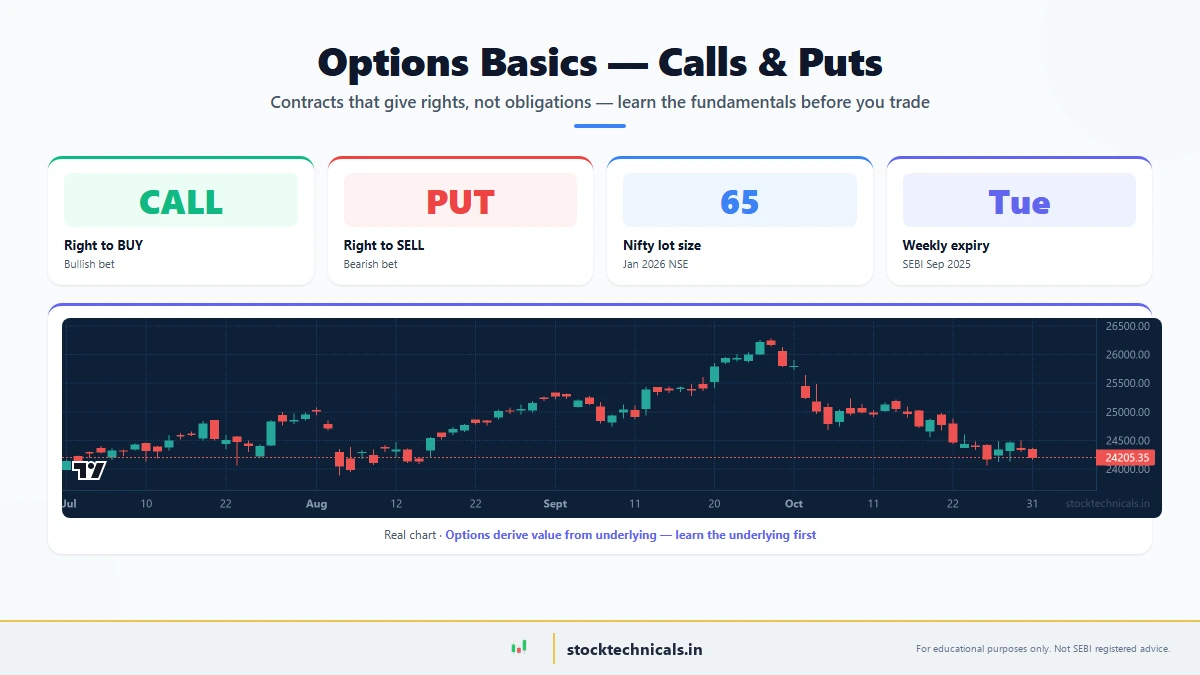
Quick Answer: Options give you the right — but not the obligation — to buy (call) or sell (put) an asset at a fixed price (strike) on or before a set date (expiry). You pay a premium for this right. Maximum loss = premium paid. Call options profit when price rises; put options profit when price falls.
Published March 2, 2026 · Last refreshed April 27, 2026. Prices and data are compiled with reasonable care but — always confirm against your broker before trading.
Options Basics: Understanding Calls and Puts
 SEBI Sep 2025).” class=”wp-image-13943″/>
Introduction
You’ve spent months learning the pillars of technical analysis. You can identify support and resistance, spot breakouts with confidence, and understand trend structure. You’re winning most of your spot market trades.
Then you walk into your broker’s office and see: “Options trading — 10x leverage, 100% profit potential.”
And your mind goes blank.
Key Takeaways
- A call option is the right to buy at a fixed price — profitable when the underlying rises above the strike price
- A put option is the right to sell at a fixed price — profitable when the underlying falls below the strike price
- Options premium = Intrinsic Value + Time Value; time value decays to zero at expiry (theta decay)
- ITM (In The Money), ATM (At The Money), OTM (Out of The Money) — strike price relative to current market price
- NSE Nifty lot size is 65 units (effective Jan 2026; was 75 earlier) — one Nifty 25,000CE contract controls ₹6,25,000 of notional value
- NSE Nifty weekly options expire every Tuesday (changed from Thursday on Sep 1, 2025 by SEBI)
Options feel like a different language. Strike price. Expiry. Premium. ITM, ATM, OTM. Call vs. put. The options chain looks like a spreadsheet from outer space. And worst of all, everyone seems to be making money on options except people new to them.
Here’s the truth: options are not rocket science. They’re actually simpler than you think — if you break them down into their core pieces.
Options are simply the right (but not the obligation) to buy or sell an asset at a fixed price, on or before a specific date. That’s it. Everything else is just details.
According to SEBI’s F&O data, Indian retail traders have discovered options in a big way. Nifty options trading volume has grown 240% in the last three years, and Bank Nifty (NSE: BANKNIFTY) options have exploded even faster. But here’s the painful part: most beginners who jump into options without understanding the fundamentals lose 80-90% of their capital within 3 months. The #1 mistake? Treating options like lottery tickets instead of strategic tools.
This article changes that. We’re going to walk through everything you need to know about calls and puts — with real Indian stock examples, NSE options chain walkthroughs, and 5 rules that will keep you from becoming another statistic.
Who is this article for? Any trader who has mastered spot trading and chart patterns, and wants to understand how options can amplify returns — or amplify losses — if used incorrectly.
What Exactly is an Option Contract?
Let’s start by removing the mystery.
An option contract is a right to buy or sell a specific asset, at a specific price, on or before a specific date — without the obligation to actually do it.
That last part is crucial. Right, not obligation. You can choose to exercise the option, or let it expire worthless, or sell it before expiry. The choice is yours.
Here’s the simplest analogy: imagine booking a restaurant table for dinner at 7 PM. You pay ₹500 upfront to hold the table. At 6:30 PM, you decide you don’t want to eat out. You don’t have to — you just lose the ₹500 booking fee. But if you do show up, you get your table at the agreed time and place.
That ₹500 is the premium. The 7 PM time is the expiry. The restaurant is the asset. And the agreement between you and the restaurant is the option contract.
An option gives you the right to buy or sell an asset at a fixed price. You pay a small premium upfront, and your maximum loss is limited to that premium.
Now, there are only two types of options:
Call Options
The right to BUY an asset at a fixed price. You buy a call when you think the price will go up. (Think of it as a way to profit from upside with limited capital.)
Put Options
The right to SELL an asset at a fixed price. You buy a put when you think the price will go down — or when you want to protect a stock you own from falling further. (Think of it as insurance.)
Everything in the options world flows from these two concepts.
Call Options Explained: Betting on Upside
Let’s say Reliance (NSE: RELIANCE) is trading at ₹2,500 today.
You’ve done your technical analysis. You’ve identified strong support at ₹2,480, resistance at ₹2,550. There’s a clear uptrend on the 4-hour chart, and a bullish trendline is intact. You’re very confident Reliance will break above ₹2,550 and test ₹2,600 in the next 2-3 weeks.
But here’s the catch: you don’t have ₹2,500 × 500 shares = ₹12,50,000 capital to buy 500 shares. That’s a lot of money tied up for just 2-3 weeks.
Enter: call options.
Instead, you buy a call option:
- Strike price: ₹2,550 (your expected breakout level)
- Expiry: 3 weeks from today (third Thursday of the month)
- Premium paid: ₹15 per share = ₹7,500 total (for 500 shares × 1 lot)
Now, here’s what happens:
Scenario 1 — You’re Right:
Reliance breaks ₹2,550 and climbs to ₹2,600 within 3 weeks. Your call option is now ₹50 in-the-money (ITM). You can exercise it (buy 500 shares at ₹2,550, which is now worth ₹2,600) and immediately sell them for a ₹25,000 profit (₹50 × 500 shares). Subtract the ₹7,500 premium you paid, and you net ₹17,500 profit.
Return on capital: You risked ₹7,500, made ₹17,500 profit = 233% return in 3 weeks.
Compare that to buying the stock: you’d have needed ₹12,50,000 capital and only made ₹25,000 profit = 2% return.
Scenario 2 — You’re Wrong:
Reliance stumbles and drops to ₹2,480 by expiry. Your call option is ₹70 out-of-the-money (OTM) and expires worthless. You lose the ₹7,500 premium you paid.
Maximum loss: ₹7,500. You risked only 0.6% of what you would have risked buying the stock outright. And your loss is capped — it cannot exceed the premium paid.
Key takeaway: Call options give you leverage (control more value with less capital) and defined risk (you can lose only the premium paid, nothing more).
Why Buy Call Options?
- Limited capital required: Control 500 shares’ movement with ₹7,500 instead of ₹12,50,000
- Defined maximum loss: You know exactly the worst case — the premium paid
- Leverage profits: If you’re right, returns are magnified
- Timing plays: You can bet on an asset moving UP, but only if it happens by expiry (perfect for your chart analysis)
- Breakout confirmation: Buy calls when price breaks above support/resistance with volume — options premium confirms your directional bias
Real NSE Example: Call Option Chain
On an NSE options chain for Reliance:
| Strike | Call Premium | Put Premium | Open Interest (Calls) |
|---|---|---|---|
| ₹2,500 | ₹45 | ₹22 | 89,450 |
| ₹2,550 | ₹22 | ₹52 | 45,230 |
| ₹2,600 | ₹8 | ₹95 | 12,100 |
The ₹2,550 call costs ₹22. If Reliance goes to ₹2,600, that call might be worth ₹70 — pure profit. If Reliance drops to ₹2,400, it expires worthless and you lose the ₹22 premium.
Put Options Explained: Profiting from Downside
Now flip the scenario.
You own 500 shares of Bank Nifty (through the stock ETF or directly), bought at ₹47,500. You’ve made great profits, but you see storm clouds forming on the 4-hour chart:
- The daily close just broke below the 20-EMA
- Support at ₹47,200 failed, and bears took control
- Open interest on calls is dropping — signals of weak hands bailing out
- You expect a sharp pullback to ₹46,500 in the next 2-3 weeks
But here’s the dilemma: you want to keep holding the stock long-term (for momentum), but you want protection in case it crashes. What do you do?
Buy put options as insurance.
You buy a put option:
- Strike price: ₹47,200 (just below current support)
- Expiry: 3 weeks (same monthly expiry)
- Premium paid: ₹35 per share = ₹17,500 total (for 500 shares × 1 lot)
Now, here’s your protection:
Scenario 1 — Market Crashes:
Bank Nifty drops to ₹46,000. Your put option is ₹1,200 in-the-money (ITM). You can exercise it (sell 500 shares at the protected ₹47,200 strike, even though market price is ₹46,000). You “lock in” ₹47,200 and avoid the ₹600 per share loss.
In effect, you paid ₹35 per share for insurance, so your net loss is only ₹35 per share = ₹17,500 total — instead of ₹300,000 (₹600 × 500 shares).
Scenario 2 — Market Recovers:
Bank Nifty rallies to ₹48,500. Your put option expires worthless (you don’t need to sell at ₹47,200 when the market is at ₹48,500). You lose the ₹17,500 premium.
But you made ₹500 × (₹48,500 – ₹47,500) = ₹500,000 profit on the stock. The ₹17,500 put premium is just a “cost of safety,” like insurance on your car. You don’t mind losing it when nothing bad happens.
Why Buy Put Options?
- Downside protection: Insurance for stocks you own
- Profit from falling prices: If you’re bearish on a technical breakdown, buy puts to profit
- Defined maximum loss: You know the worst case upfront (premium paid)
- Perfect for crashes: During sharp corrections, puts often spike in value as panic buying floods in
- Technical confirmation: Buy puts when price breaks below support on heavy volume — classic bearish setup
Real NSE Example: Put Option Chain
Same Reliance options chain, but look at puts:
| Strike | Call Premium | Put Premium | Open Interest (Puts) |
|---|---|---|---|
| ₹2,400 | ₹2 | ₹5 | 34,120 |
| ₹2,450 | ₹5 | ₹18 | 67,890 |
| ₹2,500 | ₹22 | ₹52 | 1,23,450 |
The ₹2,450 put costs ₹18. If Reliance crashes to ₹2,400, that put might be worth ₹50 — pure profit. If Reliance rallies to ₹2,550, it expires worthless and you lose ₹18.
How Options Pricing Works: Premium, Intrinsic Value, and Time Value

Alright, now that you understand what calls and puts do, we need to talk about why a ₹2,550 call costs ₹22, but a ₹2,600 call costs only ₹8.
Price is not random. It’s determined by intrinsic value and time value.
Intrinsic Value
Intrinsic value is how much an option is worth if you exercised it today.
- For a call option: Intrinsic Value = Current Stock Price − Strike Price (if positive; otherwise zero)
- For a put option: Intrinsic Value = Strike Price − Current Stock Price (if positive; otherwise zero)
Example: Reliance at ₹2,500.
- ₹2,500 call: Intrinsic value = ₹2,500 − ₹2,500 = ₹0 (not in-the-money)
- ₹2,450 call: Intrinsic value = ₹2,500 − ₹2,450 = ₹50 (in-the-money by ₹50)
- ₹2,500 put: Intrinsic value = ₹2,500 − ₹2,500 = ₹0 (not in-the-money)
- ₹2,550 put: Intrinsic value = ₹2,550 − ₹2,500 = ₹50 (in-the-money by ₹50)
Time Value (Extrinsic Value)
Time value is what traders pay for the possibility the option might become profitable.
If a ₹2,550 call costs ₹22, and the intrinsic value is ₹0 (Reliance is at ₹2,500, so the strike is OTM), then where does that ₹22 come from?
Time value = ₹22.
Traders are betting that Reliance might rally above ₹2,550 before expiry (3 weeks away). The longer the time to expiry, the higher the time value — because there’s more time for the stock to move favorably.
Three Price Zones: ITM, ATM, OTM
- In-The-Money (ITM): The option has intrinsic value. A ₹2,450 call is ITM (you can buy at ₹2,450 when market is ₹2,500). It costs more.
- At-The-Money (ATM): The strike equals the current stock price. A ₹2,500 call is ATM. High time value, moderate premium.
- Out-Of-The-Money (OTM): The option has zero intrinsic value, only time value. A ₹2,600 call is OTM (you’d need Reliance to jump ₹100 to break even). Low premium, high risk/reward.
Critical Insight: Most beginners buy OTM options because they’re cheap (₹8 instead of ₹50). But OTM options have the highest failure rate — the stock needs to move a LOT for you to profit. And when expiry comes? If the stock hasn’t moved, that ₹8 option is worthless.
Reading the Options Chain: A Walkthrough
Now let’s decode the actual NSE options chain — the intimidating spreadsheet you see on Zerodha Kite, Sensibull, or TradingView.
Here’s a snapshot of Nifty 50 (NSE: NIFTY) options chain (expiry: this Thursday):
| Strike | Call OI | Call Premium | IV | Put Premium | Put OI |
|---|---|---|---|---|---|
| 23,000 | 45,230 | ₹280 | 18% | ₹5 | 12,450 |
| 23,050 | 78,900 | ₹210 | 17% | ₹18 | 34,560 |
| 23,100 | 1,23,450 | ₹145 | 16% | ₹42 | 89,340 |
| 23,150 | 45,670 | ₹87 | 15% | ₹95 | 45,120 |
| 23,200 | 23,450 | ₹45 | 14% | ₹165 | 12,890 |
What each column means:
- Strike: The fixed price at which you can buy (call) or sell (put)
- Call OI (Open Interest): How many call contracts exist at that strike. High OI = more traders, more active buying/selling, less slippage.
- Call Premium: What you pay to buy that call right now. Notice: as strike goes up, call premium goes down (calls are less valuable when strike is higher).
- IV (Implied Volatility): How much traders expect the stock to move. Higher IV = higher premium prices. Lower IV = cheaper options.
- Put Premium: What you pay to buy that put. Opposite of calls — as strike goes up, put premium goes up (puts are more valuable when strike is higher).
- Put OI: How many put contracts exist at that strike.
How to Use It: A Real Trade
Suppose Nifty 50 is at ₹23,100 right now. You’ve identified that Nifty just broke above the 20-week moving average (strong bullish signal). You expect a rally to ₹23,300 within 2 weeks.
Your play: Buy the ₹23,150 call (one strike above current price, slightly OTM to cap risk but keep premium reasonable).
Cost: ₹87 per share × 65 shares (Nifty lot size effective Jan 2026) = ₹6,525
Max loss: ₹6,525 (if Nifty drops and the call expires worthless)
Breakeven: Nifty needs to reach ₹23,150 + ₹87 = ₹23,237 for you to break even
Max profit: Unlimited (if Nifty rallies to ₹23,500+, your call can be worth ₹350+ = 4x return)
Notice: OI at ₹23,150 is 45,670 — solid liquidity. You can enter and exit without huge slippage.
If you picked ₹23,200 instead (farther OTM), the call is cheaper (₹45), but you’d need Nifty to move even higher to break even (₹23,245). The risk/reward trade-off is tighter.
Practical How-To: Buying Your First Option
Enough theory. Let’s get practical.
Step 1: Choose Your Broker
Most Indian brokers support options: Zerodha Kite, Angel One, TradingView, Dhan, Upstox, Sensibull. Zerodha is the most popular with the clearest UI.
Step 2: Navigate to Options Chain
On Zerodha Kite:
- Search “NIFTY” or “RELIANCE” or “BANKNIFTY”
- Click on the stock/index
- Click “Options Chain” in the left menu
- Select expiry (usually Thursday for weekly, last Thursday for monthly)
Step 3: Select Your Strike and Option Type
You’ve done your chart analysis. Let’s say:
- You’re bullish on Bank Nifty (currently at ₹47,200)
- You see support at ₹47,000, resistance at ₹47,500
- You expect a breakout above ₹47,500 in 1-2 weeks
Buy: ₹47,500 call (at resistance, one strike above current), expiry: next Thursday
Premium: ₹45 per share
Lot size for Bank Nifty: 40 shares
Total cost: ₹45 × 40 = ₹1,800
Step 4: Place Order
- Click on the call premium you want to buy
- Enter quantity: 1 (for Bank Nifty, 1 lot = 30 shares (effective Jan 2026))
- Order type: “Limit” (better than market order to save a few rupees)
- Set limit price: ₹45 (or slightly higher like ₹46 to ensure execution)
- Confirm and submit
Step 5: Set a Stop Loss
This is critical and most beginners skip it.
Rule: Never buy an option without a stop loss.
If the premium drops to ₹30 (a 33% loss), exit immediately. Don’t wait and hope. Set a stop loss at ₹35 when you enter, so the system auto-sells if premium hits that level.
Step 6: Monitor and Exit
Watch your option. The premium will move with the stock price.
- Profit scenario: Bank Nifty breaks ₹47,500, the ₹47,500 call climbs to ₹85 (87% profit). Exit here.
- Loss scenario: Bank Nifty drops to ₹47,000, the call drops to ₹25 (44% loss). Exit and cut loss.
- Expiry scenario: If expiry is near and the option is losing value fast (theta decay), exit even if you’re only slightly negative.
On TradingView and Sensibull
Both platforms show live options chains and are even more visual than Zerodha Kite. TradingView lets you overlay options Greeks on your chart (delta, gamma, theta) — useful for advanced traders. Sensibull is built specifically for options and is considered the #1 platform for options analysis in India.
Advanced Context: Expiry Types and Lot Sizes
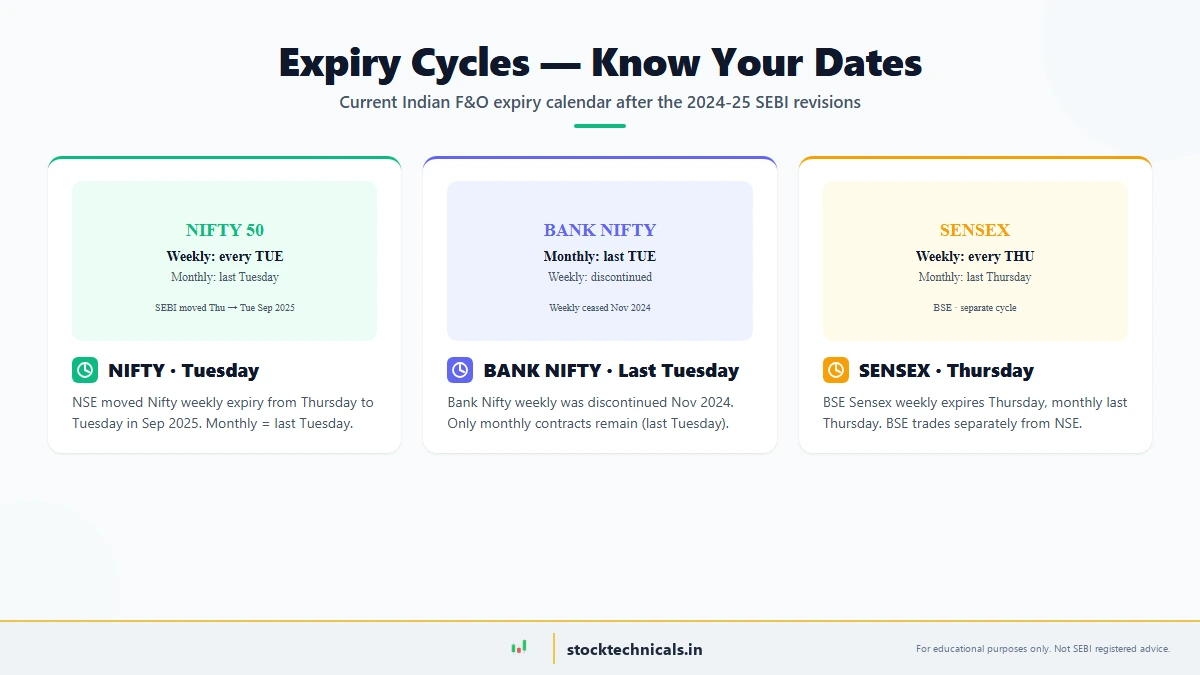
Weekly vs. Monthly Expiry
On NSE, options are traded with different expiries:
- Weekly: Expires every Thursday (has the fastest theta decay, cheapest premiums, highest volatility)
- Monthly: Expires on the last Thursday of the month (slower decay, more stable premiums)
Beginner recommendation: Start with monthly expiry. Weekly options decay so fast that a small adverse move can wipe you out. Monthly gives you time to be slightly wrong and still profit.
Lot Sizes (Critical!)
Each options contract controls a specific quantity:
| Instrument | Lot Size | Margin Required (Approx) |
|---|---|---|
| Nifty 50 | 75 shares | ₹50,000-70,000 |
| Bank Nifty | 40 shares | ₹40,000-60,000 |
| Reliance | 500 shares | ₹30,000-50,000 |
| TCS | 300 shares | ₹40,000-60,000 |
| Sensex | 10 units | ₹30,000-50,000 |
Why this matters: If Bank Nifty options cost ₹45 per share, and 1 lot = 30 shares (Jan 2026 NSE revision), you need only ₹1,800 to control ₹18,80,000 (₹47,000 × 40) of index exposure. That’s leverage.
European vs. American Options
NSE uses European-style options: You can exercise the option only on the expiry date, not before.
This is actually good for you as a buyer — it stops you from making emotional early exits. And it means you know exactly when the contract ends (3:30 PM IST on expiry Thursday).
Some platforms (US markets) use American-style where you can exercise anytime before expiry. For now, don’t worry about this distinction — NSE is European.
5 Rules Every Option Buyer Must Follow
If you follow these 5 rules, your options trading will be profitable 60-70% of the time. If you ignore them, you’ll join the 90% of beginners who lose money.
Rule #1: Only Buy Options Aligned with Your Chart Setup
Do this: Buy a call only when price breaks above resistance on heavy volume, or when the technical setup screams “upside breakout coming.”
Buy a put only when price breaks below support on heavy volume, or when the chart shows a clear reversal pattern.
Don’t do this: Buy a call because “the price is so cheap” or “OTM calls are lottery tickets with big payoff.”
Why: Options are directional bets. If your chart doesn’t confirm the direction, you’re gambling, not trading. A ₹2,550 call is cheap because Reliance needs to jump ₹50 to break even — that’s a low-probability event unless your chart shows why it might happen.
Rule #2: Always Set a Stop Loss
Do this: When you buy an option at ₹45 premium, decide upfront: “If it drops to ₹30, I’m out.” Set a stop loss immediately.
Don’t do this: “I’ll hold and hope it rebounds.” Nope. Options decay. If you’re wrong, the premium will keep dropping. Hope is not a trading strategy.
The math: If you risk losing 30% on each trade, but your win rate is 60%, you still make money long-term. If you risk losing 80% on each trade, even a 70% win rate won’t save you.
Rule #3: Don’t Fight Time Decay (Theta)
Do this: Exit options when 30-50% of the time to expiry has passed, especially if the position is near breakeven. Lock in whatever profit you can.
Don’t do this: Hold a profitable option all the way to expiry. In the last week, theta decay accelerates. A ₹80 option can drop to ₹50 in 2 days even if the stock price doesn’t move. You lose to time, not price.
Example: You bought a ₹2,550 call for ₹22 (3 weeks to expiry). Two weeks later, Reliance is still at ₹2,500. That call is now worth ₹10 (time value collapsed from ₹22 to ₹10). Exit, take the loss, move on.
Rule #4: Position Size Appropriately
Do this: Risk only 1-2% of your trading capital per options trade. If you have ₹5,00,000 account, risk max ₹10,000 per trade.
Don’t do this: “I’ll buy 5 lots of Bank Nifty calls with just 10% of my capital.” That’s ₹50,000 at risk on a single bet. One bad expiry and you’ve lost 10% of your account.
Pro tip: Use options to hedge or complement your spot trades, not replace them. If you’re bullish on Reliance stock and own 500 shares, buying 1-2 call lots makes sense. If you’re just trading options with no underlying conviction, limit size.
Rule #5: Trade with a Plan, Not Emotions
Do this: Before entering any options trade, write down:
- What chart setup triggered the trade?
- What’s your target price?
- Where’s your stop loss?
- How much are you risking?
- When will you exit?
Don’t do this: “The option is down 50%, I should hold for a reversal.” Wrong. If your original setup is broken, exit. If a better opportunity comes along, switch.
Before Buying Your First Option: The Checklist
Before you click “buy” on that first call or put, run through this checklist:
Technical Setup:
- [ ] Does my chart show a clear breakout or breakdown confirming my directional bias?
- [ ] Is volume confirming the move?
- [ ] Have I identified support and resistance levels?
Option Selection:
- [ ] Is the strike aligned with my target or stop loss?
- [ ] Have I checked the open interest (at least 10,000+)?
- [ ] Am I choosing monthly expiry (not weekly) as a beginner?
- [ ] Is my position size 1-2% of account capital?
- [ ] Have I set a stop loss (20-30% loss or fixed rupee amount)?
- [ ] Do I have an exit plan (target profit or time-based exit)?
Market Conditions:
- [ ] Is volatility (IV) reasonable, not spiked due to earnings/events?
- [ ] Is the option chain liquid enough to exit without slippage?
Psychological:
- [ ] Am I treating this as a calculated bet, not gambling?
- [ ] Have I accepted that I can lose 100% of the premium paid (worst case)?
- [ ] Do I understand this is leverage — I’m risking more than I put in?
If you’ve checked all boxes, you’re ready. If not, wait for the next setup.
Common Mistakes: What NOT to Do

Mistake #1: Buying Far OTM Options Because They’re Cheap
The trap: RELIANCE ₹2,700 call costs only ₹2. 100x return if it hits!
The reality: Reliance would need to jump 8% (from ₹2,500 to ₹2,700) in 2 weeks. That’s a Black Swan move, not a normal trade. The ₹2 option expires worthless 95% of the time.
Better approach: Buy at-the-money (ATM) or slightly out-of-the-money (OTM by ₹50-100) options. Pay more premium, but get better odds.
Mistake #2: Ignoring Theta (Time Decay)
The trap: You bought a ₹22 premium call 3 weeks ago. Now, with 2 days to expiry, it’s trading at ₹3 even though the stock price hasn’t moved.
The reality: Theta has eaten ₹19 of your ₹22 premium. If you don’t exit now, it’ll drop to ₹0 at expiry.
Better approach: Set a “theta exit rule.” If 50% of time to expiry has passed, exit even if you’re only slightly positive. Don’t let time decay kill your position.
Mistake #3: Buying Options Without a Stop Loss
The trap: “This setup is perfect. I’ll just hold and hope.”
The reality: The stock moves against you 5% in one day. Your option drops 40%. You’re now down ₹7,000 (out of ₹10,000 risked). You panic and sell at the worst moment.
Better approach: Set stops at entry. Period. Non-negotiable.
Mistake #4: Oversizing Positions
The trap: “Options are cheap. I’ll buy 5 lots of Bank Nifty calls with just ₹10,000.”
The reality: You’ve now risked ₹10,000 on a ₹18,80,000 position. One 2% move in the wrong direction and you lose it all.
Better approach: 1 lot max per trade if you have ₹5-10 lakh account. 2-3 lots only if account is ₹20+ lakh and risk is capped to 1%.
Mistake #5: Trading Options Without a Plan
The trap: “I’ll just buy this call and sell when it doubles.”
The reality: It doubles, but you miss the exit. Then it crashes 80%. Greed cost you profits.
Better approach: Before entering, know your exit: 1) Target profit level (call it ₹35 if you bought at ₹20), 2) Stop loss (₹15), 3) Time-based exit (hold max 10 days, then reassess).
Call vs. Put Options: Feature Comparison
Here’s a quick reference table:
| Feature | Call Option | Put Option |
|---|---|---|
| What it is | Right to BUY | Right to SELL |
| You buy when | Bullish (expect price up) | Bearish (expect price down) |
| Profit if | Price rises above strike + premium | Price falls below strike |
| Premium costs | Less when strike is higher | More when strike is higher |
| Max Loss | Premium paid | Premium paid |
| Max Profit | Unlimited (price can rise infinitely) | Premium × (Strike Price) — capped |
| Theta decay | Hurts you (premium drops daily) | Hurts you (premium drops daily) |
| Best for | Leveraged upside bets, breakout trades | Downside protection, bearish bets |
| NSE Lot Size | Same as underlying (Nifty = 65, Bank Nifty = 30) | Same as underlying |
| Expiry Impact | OTM expiry worthless; ITM has intrinsic value | OTM expires worthless; ITM exercised or traded |


The Bottom Line
Options are powerful — but only when you understand what you’re buying. A call is a leveraged bet on price rising; a put is a leveraged bet on price falling. Your maximum loss is always the premium paid. But options can expire worthless in days if you’re wrong on direction, magnitude, AND timing. Start with buying calls and puts on Nifty — never sell options until you understand margin, assignment, and Greeks. Master the basics here before moving to strategies.
I traded my first ATM call option on Nifty in 2022 — and lost the entire premium to time decay. I learnt that direction alone isn’t enough; theta is the silent killer.
What is a call option in simple terms?
A call option gives you the RIGHT (not obligation) to BUY a stock or index at a fixed price (strike) before expiry. You pay a small premium for this right. If NSE: NIFTY is at 22,000 and you buy the 22,200 call for ₹80, you can buy Nifty at 22,200 even if it rallies to 23,000. Your max loss = ₹80 × lot size (25 = ₹2,000). Calls are bullish bets — you profit when price rises above strike + premium.
What is a put option in simple terms?
A put option gives you the RIGHT to SELL a stock or index at a fixed strike price before expiry. You pay a premium upfront. If NSE: BANKNIFTY is at 48,000 and you buy the 47,800 put for ₹120, you profit as Bank Nifty falls below 47,680 (strike − premium). Max loss = premium paid × lot size. Puts are bearish bets — useful for hedging existing long positions too.
Who is the seller/writer of an option?
For every buyer there is a seller (writer). The seller collects the premium upfront and takes on the OBLIGATION to deliver the stock at strike if assigned. Writing options has unlimited risk (for calls) or strike-sized risk (for puts) but higher win rate — time decay and volatility crush favour sellers. On NSE, retail traders mostly BUY options; institutions and market makers WRITE. SEBI margin rules for option writers are strict.
What determines an option’s premium in the NSE?
Premium has two components: (1) Intrinsic value — how much in-the-money the option is (if NIFTY is 22,100 and call strike is 22,000, intrinsic = 100), (2) Time value — how much premium is paid for the time left and volatility potential. Time value decays rapidly in the last week of expiry (theta decay). Premium is determined by the NSE options market itself — bid/ask spreads, not by any formula alone.
What is an option’s lot size on NSE?
NSE mandates fixed lot sizes per contract. NSE: NIFTY options = 25 (as of 2026), NSE: BANKNIFTY = 15, NSE: RELIANCE stock options = 250, NSE: HDFCBANK = 550. These change periodically when SEBI revises — always check the latest via NSE website before trading. Lot size × premium = capital required per trade, which can be significant on stock options.
Can I exercise an Indian option early?
No — Indian equity options are European-style, meaning they can only be exercised at expiry, not before. This simplifies things compared to American options. What you can do before expiry: buy or sell the option in the secondary market to close your position. Most retail traders never exercise; they square off before expiry to avoid delivery obligations (for stock options) or settlement volatility (for index options).
What are the risks of trading options for beginners?
Main risks: (1) Total loss of premium — if your option expires out-of-the-money, you lose 100%. (2) Time decay — options lose value every day, so being right on direction but wrong on timing still loses money. (3) Leverage illusion — small premium = large exposure = large losses if sold. (4) Liquidity risk — deep OTM options often have wide bid/ask spreads. Start with buying only; never sell options without ₹10L+ capital and written discipline.
How is options trading taxed in India?
Options trading is treated as Non-Speculative Business Income under Indian tax law (Section 43(5), F&O is specifically excluded from speculative). Profits add to total income and are taxed at your slab rate. Losses can offset any business income and carry forward 8 years. STT on NSE options is 0.125% on premium for sell side (buyer pays none). Maintain a trading journal for tax audit — SEBI and IT dept cross-check F&O profit/loss with broker reports.
RISK NOTICE
Options trading involves significant risk. Unlike spot stocks, options can expire worthless, resulting in a 100% loss of the premium paid. The SEBI study shows 93% of intraday traders lose money — a disproportionately higher percentage in derivatives. Never risk money you cannot afford to lose. Always use stop losses. Never sell naked options without understanding pin risk, margin requirements, and assignment risk. This content is for educational purposes only and is not investment advice.