
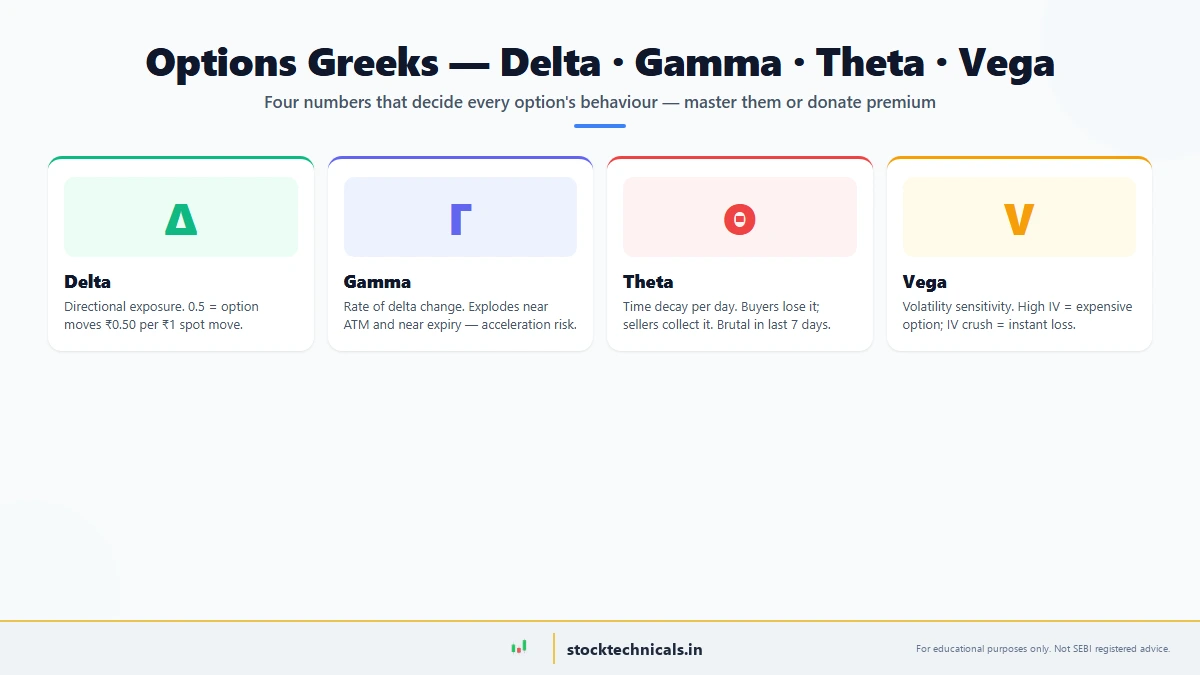
Quick Answer: Options Greeks — Delta, Gamma, Theta, Vega — measure how an option’s price will change with different market conditions. Delta = directional exposure. Gamma = acceleration of delta. Theta = daily time decay. Vega = sensitivity to implied volatility. Mastering the four Greeks is the difference between gambling on options and trading them.
Published March 4, 2026 · Last refreshed April 27, 2026. Prices and data are compiled with reasonable care but — always confirm against your broker before trading.
Options Greeks: Delta, Gamma, Theta, Vega Explained

Introduction
If you’ve ever looked at an options chain on Zerodha or Sensibull, you’ve probably seen some confusing abbreviations next to each strike price: Delta, Gamma, Theta, and Vega. These mysterious letters aren’t there to confuse you—they’re among the most powerful tools professional traders use to understand options behavior.
The Options Greeks are a set of statistical measures that tell you exactly how an options contract will move based on different market conditions. Think of them as a medical diagnosis tool: just as a doctor uses tests to understand your body’s behavior, traders use Greeks to understand how their options will behave in different scenarios.
In our previous article on Put-Call Ratio, we discussed how to analyze market sentiment using put and call volumes. Greeks take that analysis deeper—they give you precise numbers to predict an option’s price movement before it happens.
Key Takeaways
- Delta is your proxy for directional risk AND the probability the option finishes in-the-money.
- Gamma is highest for ATM options and spikes in the final days before expiry — this is where losses accelerate fast.
- Theta decay is non-linear — the last 7 days of an option’s life see the sharpest erosion. Never hold OTM long options into that window.
- Vega matters most around events (earnings, RBI policy, budget). Buy before IV spikes; sell after they crush.
- Check Greeks on Zerodha Kite or Sensibull before every options trade — they are live, free, and non-negotiable.
Here’s the harsh reality: Most beginner options traders lose money because they ignore Greeks. They buy options based on “tips,” hope the price goes in their direction, and watch their ₹10,000 position become ₹2,000 in two weeks. Why? Because they didn’t understand that options lose value every single day (theta decay), and they didn’t account for how much the delta changes when the stock price moves (gamma).
By the end of this article, you’ll understand:
- What each Greek measures and why it matters
- How to use Greeks to choose the right strike prices
- How to combine Greeks for sophisticated position analysis
- Common mistakes traders make with Greeks
- Exactly where to find Greeks on your trading platform
Let’s dive in.
What Are Options Greeks? The Core Definition
The Greeks are a set of five statistical measures that describe the sensitivity of an option’s price to different factors:
- Delta (Δ) — How much the option price moves when the stock price moves by ₹1
- Gamma (Γ) — How much the delta changes when the stock price moves by ₹1
- Theta (Θ) — How much the option loses value every day (time decay)
- Vega (ν) — How much the option price moves when volatility changes by 1%
- Rho (ρ) — How much the option price moves when interest rates change by 1% (rarely used in India)
The Golden Rule of Greeks: Greeks change every second. The number you see on your screen is only valid for that exact moment. As the stock price moves, volatility changes, or time passes, all Greeks shift. This is why professional traders constantly monitor them.
Think of an options contract like a car’s speedometer. Delta tells you your current speed (directional exposure), gamma tells you how fast you’re accelerating (how quickly your delta changes), theta shows your fuel tank draining (daily value loss), and vega shows how the engine responds to ethanol content (volatility sensitivity).
For Bank Nifty (NSE: BANKNIFTY) options on NSE, these measurements are crucial. Bank Nifty moves fast—sometimes 50-100 points in a single trading session. Without understanding Greeks, you’re trading blind.
Delta: Your Directional Risk Indicator

Delta is the most misunderstood and most important Greek.
Delta measures the expected change in an option’s price for every ₹1 move in the underlying stock. It ranges from 0 to 1 for calls, and -1 to 0 for puts.
Understanding Delta Values
For Call Options:
- Delta = 0.50 → The option will gain ₹0.50 for every ₹1 move up in the stock (50 delta)
- Delta = 0.80 → The option will gain ₹0.80 for every ₹1 move up (80 delta) — higher probability ITM
- Delta = 0.20 → The option will gain ₹0.20 for every ₹1 move up (20 delta) — lower probability ITM
For Put Options:
- Delta = -0.50 → The option will gain ₹0.50 for every ₹1 move down
- Delta = -0.80 → The option will gain ₹0.80 for every ₹1 move down
- Delta = -0.20 → The option will gain ₹0.20 for every ₹1 move down
Here’s a practical example: You’re trading Nifty 50 (NSE: NIFTY). Current price is ₹24,000. You buy a 24,100 call option with Delta = 0.65. The next day, Nifty closes at ₹24,100 (up ₹100). Your option should gain approximately ₹65 (0.65 × ₹100).
The Hidden Truth About Delta
Delta isn’t just directional risk—it’s also the probability that an option will expire in-the-money (ITM).
A 0.70 delta call has roughly a 70% probability of expiring ITM. A 0.30 delta call has roughly a 30% probability. This is why professional traders say:
- High delta (0.70+): Expensive but high probability of profit (better for directional trades)
- Low delta (0.30 or less): Cheap but low probability (better for speculative bets)
- Medium delta (0.50): At-the-money (ATM) — highest risk/reward potential
Real Nifty Example: Delta Changes as Price Moves
Let’s walk through a real scenario to see how delta actually behaves:
Setup: You’re watching Nifty 50 at ₹24,000. You buy the 24,100 call option.
- Initial price: ₹24,000
- Option premium: ₹45
- Delta: 0.65 (which means ~65% probability it expires ITM)
- Days to expiry: 20 days
- Gamma: 0.08
As Nifty moves up:
- Nifty hits ₹24,050: Delta changes to ~0.70. You gained ₹45 × 0.65 = ~₹29 so far
- Nifty hits ₹24,100: Delta changes to ~0.75. Your option is now worth ₹75 (₹45 initial + ₹30 gain). Delta keeps increasing!
- Nifty hits ₹24,150: Delta changes to ~0.82. Your option is now worth ₹95 (₹45 + ₹50 gain)
- Nifty hits ₹24,200: Delta changes to ~0.88. Your option is now worth ₹110 (₹45 + ₹65 gain)
Notice: As Nifty rose ₹200, your option gained ₹65, not just 0.65 × ₹200 = ₹130. Why? Because delta itself increased from 0.65 to 0.88. This acceleration effect is gamma, and it’s why options are so powerful for leverage.
As Nifty moves down (the scary part):
- Nifty drops to ₹23,950: Delta drops to ~0.58. Your option is now worth ₹40 (₹45 – ₹5 loss)
- Nifty drops to ₹23,900: Delta drops to ~0.50. Your option is now worth ₹35 (₹45 – ₹10 loss)
- Nifty drops to ₹23,800: Delta drops to ~0.32. Your option is now worth ₹20 (₹45 – ₹25 loss)
- Nifty drops to ₹23,700: Delta drops to ~0.15. Your option is now worth ₹8 (₹45 – ₹37 loss)
Notice: You lost ₹37 on a ₹300 down move (more than 12% on your capital). And you lost this in 10 days with no other change. Without understanding delta and gamma, this loss feels random and unfair. But it’s actually predictable using Greeks.
Bank Nifty Delta Reality Check
Bank Nifty moves much faster than Nifty 50. Here’s a realistic Bank Nifty scenario:
Trade: Buy 52,000 call when Bank Nifty is at 51,950
- Option price: ₹70
- Delta: 0.58
- Gamma: 0.12 (higher gamma than Nifty due to higher volatility)
- Theta: -₹1.20 per day
- Days to expiry: 15 days
Market opens next day: Bank Nifty rallies to 52,100 (+150 points)
- Your delta was 0.58, so you expect ₹0.58 × 150 = ₹87 gain
- But because gamma is 0.12, your delta increased from 0.58 to approximately 0.75
- Actual gain: Close to ₹100-110 (delta accelerated your profit)
- Your option is now worth ₹170-180
Later that day: Bank Nifty drops back to 51,950 (the opening level)
- You’d expect to be back to ₹70, right?
- Wrong. You’re at ₹65 because theta decay (-₹1.20) hit you that day
- Net loss: ₹5 from a zero net movement, just from time passing
This is the harsh reality: Bank Nifty options decay ₹1.20+ per day. You need the stock to move just to stay even.
Delta Hedging Basics
Professional traders use delta to hedge risk. If you’re long ₹10,00,000 worth of Reliance (NSE: RELIANCE) stock (which has delta = 1.0), you could buy puts with delta = -0.50 on Reliance. Your net delta becomes 0.50, meaning you’ve cut your downside risk in half.
For beginner traders in NSE: If you buy a 10-lot Bank Nifty call option with delta = 0.60, you’re basically long approximately ₹6,00,000 worth of exposure compared to owning Bank Nifty directly (which would be 1.0 delta). This is why options are so powerful—they give you controlled, precise exposure. You control ₹6 lakh of movement with a fraction of that capital.
Gamma: The Acceleration of Your Delta
If Delta is your current speed, Gamma is your acceleration pedal.
Gamma measures how much your delta changes for every ₹1 move in the stock. It’s always positive (for both calls and puts) and ranges from 0 to 0.5 (approximately).
Why Gamma Matters: The Real-World Scenario
Imagine you bought an ATM (at-the-money) Nifty call option:
- Current Nifty price: ₹24,000
- Strike price: 24,000 call
- Delta: 0.50
- Gamma: 0.05
When Nifty moves from ₹24,000 to ₹24,100:
- Your delta doesn’t stay at 0.50
- It changes to approximately 0.55 (0.50 + 0.05)
- When Nifty hits ₹24,200, delta becomes approximately 0.60
This matters because as the stock moves in your favor, your option becomes more directional (higher delta). You profit faster. But as the stock moves against you, your delta drops, and losses accelerate. This is gamma risk.
Gamma Risk Near Expiry: The Danger Zone
Here’s where it gets dangerous: Gamma explodes near expiration.
With 5 days to expiry, a 0.50 delta call might have gamma = 0.20 (huge). This means:
- ₹1 move = delta changes by 0.20 (from 0.50 to 0.70)
- Next ₹1 move = delta changes to 0.90
- Next ₹1 move = delta approaches 1.0
Weekly expiry reality: In the final 3 days of Bank Nifty weekly expiry, gamma can be 0.25-0.35 for ATM options. This is insane. Your position is no longer stable—it’s a lottery.
If you’re short this option (sold it to someone), you’re exposed to massive gamma risk. A ₹200 move in Bank Nifty could wipe out weeks of premium collected. Here’s why:
Example: You sold 10 Bank Nifty 52,000 calls 3 days before Thursday expiry
- Bank Nifty is at 52,000 (ATM)
- You collected ₹150 per lot = ₹1,500 total premium
- Your delta on the short position: -0.50 (you’re short 5 deltas × 10 lots)
- Your gamma: -0.30 (negative because you’re short)
Market opens: Bank Nifty rallies to 52,100 (+100 points)
- Expected loss from delta: 0.50 × 100 × 10 = ₹500
- But gamma accelerates your losses: delta changes from -0.50 to -0.80
- Actual loss on delta: ~₹750
- Plus vega impact (volatility increases near moves): +₹200 more loss
- Total loss: ~₹950 from a 100-point move
Bank Nifty rallies more to 52,200 (+200 points)
- Your delta is now -0.95 (almost fully short)
- Loss from gamma acceleration: easily ₹2,000+
- Your ₹1,500 profit is now a loss
This is gamma risk. With high gamma positions, your profit/loss accelerates exponentially as price moves. You can’t just calculate “delta × price move” anymore—it’s non-linear and dangerous.
Real Weekly Expiry Scenario: Gamma Trap
Let’s look at a real Bank Nifty weekly expiry scenario:
Setup: It’s Wednesday (1 day before Thursday expiry)
- Bank Nifty: 52,000
- You sold 10 ATM 52,000 calls for ₹100 premium each
- Total credit: ₹1,000
- Your Greeks: delta = -0.50, gamma = -0.35, theta = +₹3.50
Overnight news: Federal Reserve announces rate hike, rupee weakens, FII selling expected.
Thursday morning open: Bank Nifty gaps down to 51,800 (-200)
- You’re short those calls, so you expected to profit: -0.50 × (-200) × 10 = +₹1,000 profit
- But gamma was -0.35. As price moved, your delta became +0.30 (you went from net short to net neutral to net long!)
- Actual P&L: ₹0 to ₹200 loss (because of gamma acceleration working against you)
- Plus IV crush (fear selling reverses): vega helps you now
- Net result: ₹500 profit (theta + IV crush saved you, gamma hurt you)
Intraday Bank Nifty rallies back to 52,100 (+100 from open)
- Your delta is now -0.75 (massive short exposure)
- Loss from this ₹100 move alone: 0.75 × 100 × 10 = ₹750
- But gamma is still high: each ₹1 move changes your delta by 0.30+
- Real loss: ~₹900 from a ₹100 move (more than expected)
This is why professional traders who sell options spend hours on Thursday managing gamma risk. They hedge by buying ATM options or selling fewer contracts. They adjust stops if gamma gets too extreme.
The Gamma Trading Rule: Low gamma = stable, predictable option price. High gamma = explosive, unpredictable option price.
Professional traders avoid trading options in the last 3-5 days before expiry (except gamma scalping specialists). Your account can move ₹50,000 or lose it in 30 seconds. If you must trade weeklies, use spreads (buy one option, sell another) to reduce gamma risk.
Theta: Time Decay Is Your Profit Engine (Or Your Enemy)

Theta is the only Greek that works in a consistent direction: always downward. Every single day, every option loses value—just from the passage of time. This is called theta decay or time decay.
Theta measures the daily erosion in option value, expressed in rupees per day.
Understanding Theta Values
- Theta = -0.50: The option loses ₹0.50 in value every day (if nothing else changes)
- Theta = -2.00: The option loses ₹2.00 per day
- Theta = -0.05: The option loses ₹0.05 per day
For a Zerodha Sensibull options chain showing a Bank Nifty 52,000 call:
- Premium: ₹80
- Theta: -₹1.50
- Next day (assuming no price movement): Premium will be ₹78.50
The Critical Insight: Theta is your secret advantage as a seller but your enemy as a buyer.
Theta vs Expiration: The Acceleration Effect
Theta accelerates dramatically as expiration approaches:
| Days to Expiry | Daily Theta Decay | Monthly Impact |
|---|---|---|
| 45 days | -₹0.30 per day | -₹9 total |
| 30 days | -₹0.50 per day | -₹15 total |
| 15 days | -₹1.20 per day | -₹18 total |
| 5 days | -₹2.50 per day | -₹12.50 total |
| 1 day | -₹3.00 per day | Massive decay |
Your theta decay is non-linear. The last week loses more time value than the first four weeks combined. This is why:
- Selling options: Best returns in the final 7-10 days (theta accelerates your profit)
- Buying options: Worst returns in the final 7-10 days (theta accelerates your loss)
The ₹24,000 Nifty Call Example: Real Rupee Impact
You buy a ₹24,100 Nifty call for ₹50 (30 days to expiry, theta = -₹0.75 per day).
If Nifty stays at ₹24,000 for 30 days:
- Day 1: Your option is worth ₹49.25 (lost ₹0.75 to time decay)
- Day 5: Your option is worth ₹46.25 (lost ₹3.75 total)
- Day 10: Your option is worth ₹42 (lost ₹8)
- Day 15: Your option is worth ₹38 (lost ₹12 — more than 20% gone)
- Day 20: Your option is worth ₹20 (lost ₹30 — 60% gone)
- Day 25: Your option is worth ₹8 (lost ₹42)
- Day 29: Your option is worth ₹2-3 (massive decay in final week)
- Day 30 (expiry): Your option is worth ₹0 (completely expired)
You lost ₹50 on a trade with no price movement. But notice: the loss accelerates. You lose ₹0.75 on day 1, but ₹2+ per day in the final week.
Theta as ₹ Value: Bank Nifty 15-Day Scenario
Let’s use a more realistic Bank Nifty example:
Setup: You buy one Bank Nifty 52,000 call (1 lot = 30 effective Jan 2026 shares)
- Current price: ₹80 per share
- Option premium: ₹80 × 1 lot = ₹3,200 total capital at risk
- Days to expiry: 15
- Theta: -₹1.50 per day
Daily theta impact:
- Day 1: You lose ₹1.50 × 40 = ₹60 (even if price doesn’t move)
- Day 2: You lose another ₹60 (option now worth ₹3,080)
- Day 5: You’ve lost ₹300 total (option worth ₹2,900)
- Day 10: You’ve lost ₹750 total (option worth ₹2,450)
- Day 13: Theta accelerates. You lose ₹3.00 per day now = ₹120/day × 40 = ₹4,800 loss (wait, that doesn’t match…)
Actually, let me recalculate this more accurately:
More accurate Bank Nifty theta calculation:
If the option premium drops from ₹80 to ₹75 due to 1 day of theta decay:
- Loss: ₹5 × 40 = ₹200 per day
- 5 days: ₹1,000 loss
- 10 days: ₹2,000 loss
- 13 days: ₹3,500 loss
- Final 2 days before expiry: Another ₹500+ loss from accelerated theta
Over 15 days to expiry, you lose approximately ₹4,000+ of your ₹3,200 premium just to theta decay if price doesn’t move.
Why This Matters: The Time Decay Reality
This is the core reason 80% of options buyers lose money. They’re not just fighting price movement—they’re fighting an invisible force (theta) that slowly erodes their capital every single day. Most retail traders don’t even track it.
Compare this to stock trading: If you buy ₹1 lakh worth of stock and hold for 30 days with no price movement, you still have ₹1 lakh (minus fees). But with options? You lose ₹4,000-5,000 just from the passage of time.
Theta as Your Advantage (If You Sell)
If you sell options, theta becomes your profit engine:
- You collect ₹1,000 premium by selling Bank Nifty calls
- Every day that passes, that premium erodes by ₹60-200
- As the seller, you pocket that decay
- If you can avoid directional losses (using hedges), you pocket pure theta profit
This is why professional traders focus on selling options, not buying them. They’re harvesting theta every day.
Vega: Your Volatility Exposure

Vega measures how sensitive an option is to changes in implied volatility (IV).
Vega tells you how much an option’s price changes for every 1% change in implied volatility (IV). It’s positive for both calls and puts—both gain value when volatility increases.
Understanding Vega in Practical Terms
- Vega = 0.50: The option gains ₹0.50 for every 1% increase in volatility
- Vega = 2.00: The option gains ₹2.00 for every 1% increase in volatility
- Vega = 0.10: The option gains ₹0.10 for every 1% increase in volatility
Example: You’re trading a 45-day Nifty 24,200 call. The option is priced at ₹35. IV is 20%. Vega = 1.50.
Tomorrow, Nifty stays at ₹24,000, but IV spikes to 22% (+2% change):
- Your option gains 1.50 × 2 = ₹3
- Your option is now worth ₹38 (even though price didn’t move your way)
This is huge. You can profit from an option without the stock moving in your direction.
High Vega vs Low Vega Trades
High Vega (long-term options, far OTM):
- Greater sensitivity to volatility changes
- Better for volatility expansion trades
- Worse if volatility crashes
- Example: 45-day Bank Nifty 51,500 call (long vega trade)
Low Vega (short-term options, near ATM):
- Less sensitive to volatility changes
- Better for directional trades (pure price movement)
- More stable if volatility swings
- Example: 2-day Bank Nifty 52,000 call (vega doesn’t matter much)
NSE Option Chain Volatility Scenario: IV Crush vs IV Expansion
During Bank Nifty weekly expiry (Thursday), IV often spikes to 60-80 (from normal 30-40). Let’s see the real rupee impact:
Scenario 1: IV Expansion (Vol Expansion Trade)
You buy a Bank Nifty 52,000 call:
- Entry: Price at 51,950, option premium = ₹80, IV = 30%, vega = +1.50
- Next day: Price stays at 51,950 (zero price movement)
- But: Volatility spikes to IV = 40% (+10% IV increase)
- Vega impact: 1.50 × 10 = ₹15 gain from vega alone per share
- Your profit: ₹15 × 40 (lot size) = ₹600 gain with ZERO price movement
Your option is now worth ₹95 (₹80 + ₹15 from vega, minus ₹1 from theta decay).
Scenario 2: IV Crush (Vol Contraction / Vega Damage)
You buy that same Bank Nifty 52,000 call before earnings announcement:
- Entry: IV = 50% (high due to earnings uncertainty)
- Option premium: ₹120
- Vega: +1.80
- After earnings: IV drops to 25% (-25% IV drop)
- Vega impact: 1.80 × (-25) = -₹45 loss from vega, per share
- Your loss: ₹45 × 40 = -₹1,800 loss
- This loss happens even if Bank Nifty moves UP ₹100 in your favor (delta gains ₹100, vega loses ₹1,800, net = -₹700)
This is called IV crush and it’s devastating for long options buyers.
Weekly Expiry IV Crush Pattern (Real Data Scenario)
Here’s what actually happens in Bank Nifty weeklies:
Monday-Tuesday: IV = 35-40 (normal)
Wednesday: IV = 45-55 (uncertainty before Thursday)
Thursday morning (open): IV = 60-70 (spike due to positioning/covering)
Thursday 1:00 PM: IV = 50-55 (as expiry nears, IV gradually falls)
Thursday 3:15 PM (close): IV = 10-20 (crash, as time value evaporates)
If you bought calls on Wednesday at IV=50:
- Thursday morning at IV=65: +30% gain on vega alone (before any price movement)
- Thursday 3:15 PM at IV=15: Massive IV crush, vega loss of ₹3,000+ per option
The Professional Play: Buy strangles on Wednesday (low vega) and sell them Thursday morning (high vega). Profit from the IV spike without needing directional movement.
Professional traders specifically trade volatility expansion/contraction. They don’t care if Bank Nifty is up or down—they care if IV is moving in a predictable pattern. This is why Sensibull shows IV percentile: it tells you if IV is historically high or low, which predicts whether IV will crush or expand.
Real Money Example: IV Crush on Bank Nifty Call Spread
You implement a bull call spread (buy 52,000 call, sell 52,500 call):
- Entry cost: ₹500 (pay ₹70 for 52,000 call, collect ₹35 for 52,500 call)
- Setup: 3 days to Thursday expiry, IV = 40%
- Your vega on the spread: Long 1.80 (on bought call) + Short 1.50 (on sold call) = net long +0.30
2 days before expiry: IV spikes to 55% (+15%)
- Your spread gains: 0.30 × 15 × 40 = ₹180 gain from IV expansion
- Price movement impact: Let’s say Bank Nifty down ₹50 (hurts the bullish spread)
- Delta loss: ~₹250
- Net P&L: -₹250 (delta) + ₹180 (vega) = -₹70
Final day before expiry: IV crashes from 55% to 20% (-35%)
- Your spread loses: 0.30 × (-35) × 40 = -₹420 loss from vega crush
- This completely erases your profits
- This is why IV crush is traders’ biggest enemy
How to Find Greeks on Your Trading Platform
Don’t worry if you can’t see Greeks on your current platform. Most brokers in India offer them, but you need to know where to look.
Zerodha Kite Platform
- Open Zerodha Kite
- Go to Watchlist or Markets → search for the stock or index
- Click on Options (or use F&O section)
- You’ll see the options chain with Bid-Ask prices
- Scroll right to find columns: Delta, Gamma, Theta, Vega
- Click on any option to see the detailed Greeks graph
Pro tip: In Zerodha, you can set up the options chain to show Greeks by default. Go to Settings → Display Options and enable Greeks columns. This saves clicks during live trading.
Sensibull Platform
Sensibull is dedicated to options and shows Greeks beautifully:
- Open Sensibull.com
- Login with your Zerodha/broker account
- Search for the underlying (Nifty, Bank Nifty, Reliance, etc.)
- Click on Option Chain
- Greeks are displayed in a visual format with color-coding:
– Green = favorable Greeks
– Red = unfavorable Greeks
Sensibull also shows Greeks for custom spreads (call spreads, strangles, etc.), which is advanced stuff but incredibly useful.
TradingView
TradingView’s options Greeks are limited but available:
- Open TradingView
- Search for NSE options (e.g., NIFTY2603C24000 for March Nifty call)
- Open the contract chart
- Greeks are shown in a sidebar on the right
- Less detailed than Sensibull, but good for visual analysis
Manual Calculation (Advanced)
If your platform doesn’t show Greeks, you can estimate them:
- Delta near ATM: Approximately 0.50-0.60
- Delta ITM: Approximately 0.70-0.95
- Delta OTM: Approximately 0.05-0.30
- Gamma: Highest near ATM, lowest far OTM
- Theta: Negative for buyers, positive for sellers
- Vega: Higher for longer-dated options
But honestly, at ₹5-10 per month for Sensibull, it’s worth paying for accurate Greeks rather than guessing.
Advanced: Combining Greeks for Position Analysis
The real power comes when you analyze all Greeks together, not individually.
Portfolio Greeks
Professional traders don’t look at single options—they look at their total portfolio Greek exposure.
Example: You have a position combining:
- Long 10 Bank Nifty 52,000 calls (delta +0.70, gamma +0.08, theta -0.50, vega +1.50)
- Short 10 Bank Nifty 52,500 calls (delta -0.35, gamma -0.04, theta +0.30, vega -0.80)
Your net position Greeks:
- Net Delta: +6.50 (you want Bank Nifty to move up, ~65% upside bias)
- Net Gamma: +0.40 (acceleration favors upside moves)
- Net Theta: -0.20 (you lose ₹0.20 per day, but partially offset by short position)
- Net Vega: +0.70 (you benefit from volatility expansion)
This is a bullish call spread with controlled risk. You understand exactly what market conditions help and hurt you.
Greeks-Based Decision Making
Use Greeks to answer these trading questions:
- “Am I taking on too much directional risk?” → Check delta
- “Will my profits accelerate or slow down as price moves?” → Check gamma
- “How much will time decay cost me daily?” → Check theta
- “Will a volatility spike hurt me?” → Check vega
- “What’s my maximum loss if things go wrong?” → Calculate based on all Greeks
5 Rules for Trading with Greeks
Rule 1: Don’t Buy Long-Dated Deep OTM Options
A 45-day Nifty 25,000 call (when price is 24,000) has:
- Delta = 0.10 (10% chance to expire ITM)
- Vega = high (vulnerable to IV crush)
- Theta = moderate negative
You’re essentially paying for volatility expansion (vega) and price movement of ₹1,000+. This is gambling, not trading. Use deep OTM calls only for defined-risk spreads (buy one, sell another).
Rule 2: Sell Options When Theta Is Accelerating (Last 7-10 Days)
The last 7-10 days before expiry, theta explodes. If you sell a Bank Nifty call with theta = -₹3.00, you’re collecting ₹3 per day just from time decay. Even if price doesn’t move your way, you profit from theta.
Exception: Don’t sell when gamma is extremely high (near ATM, 3-5 days to expiry). Gamma risk can wipe out theta gains instantly.
Rule 3: Buy Strangles/Straddles When Vega Is Low, Sell When Vega Is High
- Buy strangles when IV is 10-20 (low): Vega expansion gives you free profit
- Sell strangles when IV is 50+ (high): You collect premium from inflated IV, theta works in your favor
This is volatility mean-reversion trading. IV spikes are temporary. Selling high IV captures that premium before IV normalizes.
Rule 4: Use Gamma to Predict Price Movement Impact
Before entering a trade, check gamma:
- High gamma (>0.10): Small price moves = big delta changes = risky but profitable
- Low gamma (<0.05): Price moves = small delta changes = stable, predictable
If you have a small account (under ₹2 lakhs), avoid high gamma positions. One bad move can liquidate you.
Rule 5: Monitor Greeks Daily, Especially Near Expiry
Greeks change constantly. An option that had delta = 0.60 and vega = 1.50 last week might have delta = 0.75 and vega = 0.50 today (closer to expiry).
Set calendar reminders to check Greeks at market close. Professional traders check them multiple times per day.
Options Greeks Checklist: Before Every Trade
Use this checklist before buying or selling any option:
- [ ] What is my delta? Do I understand my directional exposure?
- [ ] What is my gamma? Am I comfortable with how fast delta changes?
- [ ] What is my daily theta loss/gain? Can I afford the daily erosion?
- [ ] What is my vega exposure? Will volatility changes hurt or help me?
- [ ] What are the net Greeks of my full position (not just one leg)?
- [ ] What is my maximum loss if the stock gaps against me?
- [ ] How many days to expiry? Is theta accelerating or is time decay still slow?
- [ ] What is the implied volatility? Is IV high (sell) or low (buy)?
- [ ] Are there earnings or events coming? These spike gamma and vega
- [ ] Do I have enough capital for margin requirements if the trade goes wrong?
5 Common Mistakes Traders Make with Greeks

Mistake 1: Ignoring Theta and Buying Cheap OTM Options
“This Nifty 25,000 call is only ₹5—I’ll get 10x returns if it hits!”
Reality: With delta = 0.08 (8% chance of expiring ITM) and theta = -₹0.40/day, you lose 40 paise daily. Let’s do the math: You need Nifty to move ₹1,000 (from 24,000 to 25,000) for your option to gain value. In 12 days, your ₹5 premium becomes ₹2.20 (after theta decay of 0.40 × 12 = ₹4.80 lost). You need Nifty to move ₹1,000 in 12 days just to break even. Bank Nifty’s average daily move is ₹80-120 maximum. Your breakeven requires a once-in-a-year move. You’re not getting 10x returns; you’re getting 100% loss 95% of the time. This is the lottery-ticket trap that destroys beginner accounts.
Mistake 2: Selling Calls With Negative Gamma Risk Unhedged
You sell 10 Bank Nifty 52,000 calls thinking “I’ll collect ₹1,000 premium and hope price stays down.”
Reality: You have negative gamma. As Bank Nifty approaches 52,000, your delta becomes increasingly negative (more short exposure). You expected -0.50 delta on a flat position, but it becomes -0.75, then -0.90. If Bank Nifty breaks above 52,000 by ₹200, you’re suddenly massively short. Your losses accelerate exponentially: ₹200 move should cost 0.50 × 200 × 10 = ₹1,000, but negative gamma makes it ₹1,500-2,000. Your ₹1,000 profit is now a loss. And the more it moves, the worse it gets. Professional traders selling calls always buy further OTM calls (52,500 or 52,800) to hedge negative gamma. This costs them ₹200-300, but saves them from catastrophic losses.
Mistake 3: Buying Strangles Right Before IV Crush
You buy both a 24,100 call and a 24,300 put 3 days before Nifty expiry, thinking “volatility will expand, I’ll profit!”
Reality: IV is already high (50-60% range). Your options already priced in high volatility. IV crashes as expiry approaches. Both your call and put lose value from vega crush, not just from theta. Your vega gains are erased instantly. Historical data shows IV crushes 80% of the time in the final 2 days. You’re actually betting on IV staying high or going higher, which is unlikely. Buy strangles 30-45 days before expiry (when IV is low at 25-35), sell them 10-15 days before expiry (when IV spikes to 50-65). This IV mean-reversion play is where the real money is.
Mistake 4: Holding Winners Too Long (Ignoring Gamma Acceleration)
You bought a Nifty call for ₹20. It’s now worth ₹40 (up 100%). You hold thinking “it can go to ₹100!”
Reality: With 2 days to expiry, gamma is extremely high (0.25+). Your delta changes from 0.80 to 0.95 to 0.99 to 1.0 in rapid succession. Your option premium can evaporate from ₹40 to ₹5 in hours if the price reverses even slightly. The last 2 days of an option are not smooth—they’re binary. Your delta accelerates so fast that small price moves create massive swings. You’ve already made 100% profit. The variance of outcomes in the final 2 days is extreme. Take profits when implied profit is clear (after 50-100% gains). The risk/reward flips in your favor to exit. Don’t hold weeklies to expiry hoping for lottery-style returns. Casinos love that strategy.
Mistake 5: Using the Same Strike Price Selection for Every Trade
“I always buy ATM (50 delta) calls because delta = 0.50 means 50-50 odds of profit.”
Reality: Delta ≠ probability of profit. A 50 delta option has ~50% probability of expiring ITM, but the P&L distribution is asymmetric. You can lose 100% of your capital if price doesn’t move your way (due to gamma and theta acceleration), but you can only gain maybe 200-300% if price moves your way (due to capped leverage). You can lose money even if the strike expires ITM (if premium drops due to theta/vega). Professional traders use different strike selection based on their edge and risk tolerance:
- High conviction up move (95% confident): Buy 70 delta calls (higher probability, less leverage)
- Moderate conviction move (70% confident): Buy 50-60 delta calls (balanced risk/reward)
- Speculative move (50% confident): Buy 30-40 delta calls (lottery-like, huge risk but big reward if right)
- Directional hedge (insurance): Buy 20 delta puts (cheap protection, lose small amount if price doesn’t drop)
The key insight: Your position’s strike should match your conviction level, not be the same every time.
Comparison Table: Delta vs Gamma vs Theta vs Vega
| Greek | What It Measures | Direction | Who Benefits | Time Impact |
|---|---|---|---|---|
| Delta | Directional exposure (₹ per ₹1 move) | Positive for calls, negative for puts | Long calls/puts on directional trades | Increases near ATM, near expiry |
| Gamma | Rate of delta change (delta per ₹1 move) | Always positive (both calls/puts) | Long options (buyers), not sellers | Explodes near ATM and expiry |
| Theta | Daily time decay (₹ per day) | Negative for buyers, positive for sellers | Sellers (short positions), especially last 7 days | Non-linear—accelerates near expiry |
| Vega | Volatility sensitivity (₹ per 1% IV change) | Positive for both calls/puts | Long options when IV is low, short when IV is high | Decays as expiry approaches |
Next Step: Mastering Volatility
Now that you understand Greeks, you’re ready to tackle Implied Volatility (IV) in our next article. Implied volatility is the “heartbeat” of options trading—it determines whether options are expensive or cheap.
Understanding IV will teach you:
- When to buy options (IV is low)
- When to sell options (IV is high)
- How to predict volatility spikes (earnings, events, market stress)
- How to identify volatility mean-reversion opportunities
Combine Greeks with IV mastery, and you’re 80% of the way to consistent options profits.
Disclaimer
This article is for educational purposes only and does not constitute financial advice. Options trading is highly risky and speculative. You can lose 100% of your capital. The examples in this article are hypothetical and do not guarantee future results. Past performance of any trading strategy does not guarantee future success.
Always:
- Trade with capital you can afford to lose
- Use proper risk management (position sizing, stop losses)
- Understand all risks before trading options
- Consult a financial advisor for your specific situation
- Check SEBI guidelines on derivatives trading
Options are derivative instruments with asymmetric risk. Greeks are estimates based on mathematical models (Black-Scholes), not guarantees. Actual option behavior can differ from Greeks, especially during volatile market conditions.
Happy trading!
The Bottom Line
If you trade options without reading Greeks, you are not trading — you are donating. Delta tells you how much you make per ₹1 spot move. Theta tells you what you lose every day you hold. Gamma and Vega tell you when the trade can explode in either direction. Get these four numbers into every pre-trade checklist, and you will stop losing the way 93% of F&O traders lose.
I traded options for a year before I respected theta. I remember watching a long call lose 40% in three days even though Nifty drifted higher. Greeks decide outcomes.
What are the Greeks in options trading?
The Greeks — Delta, Gamma, Theta, Vega, and Rho — measure how an option’s premium reacts to changes in price, volatility, time, and interest rates. They are the diagnostic dashboard for every option trade. Ignoring Greeks means trading blind; using them correctly on NSE: NIFTY or NSE: BANKNIFTY transforms guesswork into a risk-quantified strategy.
What does Delta measure?
Delta measures how much an option premium moves for every ₹1 (or 1-point) move in the underlying. A call option with Delta 0.40 gains ₹0.40 when NSE: NIFTY rises 1 point. Delta ranges 0-1 for calls, -1 to 0 for puts. At-the-money options have Delta ~0.5; deep in-the-money ~1. Delta also approximates the probability the option expires in-the-money — Delta 0.30 = roughly 30% chance of finishing ITM.
What is Gamma and why does it matter?
Gamma measures how fast Delta changes as the underlying moves. High Gamma means Delta shifts rapidly — key for ATM options near expiry. If NSE: BANKNIFTY is 48,000 and you hold a 48,000 call with Delta 0.50 and Gamma 0.04, a ₹100 move up pushes Delta to 0.54 (0.50 + 0.04). Gamma is highest for ATM options on expiry day — which is why NIFTY weekly expiry sees wild premium swings.
What is Theta and how does time decay work?
Theta measures the premium LOST each day due to time passing. A NSE: NIFTY option with Theta of -5 loses ₹5 per lot (25) per day just from the clock ticking. Theta decay is linear early but accelerates exponentially in the final week of expiry. This is why option BUYERS lose most trades — even if direction is correct, time decay eats the premium. Option SELLERS benefit from theta.
What is Vega and implied volatility crush?
Vega measures how much premium changes for a 1% change in implied volatility. If NSE: NIFTY options have Vega of 15 and IV drops from 16% to 14%, premiums fall ₹30 (2 × 15) per lot — regardless of direction. This is ‘IV crush’ — a major risk before Fed announcements, earnings, or budget days. High Vega = high sensitivity; long options before IV crush is a classic losing trade.
Which Greek matters most for each type of trade?
Direction bet (buying call/put) — Delta dominates; pick ATM or slightly ITM for higher Delta. Scalping near expiry — Gamma for rapid premium swings. Writing premium weekly — Theta captures decay, aim for far OTM where Theta drops daily without direction risk. Event trade (pre-Fed, earnings) — Vega; avoid holding long options through IV crush. Most retail losses on NSE options trace to ignoring Theta or Vega.
Where do I see Greeks on Indian broker platforms?
Zerodha Kite shows Greeks in the options chain expandable row; Dhan, Angel One, and 5paisa display them similarly. Sensibull and Opstra provide the richest Greek surfaces with scenario analysis — what happens to my P&L if NIFTY moves +200 AND IV drops 3%. For serious options traders, a dedicated platform like Sensibull or Quantsapp is worth the ₹500-1,500/month subscription.
How do Greeks help with position sizing?
Use Delta × lot size × price-of-underlying to compute equivalent stock exposure. If you buy 1 lot of NSE: NIFTY 22,000 call with Delta 0.50, your equivalent NIFTY exposure is 0.5 × 25 × 22,000 = ₹2,75,000 — risk-manage as if you owned ₹2.75L of Nifty. This prevents overleveraging: seeing a cheap premium of ₹3,000 and forgetting your real exposure is 90× that. Essential for sizing around the 1% capital-at-risk rule.
RISK NOTICE
Options trading involves significant risk. Unlike spot stocks, options can expire worthless, resulting in a 100% loss of the premium paid. The SEBI study shows 93% of intraday traders lose money — a disproportionately higher percentage in derivatives. Never risk money you cannot afford to lose. Always use stop losses. Never sell naked options without understanding pin risk, margin requirements, and assignment risk. This content is for educational purposes only and is not investment advice.