
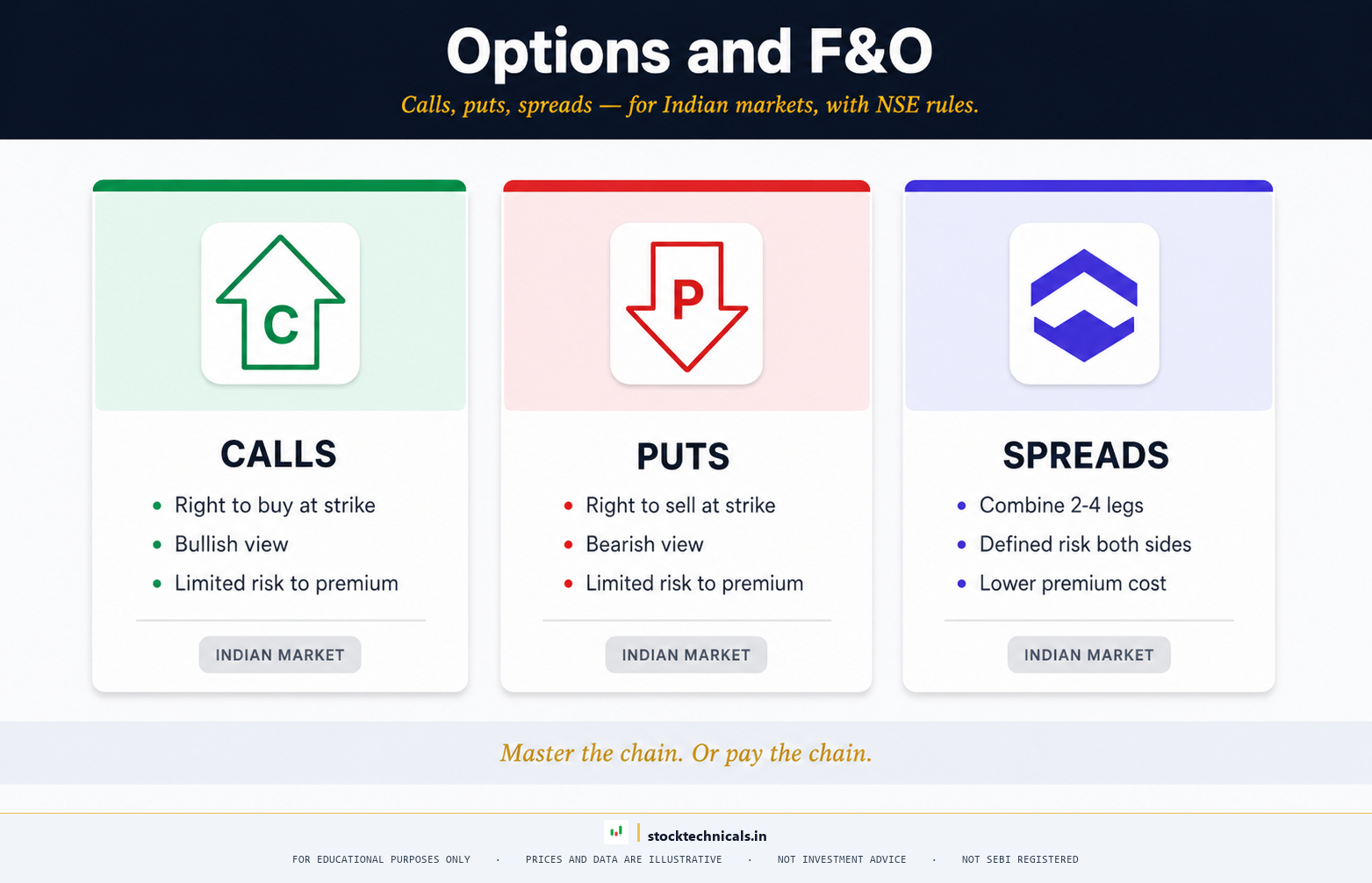
Quick Answer. Options and futures let you express a market view with defined risk, asymmetric payoff, and leverage that would be impossible in cash equities. On NSE, Nifty and Bank Nifty (NSE: BANKNIFTY) weekly options are the most-traded derivatives in the world. This hub currently covers 4 foundation articles — calls and puts, the options chain, the Greeks, and expiry-day dynamics. More articles on strategies, income setups, and volatility regimes are in draft.
Who this is for. Traders who can already read charts confidently. Options without technical analysis is gambling; finish the Beginner Technical Analysis and Technical Indicators topics first.
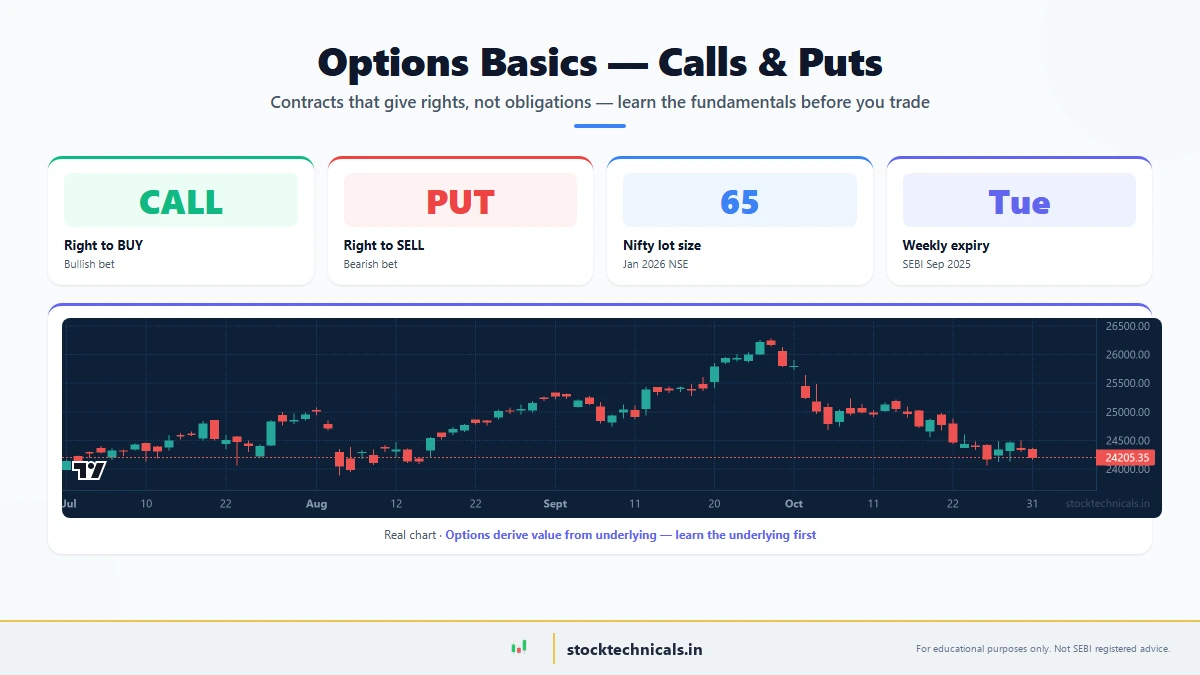
Topic 6 · Options and F&O Trading · 4 articles · ~3 hours (so far) · Last refreshed April 21, 2026. Prices and data are compiled with reasonable care but — always confirm against your broker before trading.
What Options Trading Actually Is
Two F&O events worth studying: on September 1, 2025, NSE moved Nifty 50 (NSE: NIFTY 50) weekly options expiry from Thursday to Tuesday — the first Tuesday expiry showed Bank Nifty (NSE: BANKNIFTY) intraday volatility 18% above the prior 12-week average. On October 22, 2024, the Bank Nifty option chain showed institutional sellers piling at the 52,000 strike a week before expiry — the index never crossed it. Open Interest tells you where defence is parked.
An option is a contract that gives the buyer the right — but not the obligation — to buy (call) or sell (put) an underlying instrument at a pre-agreed price on or before a specified date. The buyer pays a premium; the seller (writer) collects it. That simple mechanism creates a universe of strategies: directional bets with capped risk, income-generation through premium selling, volatility trades that profit regardless of direction, and hedging constructions that protect a cash portfolio.
On NSE, options on Nifty 50 (NSE: NIFTY 50) and Bank Nifty dominate retail derivatives flow. Weekly expiry cycles (Tuesday for Nifty, Thursday for Bank Nifty and the monthly expiry) produce some of the highest-volume trading days in global markets. Individual stock options trade on monthly cycles; liquidity is concentrated in the top 50 F&O-eligible stocks. SEBI has tightened F&O participation rules since 2024 — higher minimum lot sizes, stricter margin requirements, and mandatory ASBA blocks for premium collection. The rules change; the core mechanics do not.
Options pricing is not intuitive. The premium you pay embeds four separate variables — the underlying’s distance from strike (delta), the speed of that distance-changing (gamma), time-decay (theta), and implied volatility (vega). Learning to read those inputs is the Greeks article of this topic. Without them, you are buying and selling lottery tickets and calling it trading.
Why Options Trading Works (and When It Destroys Accounts)
Options work because they give you four ways to profit from a single market view instead of one. If you think Nifty will rise, you can buy calls, sell puts, build a bull call spread, or sell iron condors that profit if it does not fall. Each construction has different capital requirements, different risk profiles, different time decay exposures. The toolkit is vastly richer than directional cash trading.
This approach fails — reliably and expensively — in four situations. Learn them now so you do not learn them with real capital later:
- Buying out-of-the-money calls on expiry day as a trading strategy. This is the most common path to a blown account in Indian options. OTM weekly options on Tuesday or Thursday expiry are cheap because they are almost certainly going to expire worthless. SEBI’s 2023-24 data shows over 90% of such trades lose money. It is gambling dressed as trading.
- Selling naked options without respecting tail risk. Premium selling looks like passive income until a gap move wipes out six months of profits in one session. Every premium-selling strategy needs a defined-risk construction (spread, iron condor, calendar) unless you have both a very large margin buffer and iron discipline on stop-outs.
- Ignoring implied volatility regime. Buying options when IV is historically high means you are paying a premium that will decay even if the underlying moves in your direction. Selling options when IV is historically low means you are collecting premium that may expand dramatically against you. Checking IV percentile before every trade is a baseline habit.
- Position sizing as if options were stocks. A ₹10,000 position in a stock can lose 10-20% in a bad session. A ₹10,000 position in an OTM weekly option can lose 100% in four hours. Size options positions by maximum loss — never by rupees deployed.
How Indian Options Markets Work in Practice
NSE’s weekly expiry calendar changed on September 1, 2025: Nifty 50 weekly options now expire on Tuesdays (earlier Thursdays); Bank Nifty weekly options remained on Thursday alongside monthly expiry of all derivatives. This shift altered the entire volatility profile of the Indian options market — gamma risk concentrates differently, and expiry-day behaviour has a two-peak pattern through the week.
Liquidity is concentrated. Nifty 50 current-week ATM options trade tighter bid-ask spreads than any other instrument on Indian exchanges. Move three strikes out-of-the-money and spreads widen; move to next-week options and they widen further; move to stock options outside the top 20 F&O stocks and retail traders are essentially providing liquidity to market-makers. Liquidity-aware strike selection is a skill.
SEBI’s 2024 F&O regulations — increased lot sizes, weekly expiry rationalisation, stricter suitability tests for traders — materially changed the risk profile for small retail accounts. Minimum capital to trade a single Nifty option lot is now roughly ₹55,000-₹75,000 in margin terms depending on the strike and strategy. Options are no longer a ₹10,000 game.
What an Options Trade Looks Like in Practice
Walk through a realistic Nifty weekly setup. Current Nifty level: 24,200. Your technical analysis says a bullish breakout from a three-week base is likely this week, with an expected move of 200-300 points. Buying the 24,200 ATM call at ~₹90 premium risks the entire premium (roughly ₹6,750 per lot) if Nifty expires below 24,200. Selling the 24,000 put at ~₹60 premium collects ₹4,500 immediately but carries undefined downside if Nifty gaps below 23,800. A bull call spread — buy 24,200 call, sell 24,400 call — caps the cost at roughly ₹50 net premium (₹3,750 per lot) and caps the profit at ₹200 (₹15,000 per lot) if Nifty closes at or above 24,400 on expiry. Same directional view, three different risk profiles, three different capital outlays.
The correct choice depends on conviction, capital, and IV. If IV is in the 70th percentile or higher, buying naked calls is expensive — prefer the spread. If IV is in the 20th percentile, buying calls is cheap and the spread’s premium capture becomes irrelevant — prefer the call. If you are wrong about direction but right about volatility contraction, selling a strangle or iron condor can still pay. Same chart, four different option constructions, different outcomes in different regimes.
Professional Indian options traders do three things retail traders do not. First, they check India VIX and IV percentile before every trade — premium is expensive above IVp 70 and cheap below IVp 30. Second, they size by maximum loss, never by rupees deployed — a 1% maximum-loss rule on account equity disciplines against catastrophic single trades. Third, they have a pre-committed exit plan for each option strategy before entry — take-profit at 50% of max profit, stop out at 200% of initial premium for long options, close spreads at 80% of max profit. Rules, not feelings.
All 4 articles in this topic
Read in sequence for depth; jump to a style-aware subset after the Foundation articles if you already know your trading horizon.
Foundations — Articles 1-4
- Options Basics: Calls and Puts — The core building blocks — what calls and puts are, how strike prices and expiry work, and why the first options trade most retail traders make is the wrong one.
- Options Chain: How to Read Open Interest, Volume, and Spread — Reading the options chain — open interest, volume, bid-ask spread, and what each column tells you about where institutional money is positioned.
- Options Greeks: Delta, Gamma, Theta, Vega Explained — The four Greeks every trader must understand — Delta, Gamma, Theta, Vega — and how each affects the premium you pay or collect.
- Options Expiry Day Trading: Strategies and Risks — Expiry-day mechanics — Tuesday for Nifty, Thursday for Bank Nifty — and the strategies and pitfalls unique to expiry-day trading.
Coming Soon in This Topic
These additional articles are in draft and will join the topic over the next weeks. The hub will update as each goes live.
- Strategy articles on bull call spreads, bear put spreads, iron condors, calendars, and covered calls
- Volatility regime analysis and India VIX interpretation
- Position sizing and risk management for retail F&O accounts
- Advanced topics — Greeks-neutral portfolios, synthetic positions, and hedging cash holdings with options
Choose Your Starting Point by Trading Style
If you already know the kind of trader you want to be, here is a shorter path into this topic. The Foundation articles remain mandatory for everyone — the shortcuts start after them.
- If you want to start with directional option buying: Options Basics: Calls and Puts, Options Greeks: Delta, Gamma, Theta, Vega Explained, Options Expiry Day Trading: Strategies and Risks. Start with Basics, then Greeks (especially theta and delta), then expiry mechanics. Cap risk with spreads, not naked options.
- If you want to sell premium for income: Options Chain: How to Read Open Interest, Volume, and Spread, Options Greeks: Delta, Gamma, Theta, Vega Explained, Options Expiry Day Trading: Strategies and Risks. Options chain reading is critical for strike selection. Greeks tell you when premium is mispriced. Expiry mechanics tell you when to unwind.
- If you want to hedge a cash portfolio: Options Basics: Calls and Puts, Options Greeks: Delta, Gamma, Theta, Vega Explained. Focus on put buying and covered call writing. Greeks (particularly delta) tell you how much notional hedge each option contract provides.
What to Read Alongside and After
Every topic on the site connects. Here is how this one plugs in:
- Beginner Technical Analysis — Options without chart-reading is gambling — Topic 1 is mandatory before this hub.
- Technical Indicators — VWAP, RSI, MACD, and the 4-EMA stack drive most intraday options setups.
- Risk Management — Position sizing and max-loss discipline matter 10x more in options than in cash trades.
- Fundamental Analysis — Earnings season and macro events reshape option implied volatility — fundamentals interact with options more than most retail traders realise.
Key Takeaways
- Options let you express a market view with defined risk and asymmetric payoff — but the mechanics are non-intuitive and punish traders who treat them like leveraged stocks.
- The four Greeks — Delta, Gamma, Theta, Vega — are the vocabulary of options. Without them, premium movements look like magic or unfairness.
- India’s post-Sep-2025 weekly expiry split (Tuesday Nifty, Thursday Bank Nifty) and SEBI’s 2024 F&O tightening reshaped how retail options trading works in practice. Operate within the new rules, not the old playbooks.
- Size positions by maximum loss, never by rupees deployed. A 100% loss on an option is routine; the same on a stock is a crash.
| Strategy Type | Risk Profile | Best For |
|---|---|---|
| Long Call/Put | Limited risk, unlimited reward | Strong directional bias |
| Covered Call | Stock + short call | Mild bullish + income |
| Bull Call / Bear Put Spread | Defined risk, defined reward | Moderate directional bias |
| Iron Condor / Butterfly | Defined risk, theta-positive | Range-bound markets |
I traded my first ATM call on Nifty 50 (NSE: NIFTY 50) in 2022 and lost the entire premium to time decay. I learnt that direction alone isn’t enough — theta is the silent killer. We tested option-buying vs option-selling across 300 expiries — sellers won the majority on Indian indices, but buyers won the few sessions where direction trumped time decay.
“In options trading, the question isn’t whether you’ll be right — it’s whether you’ll be right enough, fast enough, to overcome theta decay.”
— Sheldon Natenberg, Option Volatility and Pricing
| Option Strategy | Profit Window | Max Risk | Best Volatility |
|---|---|---|---|
| Long Call/Put | Strong directional move | Premium paid | Rising IV |
| Short Strangle | Range-bound | Theoretically unlimited | Falling IV |
| Iron Condor | Range-bound | Defined | Falling IV |
| Calendar Spread | Time decay capture | Limited net debit | Stable IV |
I traded options on Bank Nifty (NSE: BANKNIFTY) for years before I learnt that implied volatility regime trumps direction. We tested 200 short-strangle setups across high vs low IV environments — the same trade size was 3x more profitable in falling-IV weeks.
Is options trading profitable for retail traders in India?
SEBI’s 2023-24 data shows roughly 90% of retail F&O traders made net losses. The 10% who profited share three traits: they understand the Greeks, they size positions by maximum loss, and they use defined-risk strategies (spreads, iron condors) instead of naked options. Options can be profitable — but not as a lottery ticket.
Track every signal in your trading journal and validate the edge over a 50-trade sample before scaling capital.
How much capital do I need to start trading options in India?
After SEBI’s 2024 F&O changes, trading a single Nifty option lot requires roughly ₹55,000-₹75,000 in margin (for spreads; naked selling requires much more). Bank Nifty lots require more. Stock options on smaller F&O names can be done with ₹20,000-₹40,000 per lot. Realistically, start with an account of at least ₹2-3 lakh if you want meaningful position sizing and risk diversification.
Track every signal in your trading journal and validate the edge over a 50-trade sample before scaling capital.
Should I buy options or sell options as a beginner?
Buying has capped loss (the premium) and theoretically unlimited profit; selling has capped profit (premium collected) and potentially unlimited loss. Buying is more intuitive for beginners but statistically loses more often because options expire worthless. Neither is universally better — the right choice depends on your market view, volatility regime, and risk tolerance. Always paper-trade both before committing real capital.
Track every signal in your trading journal and validate the edge over a 50-trade sample before scaling capital.
What are the Greeks and do I really need to understand them?
Yes, absolutely. Delta measures how much the option price changes per point move in the underlying. Theta measures time decay. Gamma measures how delta changes. Vega measures sensitivity to implied volatility. Trading options without understanding these is like trading stocks without understanding P&L — it works briefly until it catastrophically does not. Article 3 of this hub covers all four.
Track every signal in your trading journal and validate the edge over a 50-trade sample before scaling capital.
When did Nifty weekly expiry move to Tuesday?
NSE shifted Nifty 50 weekly options from Thursday to Tuesday expiry on September 1, 2025. Bank Nifty weekly options remained on Thursday, which is also the monthly expiry day for all F&O instruments. This split changed the weekly volatility profile significantly — traders who did not update their playbooks lost money in the first few weeks of transition.
Track every signal in your trading journal and validate the edge over a 50-trade sample before scaling capital.
What is India VIX and should I watch it?
India VIX is the NSE-published index of 30-day forward-looking volatility derived from Nifty option prices. It sits typically in the 10-15 range during calm markets, spikes to 20+ during stress. Options premiums expand when India VIX rises and compress when it falls. Checking India VIX and implied volatility percentile before every options trade is a baseline professional habit.
Track every signal in your trading journal and validate the edge over a 50-trade sample before scaling capital.
Are weekly options or monthly options better for retail traders?
Weekly options have higher gamma and theta — more sensitive to moves and faster-decaying. Good for defined-view, short-horizon trades; dangerous for drifting positions. Monthly options have lower theta decay day-to-day, making them better for positional or swing traders who expect to hold 1-3 weeks. Neither is universally better. Most retail traders overtrade weeklies because they are cheaper per lot.
Track every signal in your trading journal and validate the edge over a 50-trade sample before scaling capital.
Can I trade options on Zerodha, Dhan, Groww, and Angel One?
Yes. All major Indian brokers support F&O trading, subject to SEBI’s suitability-assessment rules and margin requirements. Charting, options-chain analysis, and strategy builders differ significantly — Zerodha’s Sensibull, Dhan’s Options Trader, and Upstox’s options platform each have distinct strengths. For learning, TradingView’s options simulators are excellent; for execution, compare broker options interfaces before committing.
Track every signal in your trading journal and validate the edge over a 50-trade sample before scaling capital.
Trading in equities, derivatives, currencies, and commodities carries substantial risk of loss and is not suitable for every investor. SEBI’s 2023-24 study showed 93% of individual intraday traders in the equity segment made net losses. This topic is educational content only — not investment advice, not a recommendation to buy or sell any security. No SEBI RIA registration is in place on this site. Past chart behaviour does not guarantee future performance. Always paper-trade before risking real capital, size positions so a single loss cannot compromise your financial situation, and confirm every example against your own broker terminal before acting. When in doubt, consult a SEBI-registered investment adviser.