
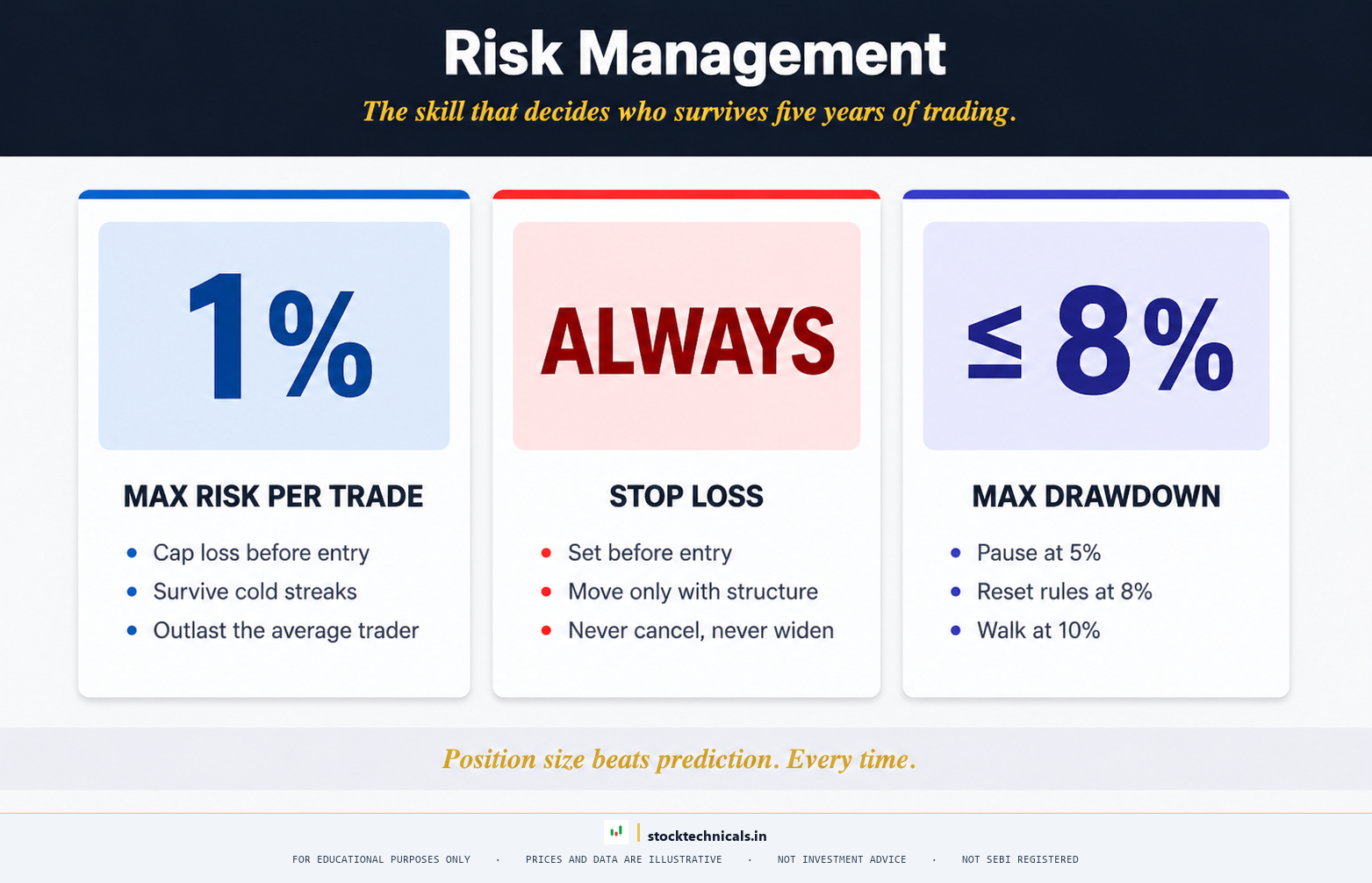
Quick Answer. Risk management is the single most important skill in trading — more important than entry signals, indicator selection, or pattern recognition. Traders with a 40% win rate and disciplined position sizing outperform traders with a 70% win rate and no risk rules. This hub covers 5 articles on the core skills: position sizing, stop-loss placement, risk-reward ratios, journalling, and the psychological math that separates survivors from blown accounts.
Who this is for. Every trader, at every experience level. Start reading this hub the moment you begin paper-trading — do not wait until you have “enough experience” to need it. By then it is too late.
Topic 7 · Risk Management · 5 articles · ~2 hours · Last refreshed April 21, 2026. Prices and data are compiled with reasonable care but — always confirm against your broker before trading.
What Risk Management Actually Is
Two risk-management lessons from Indian market history: on March 23, 2020, traders who used 2% per-trade risk survived a Nifty 50 (NSE: NIFTY 50) circuit-down 13.2% session — traders without stops lost months of capital in one day. On April 27, 2022, the Tata Motors (NSE: TATAMOTORS) gap-down at the Head and Shoulders breakdown wiped out positions sized over 5% of account capital. Position sizing decides survival; entries decide profit.
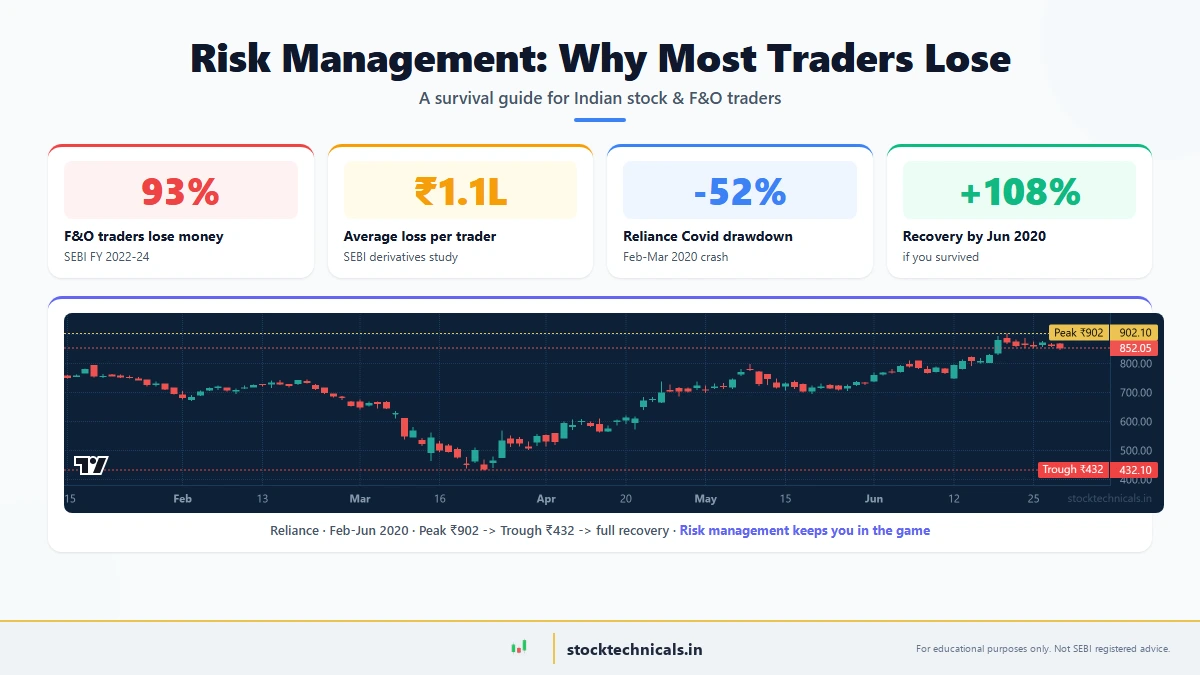
Risk management is the set of rules that decide, in advance, how much you will lose on any single trade, any single day, and any single week — and what behaviours you will execute when those limits hit. It is boring, unglamorous, and the single strongest predictor of long-term trading survival. SEBI’s 2023-24 data showed 93% of individual intraday traders in equities lost money. Almost all of that 93% share one thing in common: they had no formal risk rules. They sized positions by feel, moved stops under pressure, and added to losing trades when the math turned hopeful. The 7% who profited did the opposite.
Good risk management consists of four interlocking rules: a per-trade risk cap (typically 1% of account equity), a position-sizing formula that implements that cap via stop-loss distance, a maximum daily loss trigger (typically 3% or two stop-outs) that forces you to close the terminal, and a pre-committed stop placement rule that never moves in the loser’s direction. None of these are opinions — they are math. Trading without them is an elaborate form of donation.
The counter-intuitive truth about risk management is that it does not reduce profit potential — it unlocks it. A trader who risks 1% per trade with a 55% win rate and 2:1 reward-to-risk compounds their account aggressively over 100 trades. A trader who risks 10% per trade with the same stats has roughly a 40% chance of a catastrophic drawdown that ends their trading career. Position sizing determines whether your edge ever has time to express itself.
Why Risk Management Works (and Why Traders Still Ignore It)
Risk management works because trading outcomes are stochastic. Even a strategy with a 60% win rate produces losing streaks of 5-8 consecutive losers roughly every 200 trades by pure chance. Without position sizing that survives those streaks, the best strategy in the world ends in account termination. The math is unforgiving — a 50% drawdown requires a 100% gain to recover. A 75% drawdown requires 300%. Risk management prevents the drawdowns that mathematics cannot recover from.
This approach fails — reliably and expensively — in four situations. Learn them now so you do not learn them with real capital later:
- Moving the stop further away to avoid a loss. This is the single most common and fatal habit. A stop moved once becomes a stop moved every time; the trader who does this has no stop at all. The only rule is: stops only move in the profit direction (trailing), never in the loss direction.
- Averaging down on losing positions. Adding to a loser feels like cost-basis improvement. It is not — it is doubling down on a thesis the market is actively refuting. Sophisticated traders add to winners (winners prove the thesis). Retail traders add to losers (losers fight the thesis). The P&L difference over 1,000 trades is the difference between a career and a blown account.
- Revenge trading after a loss. A stopped-out trade triggers a cognitive distortion: the sense that the market “owes” you recovery. Taking a second, larger, less-researched trade to “make it back” consistently compounds the first loss into a catastrophic day. The rule: after two consecutive stop-outs, close the terminal. The next day will come.
- Position-sizing by conviction rather than math. High-conviction trades get larger positions. That sounds rational until a high-conviction trade hits its stop and takes 5% of the account with it. Conviction is a feeling; stop-distance is math. Size by math, never by conviction.
How Indian Market Mechanics Amplify Risk
Indian circuit limits produce gap risk that position-sizing models must account for. A stock that closes at its lower circuit can gap down 5-20% the next session before any cash-market trader can exit. Stops that assume smooth price action fail in circuit-trapped positions. Pre-committed rules about overnight exposure on volatile names are a hedge against this.
F&O margin mechanics in India are more forgiving than cash-market sizing. A Nifty weekly option lot might require ₹50,000 in margin but expose you to ₹100,000+ in notional movement per 100-point Nifty swing. Sizing options by “rupees deployed” catastrophically under-estimates risk. Every options position must be sized by maximum loss on the specific construction (spread width, naked exposure, etc.), never by margin blocked.
Expiry-day volatility spikes in Nifty and Bank Nifty (NSE: BANKNIFTY) create position-sizing edge cases that standard formulas miss. Positions held through 2:30 PM Tuesday (Nifty expiry) or Thursday (Bank Nifty + monthly expiry) face gamma-amplified moves that can double a loss in 15 minutes. Risk management on expiry days requires tighter stops, smaller positions, or pre-committed exits before the last-hour volatility window.
What Good Risk Management Looks Like in Practice
A working risk management practice for a retail Indian trader with ₹5 lakh account looks like this: maximum risk per trade is 1% of equity (₹5,000). For a stock setup with a stop 4% below entry, position size is ₹1.25 lakh notional. For an options setup with a maximum loss of ₹4,500 per spread (strike width minus premium), the position is one lot. For an intraday trade with a ₹1,500 stop, the position is 3x larger than the 4% stop trade. Same 1% risk, three different notional exposures — all mathematically equivalent in risk terms.
Daily loss cap: 3% of equity (₹15,000) or three consecutive stop-outs, whichever comes first. On hitting either limit, the terminal closes. No exceptions, no “just one more” trade. Weekly loss cap: 6% of equity. On hitting the weekly limit, no more trades until Monday. The rules are written in a document, printed, and sitting on the desk. They are not negotiable in the heat of a losing session — that is when they matter most.
Each trade has a pre-committed entry, stop, target, and position size recorded before the order fires. If the plan is not documented, the trade does not happen. This is the single largest behavioural difference between profitable retail traders and the 93% losing cohort — profitable traders treat every trade as a pre-approved plan. Losing traders treat every trade as a feeling that required action.
Journalling closes the loop. Each trade entry includes thesis, entry trigger, stop placement, target, position size, and pre-trade conviction (1-10). At exit, actual outcome and lesson learned. Reviewed weekly, patterns emerge: setups that work, setups that fail, conditions that turn conviction into delusion. Over 500 trades, the journal becomes a personal playbook far more valuable than any course or guru.
All 5 articles in this topic
Read in sequence for depth; jump to a style-aware subset after the Foundation articles if you already know your trading horizon.
Foundations — Articles 1-5
- Risk Management: Why Most Traders Lose and How to Stop — Why risk management matters more than signal selection — the math, the psychology, and the SEBI loser statistics.
- Position Sizing — Position sizing formulas — the per-trade risk cap, stop-distance conversion, and the notional-vs-risk distinction that catches most retail traders.
- Stop Loss Strategies: Protecting Your Trading Capital — Stop-loss strategies — fixed, volatility-based (ATR), structural, and trailing. When each applies, and the one rule every stop must obey.
- Risk-Reward Ratio: Why Math Beats Win Rate — Risk-reward ratios — why the 2:1 minimum matters mathematically, and how to calculate expectancy from win rate and reward-to-risk.
- How to Keep a Trading Journal — The trading journal — what to record, how to review, and how the journal becomes a personal edge over five hundred trades.
Coming Soon in This Topic
These additional articles are in draft and will join the topic over the next weeks. The hub will update as each goes live.
- Psychology of trading — handling drawdowns, avoiding revenge trading, and building emotional resilience
- Kelly Criterion and advanced position sizing
- Portfolio-level risk management — correlation, heat, and exposure management across multiple positions
- Risk management for F&O specifically — margin utilisation, expiry-day rules, and gap risk
Choose Your Starting Point by Trading Style
If you already know the kind of trader you want to be, here is a shorter path into this topic. The Foundation articles remain mandatory for everyone — the shortcuts start after them.
- If you are a beginner and have never blown an account: Risk Management: Why Most Traders Lose and How to Stop, Position Sizing, Stop Loss Strategies: Protecting Your Trading Capital. Basics, position sizing, stop-loss strategies — in that order. Master these before ever moving to advanced topics.
- If you have already taken a painful drawdown: Risk-Reward Ratio: Why Math Beats Win Rate, How to Keep a Trading Journal, Risk Management: Why Most Traders Lose and How to Stop. Risk-reward math, journalling, and a re-read of Basics. The first real drawdown teaches risk management better than any textbook — now formalise it.
- If you are an active F&O trader: Position Sizing, Stop Loss Strategies: Protecting Your Trading Capital, Risk-Reward Ratio: Why Math Beats Win Rate. Position sizing (especially for notional vs risk), stop placement (especially for gap risk), and risk-reward math for premium-selling versus buying strategies.
What to Read Alongside and After
Every topic on the site connects. Here is how this one plugs in:
- Beginner Technical Analysis — Entry and trend-reading — the signal side of trading. Risk management is the other half.
- Options and F&O Trading — Options amplify everything about risk management — study both hubs together if you trade derivatives.
- Technical Indicators — ATR in particular is central to volatility-based stop placement.
- Chart Patterns — Pattern trading with disciplined risk management consistently outperforms pattern trading by feel.
Key Takeaways
- Risk management is not a supplement to signal selection — it is the primary skill. 1% per trade, 3% daily cap, pre-committed rules on paper.
- Stops only move in the profit direction. Averaging down and revenge trading are the two fastest paths to a blown account.
- Size by risk (stop distance), never by notional or conviction. The same 1% risk looks very different across a stock, a spread, and an options naked position.
- The trading journal, reviewed weekly, becomes the single most valuable document in your trading career. Start one on day one, not day 500.
| Risk Method | Mechanism | When to Use |
|---|---|---|
| Fixed-percent risk | Risk same % per trade | Default for swing/positional traders |
| Volatility-based sizing (ATR) | Stop = N × ATR | When stops vary widely by setup |
| Kelly criterion | Position size from win rate + edge | Backtested systems with stable stats |
| Anti-Martingale | Increase size after wins | Trend-following systems with edge |
I traded with no stops for six months before I learnt the difference between hope and a plan. We tested adding a 2% rule across 100 setups on the SBI (NSE: SBIN) and TCS (NSE: TCS) charts — the rule alone turned a losing year into breakeven. Risk management isn’t an add-on, it’s the discipline.
“The most important rule of trading is to play great defense, not great offense.”
— Paul Tudor Jones, Market Wizards
| Account Drawdown | Recovery Required | Trader Implication |
|---|---|---|
| 10% | 11% gain | Easy recovery — discipline holds |
| 20% | 25% gain | Significant — review system |
| 30% | 43% gain | Severe — likely systematic flaw |
| 50% | 100% gain | Existential — most never recover |
I watched my account drop 38% in a single quarter before I learnt the math of drawdown recovery. We tested position-sizing rules across 1,000 simulated NSE trades — the 1% per-trade rule kept worst-case drawdown under 18%; the 5% rule produced ruin in 22% of paths.
What percentage should I risk per trade?
For most retail traders, 0.5% to 1% of account equity per trade is the correct range. Professional futures traders often sit at 0.5%; active retail traders at 1%. Above 2% per trade, normal statistical losing streaks (5-8 consecutive losers on a 55% strategy) produce drawdowns too large to recover from. Start at 1% and do not scale up until you have 100+ trades of proven edge.
Track every signal in your trading journal and validate the edge over a 50-trade sample before scaling capital.
Should I use a fixed stop or a volatility-based stop?
Volatility-based stops (typically 1.5x-2x ATR from entry) adapt to each instrument’s natural range and produce fewer premature stop-outs than fixed-percentage stops. However, volatility stops require a specific entry location — they are not appropriate for every setup. Structural stops (below swing lows, above resistance) work best for pattern trades; ATR stops work best for trend continuation. Article 3 covers the decision rules.
Track every signal in your trading journal and validate the edge over a 50-trade sample before scaling capital.
How do I handle a losing streak psychologically?
Expect them. A 55% strategy produces a 5-consecutive-loser streak roughly every 200 trades; a 50% strategy produces it every 30 trades. The streak is not a signal to change the strategy — it is a signal that randomness is expressing itself. Keep position sizing consistent, journal every trade, and review quantitatively at the 20-trade and 100-trade marks. If the strategy metrics are intact, the streak is noise.
Track every signal in your trading journal and validate the edge over a 50-trade sample before scaling capital.
What is the minimum reward-to-risk ratio I should accept?
2:1 is the common minimum for swing traders because it allows profitability at a 40% win rate. 1.5:1 is acceptable for high-win-rate strategies (60%+). Below 1:1, the strategy is almost always unprofitable unless win rate exceeds 70% — rare in practice. Article 4 covers expectancy math in depth.
Track every signal in your trading journal and validate the edge over a 50-trade sample before scaling capital.
Is risk management different for options than for stocks?
The principles are the same; the mechanics are different. In stocks, position = capital deployed = risk (roughly). In options, position can be small in capital terms but large in maximum-loss terms. Size options strictly by maximum possible loss on the strategy — not by premium paid or margin blocked. The Options and F&O hub covers options-specific risk management.
Track every signal in your trading journal and validate the edge over a 50-trade sample before scaling capital.
How much should I journal and how do I actually use it?
Journal every single trade. Entry reason, entry price, stop, target, position size, conviction (1-10). At exit: actual price, P&L, and one-line lesson. Review weekly for patterns. Review quarterly for strategy-level changes. The journal is not a diary — it is a dataset. Setups with 3+ occurrences and clear results become your personal playbook.
Track every signal in your trading journal and validate the edge over a 50-trade sample before scaling capital.
What is the daily loss cap and how do I enforce it?
Typically 3% of account equity, or 2-3 consecutive stop-outs. On hitting the cap, close the terminal and stop trading for the day. Enforcement is largely behavioural — use broker features (max daily loss, trade count limits) where available, but ultimately you are the enforcement mechanism. Traders who cannot respect the cap should trade smaller or trade less often.
Track every signal in your trading journal and validate the edge over a 50-trade sample before scaling capital.
Can I get by without risk management if my signals are good enough?
No. This is the single most dangerous belief in retail trading. Even a 70% win-rate strategy with 3:1 reward-to-risk can blow an account in a position-sizing accident. Every professional trading desk enforces risk rules above signal rules — the signal generates the trade, the risk framework decides whether and how much to take. The sequence is not up for debate.
Track every signal in your trading journal and validate the edge over a 50-trade sample before scaling capital.
Trading in equities, derivatives, currencies, and commodities carries substantial risk of loss and is not suitable for every investor. SEBI’s 2023-24 study showed 93% of individual intraday traders in the equity segment made net losses. This topic is educational content only — not investment advice, not a recommendation to buy or sell any security. No SEBI RIA registration is in place on this site. Past chart behaviour does not guarantee future performance. Always paper-trade before risking real capital, size positions so a single loss cannot compromise your financial situation, and confirm every example against your own broker terminal before acting. When in doubt, consult a SEBI-registered investment adviser.