Morning Star and Evening Star Patterns with Real Chart Examples

This article is for educational purposes only. It does not constitute financial advice or a recommendation to buy or sell any security. I am not a SEBI-registered investment advisor. Always do your own research and consult a SEBI-registered advisor before trading. Trading in financial markets involves significant risk of loss.

"In This Article"

Introduction

02 Morning Star Anatomy

Three-candle reversal patterns are among the most reliable signals in technical analysis, and the Morning Star and Evening Star patterns rank at the top of every professional trader’s watchlist. These patterns represent a complete psychological shift in the market—from weakness to strength (Morning Star) or from strength to weakness (Evening Star).

Quick Answer: Morning Star (bullish, at bottom) and Evening Star (bearish, at top) are three-candle reversal patterns. Middle candle shows indecision, third confirms direction.

Here’s what makes them different from simple two-candle patterns like Engulfing or Harami: they incorporate a gap, a small-bodied candle, and directional confirmation. This three-part structure makes them statistically more reliable.

In this article, we’ll break down exactly what these patterns look like, how to spot them on real Indian stock charts (Reliance, TCS, HDFC Bank, Bank Nifty), why the gap matters more than you think, and how to combine them with other tools for a complete trading plan. By the end, you’ll know how to use Morning Stars to catch the start of uptrends and Evening Stars to exit before downtrends accelerate.

A reality check: SEBI research shows that 93% of intraday traders lose money, often because they trade without understanding pattern context. This article ensures you won’t be in that group.


What Makes a Morning Star and Evening Star Different?

03 Evening Star Anatomy

Before we dive into the mechanics, let’s establish what separates these patterns from other reversals you’ve studied.

The Three Components That Matter:

  • The Gap — Most two-candle patterns (Engulfing, Harami) don’t require a gap. Morning Stars and Evening Stars do. This gap is the market taking a breath and changing direction.
  • The Small-Bodied Middle Candle — This is often called the “star.” It’s a doji, spinning top, or small real body that shows indecision. Traders are pausing, not pushing in either direction.
  • The Confirmation Candle — The third candle must move decisively in the reversal direction. Without this, it’s not yet a complete pattern.

Why This Three-Part Structure Matters:

  • Two-candle patterns tell you there’s a reversal candidate. You still need confirmation.
  • Three-candle patterns include that confirmation within the pattern itself. The odds of a real reversal are higher.

A trader using only Engulfing patterns might enter on the close of the second candle. A trader using Morning Stars enters with more confidence because the third candle already proves the buyers took control.


The Morning Star Pattern: Anatomy of a Bullish Reversal

11 Morning Star Confirmation
04 Morning Vs Evening Comparison

Definition and Structure

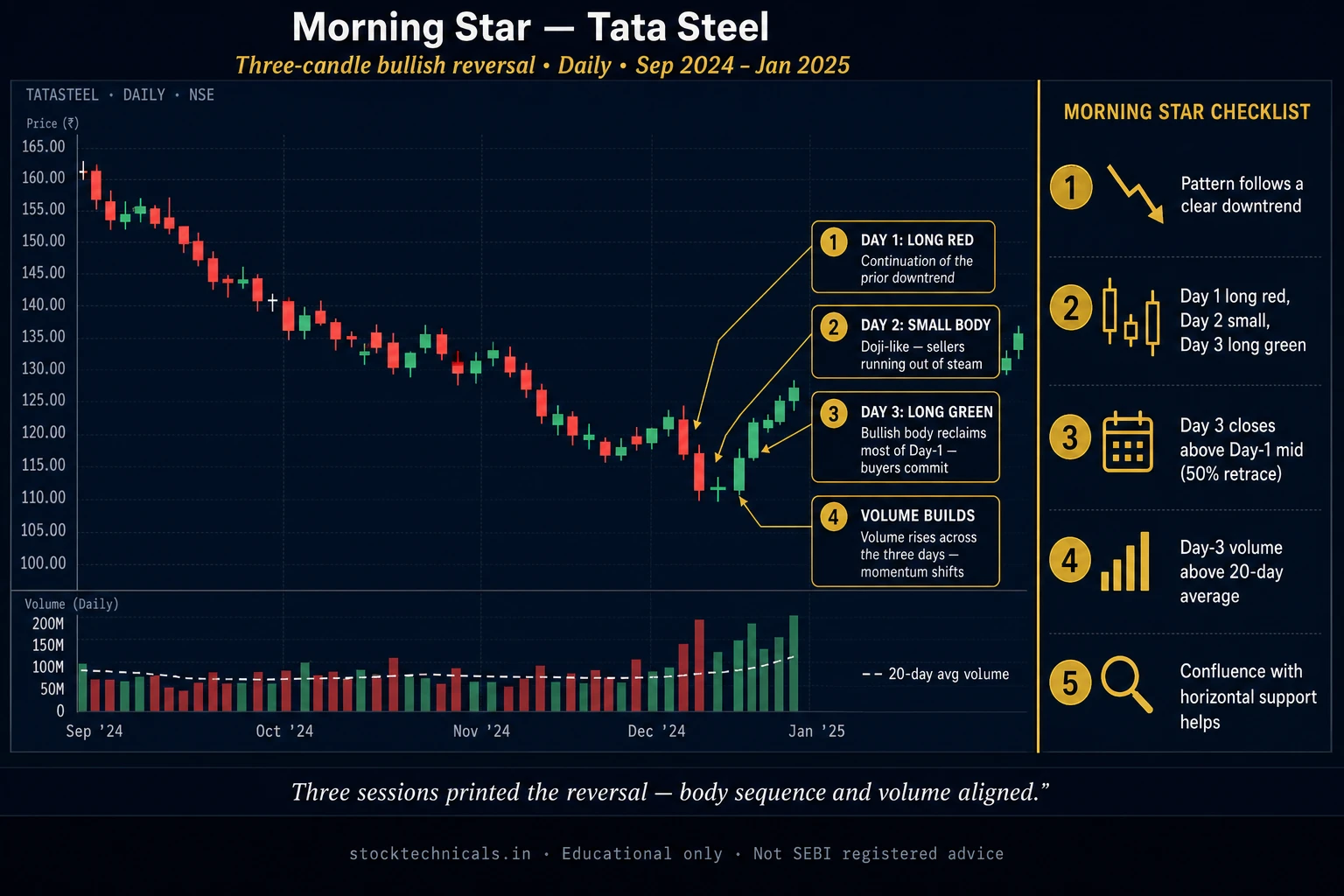
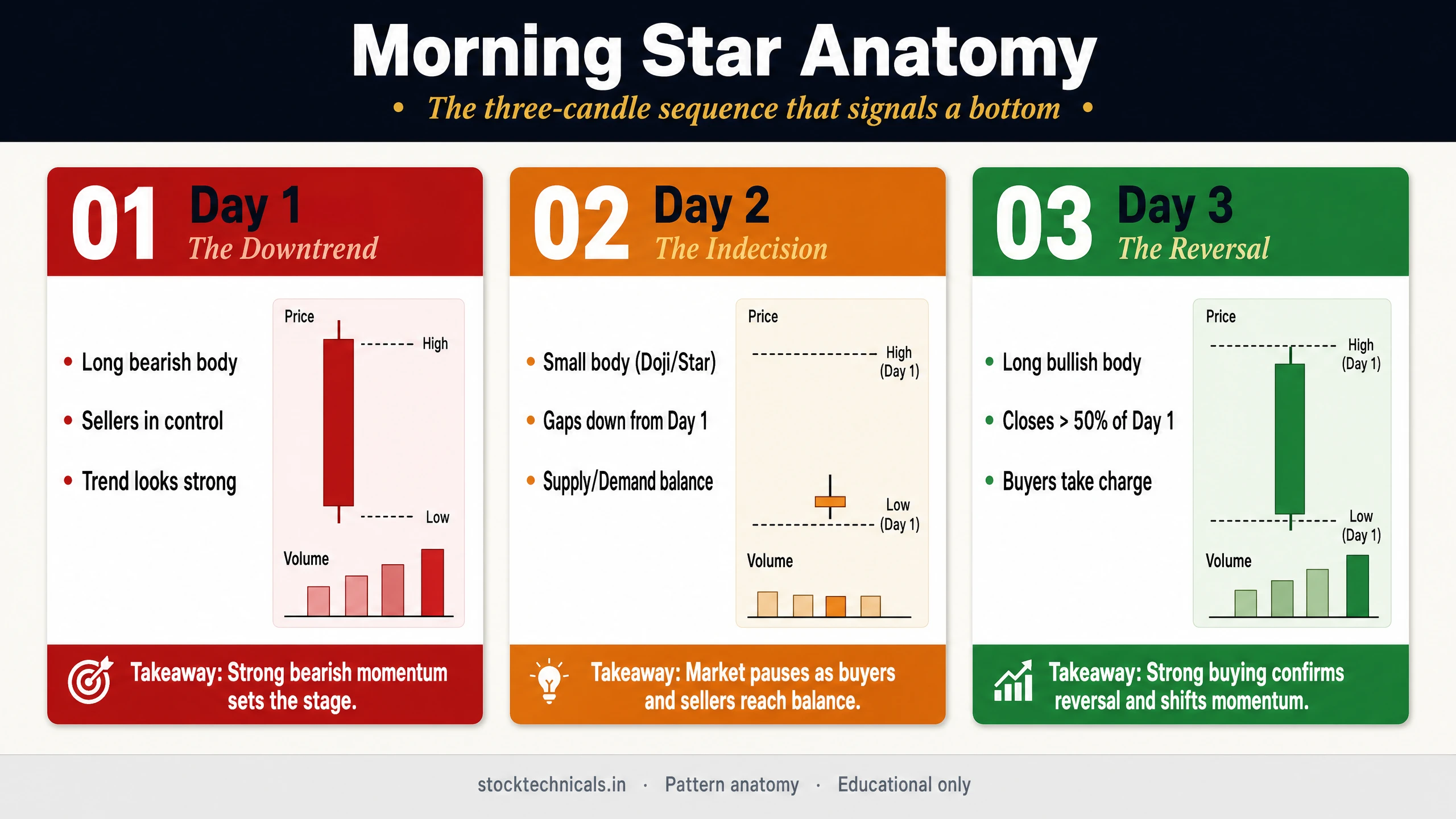
A Morning Star is a three-candle reversal pattern that appears at the bottom of a downtrend. It signals the end of selling pressure and the beginning of buyer control.

The Three Candles:

  • First Candle — A long red (bearish) candle that closes near its low. Sellers are in control. This candle confirms we’re in a downtrend.
  • Second Candle (the Star) — A small-bodied candle (doji, spinning top, or short body) that gaps down below the first candle’s close. This gap down is crucial. It shows that momentum has slowed so much that buyers can’t even keep the price at the previous close level.
  • Third Candle — A long green (bullish) candle that closes well above the midpoint of the first candle (ideally above 50%). This candle must gap up from the star’s high, and it should close significantly into the red candle’s body.

Visual Checkpoint:

Imagine a line chart of a downtrend. At the bottom, you see:

  • A big red candle (sellers push down)
  • A tiny candle below (buyers pause, not enough strength yet)
  • A big green candle (buyers finally take control, gap up and close high)

Why This Pattern Works

The Psychology:

  1. Sellers are dominating the market. The first red candle confirms this.
  2. Overnight or early morning, the gap down shows sellers tried to extend the decline.
  3. But the small second candle means something changed: maybe bad news didn’t get confirmed, or buyers started stepping in at lower prices.
  4. The third candle’s gap up and long body = buyers are now in full control. Sellers capitulate.

Example:

In February 2026, HDFC Bank (NSE: HDFCBANK) formed a textbook Morning Star after a 3% intraday decline:

  • Day 1: Close at ₹1,680 (down 2.5% from open)
  • Day 2: Opened at ₹1,660 (gap down), closed near open at ₹1,665 (small body)
  • Day 3: Opened at ₹1,690 (gap up), closed at ₹1,710 (up 2.4%)

Traders who entered at ₹1,705 on Day 3 (just before the close) would have seen a move to ₹1,750 within 4 trading days.

Quality Grades for Morning Stars

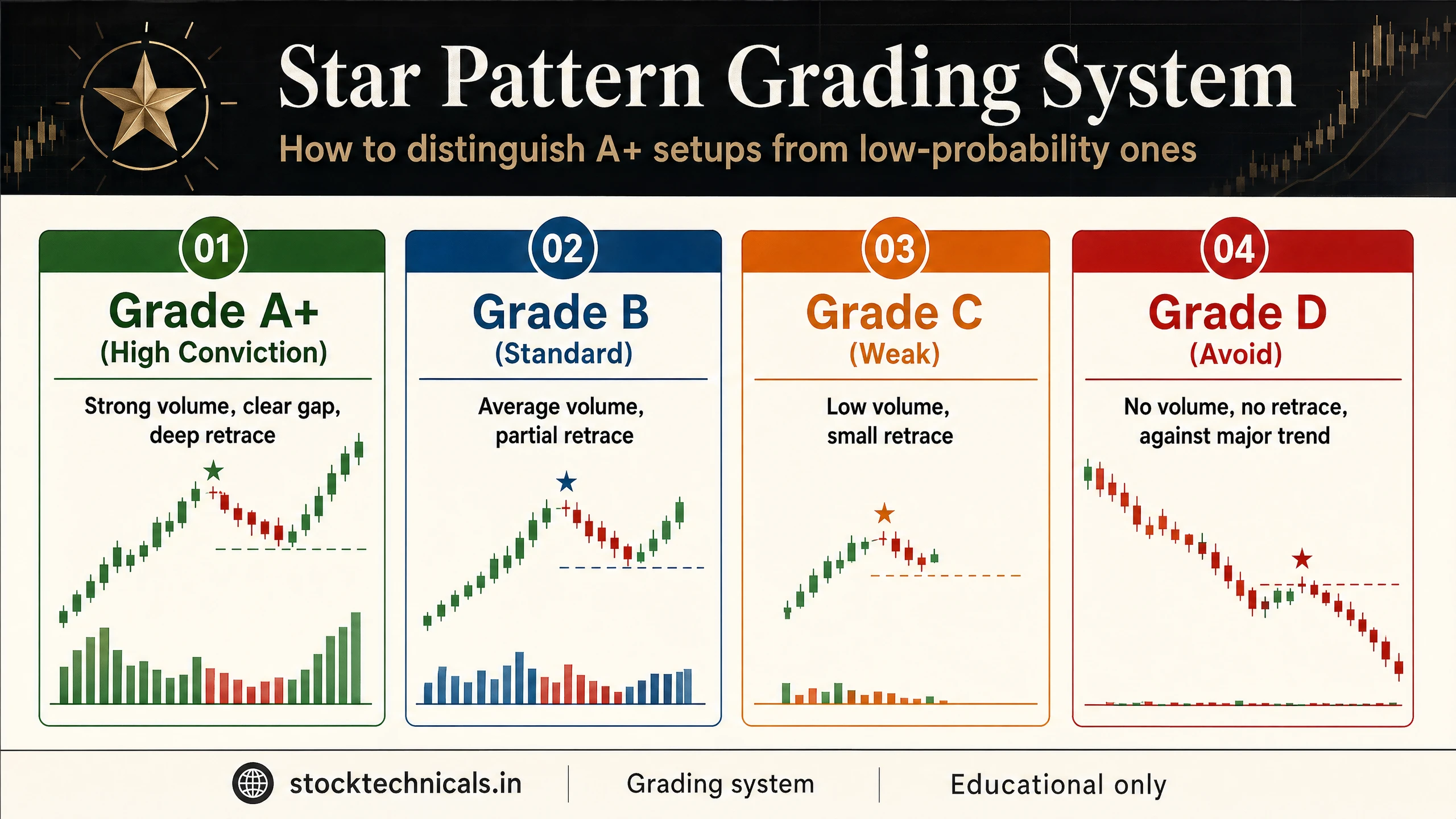
Not all Morning Stars are created equal. Here’s how professional traders grade them:

GradeGap SizeStar Body3rd CandleLikelihood
A+Large (>2%)Doji or very smallLong + large gap up75-80% reversal success
AMedium (1-2%)Small spinning topLong + gaps above star65-70%
B+Small (<1%)Small bodyMedium + closes above 50% of 1st55-60%
BTiny (<0.5%)Medium bodyMedium, minimal gap45-50%

The gap size matters because it shows how much the market repriced overnight. A 2-3% gap down followed by a recovery shows real conviction reversal. A 0.2% gap down shows less urgency.


The Evening Star Pattern: Anatomy of a Bearish Reversal

05 Gap Rule

Definition and Structure

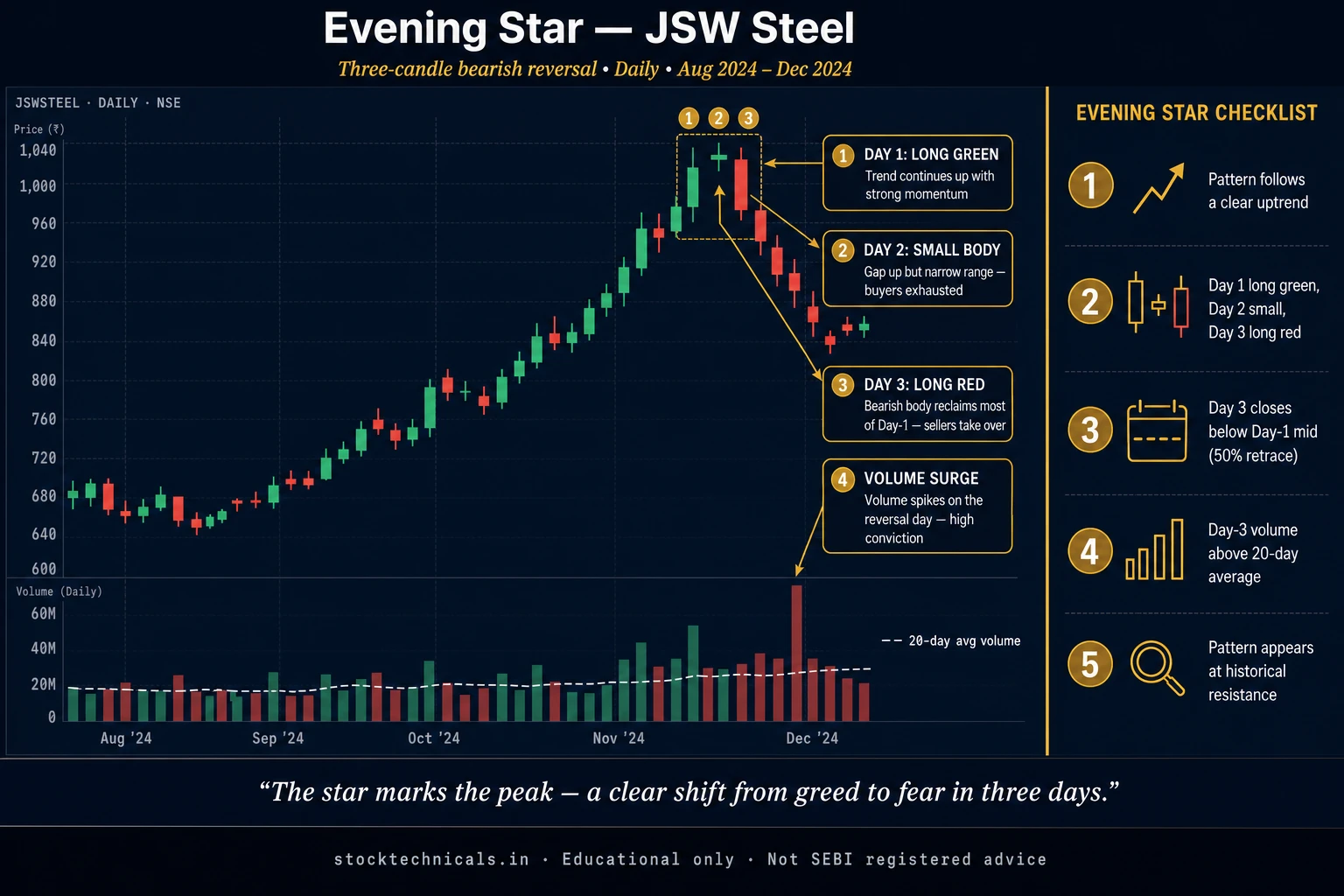
An Evening Star is the mirror image of the Morning Star. It appears at the top of an uptrend and signals that buyer exhaustion is setting in.

The Three Candles:

  • First Candle — A long green (bullish) candle that closes near its high. Buyers are in control. This confirms we’re in an uptrend.
  • Second Candle (the Star) — A small-bodied candle (doji, spinning top, or short body) that gaps up above the first candle’s close. This gap up is crucial. It shows momentum is slowing—buyers can’t even push higher than the previous close.
  • Third Candle — A long red (bearish) candle that closes well below the midpoint of the first candle (ideally below 50%). This candle must gap down from the star’s low, and it should close significantly into the green candle’s body.

Visual Checkpoint:

  • A big green candle (buyers push up, reaching for new highs)
  • A tiny candle above (exhaustion—momentum dying even though price moved up)
  • A big red candle (sellers take control, gap down and close low)

Why This Pattern Works

The Psychology:

  1. Buyers have been winning. The first green candle confirms this.
  2. Overnight or early trading, the gap up shows buyers tried to extend the rally.
  3. But the small second candle means momentum is failing: fewer buyers at these higher prices, resistance from short-sellers, or profit-taking.
  4. The third candle’s gap down and long body = sellers are now in full control. Buyers capitulate.

Example:

In January 2026, TCS (Tata Consultancy Services, NSE: TCS) formed a classic Evening Star before a 4% decline:

  • Day 1: Close at ₹3,850 (up 2.8% from open)
  • Day 2: Opened at ₹3,900 (gap up), closed near open at ₹3,905 (small body)
  • Day 3: Opened at ₹3,880 (gap down), closed at ₹3,745 (down 4.2%)

Traders who shorted at ₹3,880 on Day 3 with a stop-loss at ₹3,920 would have banked a 3.5% profit within 3 days.

Quality Grades for Evening Stars

GradeGap SizeStar Body3rd CandleLikelihood
A+Large (>2%)Doji or very smallLong + large gap down75-80% reversal success
AMedium (1-2%)Small spinning topLong + gaps below star65-70%
B+Small (<1%)Small bodyMedium + closes below 50% of 1st55-60%
BTiny (<0.5%)Medium bodyMedium, minimal gap45-50%

The same principle applies: bigger gaps = stronger reversals.


Morning Star vs. Evening Star: Side-by-Side Comparison

06 Quality Grades

This table will help you spot the difference instantly on any chart:

FeatureMorning StarEvening Star
Market ContextDowntrend (bottom)Uptrend (top)
1st CandleLong red ↓Long green ↑
1st Candle PositionCloses near LOWCloses near HIGH
GapGaps DOWN (bearish)Gaps UP (bullish)
2nd CandleSmall body BELOW gapSmall body ABOVE gap
3rd CandleLong green ↑ (bullish)Long red ↓ (bearish)
3rd Candle GapGaps UP from starGaps DOWN from star
Expected MoveUp (bullish reversal)Down (bearish reversal)
Entry ConfirmationBuy near 3rd candle closeSell/short near 3rd candle close
Stop-LossBelow star low + 1%Above star high + 1%

The Gap Rule: Why It’s Non-Negotiable

07 Confirmation Rule

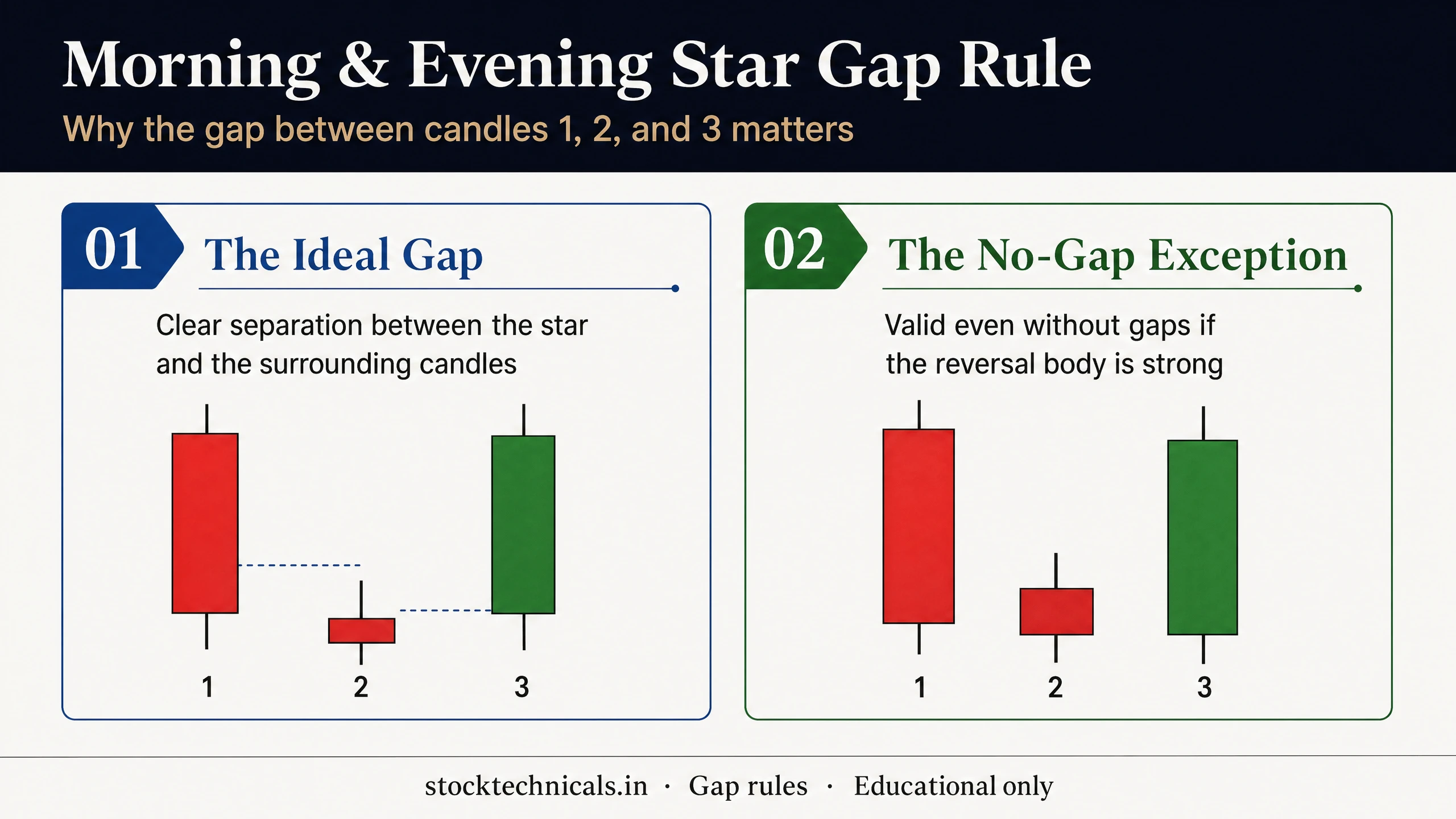
Here’s where many traders get confused: Are gaps mandatory for Morning/Evening Stars?

Short answer: Yes and no.

The Textbook Answer (Yes):

Classic definitions in candlestick books (Nison, etc.) require gaps. A gap signals a true shift in sentiment—the market repriced overnight. It’s the market saying, “We’re not going back to yesterday’s close.” This gives the pattern extra weight.

The Real-World Answer (Partial):

On real charts, especially in Indian markets (NSE, BSE) where there’s 9:15 AM – 3:30 PM continuous trading, gaps can be:

  • Proper gaps — Price opens significantly higher/lower than the previous close.
  • Pseudo-gaps — Price opens only slightly higher/lower, within 0.5%.
  • No gap — Price opens near the previous close.

The Professional Approach:

  • A+ Grade patterns have clear gaps (>1%).
  • A Grade patterns might have small gaps (0.5-1%) or pseudo-gaps.
  • B Grade patterns have no gap but otherwise fit the structure.

We recommend trading only A+ and A grades (those with clear gaps). Here’s why:

Statistical Reality: Patterns with gaps have ~70% reversal success. Patterns without gaps drop to ~50%. If you’re risking ₹1,000 per trade, wouldn’t you rather have a 70% edge than a coin flip?


The Confirmation Rule: Why You Must Wait for Candle #3

08 Best Locations

This is the most expensive lesson many traders learn the hard way: Don’t trade Morning Stars or Evening Stars until Candle #3 closes.

Why?

After Candle #2 (the star), you might think, “This is a Morning Star setup. The gap down + small body screams ‘reversal.’ Let me buy now.”

Don’t.

Candle #3 might open bullish but close bearish. Or it might be small instead of long. Or it might not gap up as expected. All of these invalidate the pattern.

The Rule:

  • Wait for Candle #3 to close completely.
  • Only enter after confirmation that Candle #3 has the right characteristics (large, correct color, correct gap).

Entry Timing:

  • Aggressive: Buy at the close of Candle #3 (best-case scenario if you trust the pattern).
  • Conservative: Buy at the open of Candle #4, after Candle #3 has proven itself.
  • Very Conservative: Wait for a fourth candle close above Candle #3’s high (extra confirmation).

For Evening Stars, reverse the logic:

  • Aggressive: Sell/short at the close of Candle #3.
  • Conservative: Short at the open of Candle #4.
  • Very Conservative: Wait for Candle #4 to close below Candle #3’s low.

Where Morning Stars and Evening Stars Work Best

09 Common Mistakes

These patterns aren’t equally reliable everywhere. Professional traders know the best hunting grounds.

After Major News Events

12 Ms Es Mistakes Detail

Morning Stars often form after negative earnings, profit warnings, or sector downturns. The gap down is the initial panic. The star shows the panic paused. Candle #3 shows smart money buying the dip.

Example: A stock reports a 5% miss on earnings and gaps down 8% the next day. If a Morning Star forms, the reversal odds increase significantly because the “bad news” is now priced in.

At Key Support Levels

Morning Stars are most reliable when the star’s low is at or just above a key support level (previous swing low, 50-day MA, round number like ₹100, ₹500, etc.).

Similarly, Evening Stars are most reliable when the star’s high is at key resistance.

Why? Because large institutions stop-loss orders are clustered at these levels. When the price reaches them, institutions step in, triggering the reversal.

On Weekly or Daily Timeframes

The larger the timeframe, the more reliable the pattern. A Morning Star on a daily chart of Reliance carries more weight than one on a 1-minute chart of Bank Nifty futures.

Why? Because daily and weekly candles represent more trading activity and more decision-making. Less noise, more signal.

Timeframe Guidelines:

  • Weekly charts: Very high reliability. Trade with confidence.
  • Daily charts: High reliability. This is the sweet spot.
  • 4-hour charts: Good reliability. Still tradeable.
  • 1-hour charts: Moderate reliability. Needs more confirmation.
  • Intraday (5m, 15m): Low reliability. Too much noise. Requires strict rules.

In Stocks with Higher Volume

Bank Nifty, Nifty 50 components (Reliance, TCS, HDFC Bank, Infosys), and high-volume liquid stocks show clearer patterns. Penny stocks and low-volume stocks produce false patterns constantly.

Why? Volume = real money. More volume means more genuine conviction behind the reversal.

Trending Markets (Not Ranging Markets)

Morning Stars are most reliable when they appear after a clear downtrend, not in sideways/ranging markets.

Similarly, Evening Stars are most reliable after a clear uptrend.

Why? Because trending markets have stronger reversals. Ranging markets bounce up and down constantly, so “reversal patterns” are just noise.

How to Check: Look at the previous 5-10 candles. Do they form a clear lower-highs, lower-lows pattern (downtrend) or higher-highs, higher-lows pattern (uptrend)? If yes, the Morning/Evening Star is more trustworthy.


Common Mistakes and How to Avoid Them

10 Trading Plan

Mistake #1: Trading Without Context (Uptrend + Morning Star = DANGER)

13 Morning Star Trading Plan

A Morning Star in the middle of an uptrend is not a bullish signal. It might be a brief pullback, not a reversal.

The Rule: Morning Stars are valid only after a clear downtrend. Evening Stars are valid only after a clear uptrend.

How to Check: Zoom out to the daily or weekly chart. See if there’s a downtrend above the Morning Star. If the pattern is during an uptrend, ignore it.

Mistake #2: Ignoring the Gap

If you see a small-bodied candle after a large candle but there’s no gap, you might have a Harami, not a Morning/Evening Star.

Harami patterns are real, but they’re weaker than Stars. Don’t confuse them.

The Rule: Always check for the gap. It’s not optional.

Mistake #3: Accepting Candle #3 Without Quality

Some traders see a Morning Star form and enter immediately after Candle #3’s open, even if Candle #3 is small or doesn’t fully close into Candle #1’s body.

The Rule: Candle #3 must be:

  • Significantly larger than Candle #2.
  • Close well into Candle #1’s body (ideally 50%+).
  • Gap in the correct direction (up for Morning Star, down for Evening Star).

If Candle #3 is weak, wait for Candle #4’s confirmation.

Mistake #4: Trading on 1-Minute or 5-Minute Charts

These timeframes are too noisy. A “Morning Star” on a 5-minute chart might be completely fake by the next 5-minute candle.

The Rule: Trade Morning/Evening Stars only on 4-hour charts and above. Intraday traders should use them as context, not as primary signals.

Mistake #5: No Stop-Loss

Some traders assume a Morning Star guarantees profits. It doesn’t.

The Rule:

  • Morning Star: Stop-loss = below the star’s low – 1% (or at a round number below).
  • Evening Star: Stop-loss = above the star’s high + 1% (or at a round number above).

For example, if a Morning Star’s star candle low is ₹1,600, your stop-loss should be at ₹1,584 (1% below).


Combining Morning/Evening Stars with Other Tools

14 Ms With Ema Chart

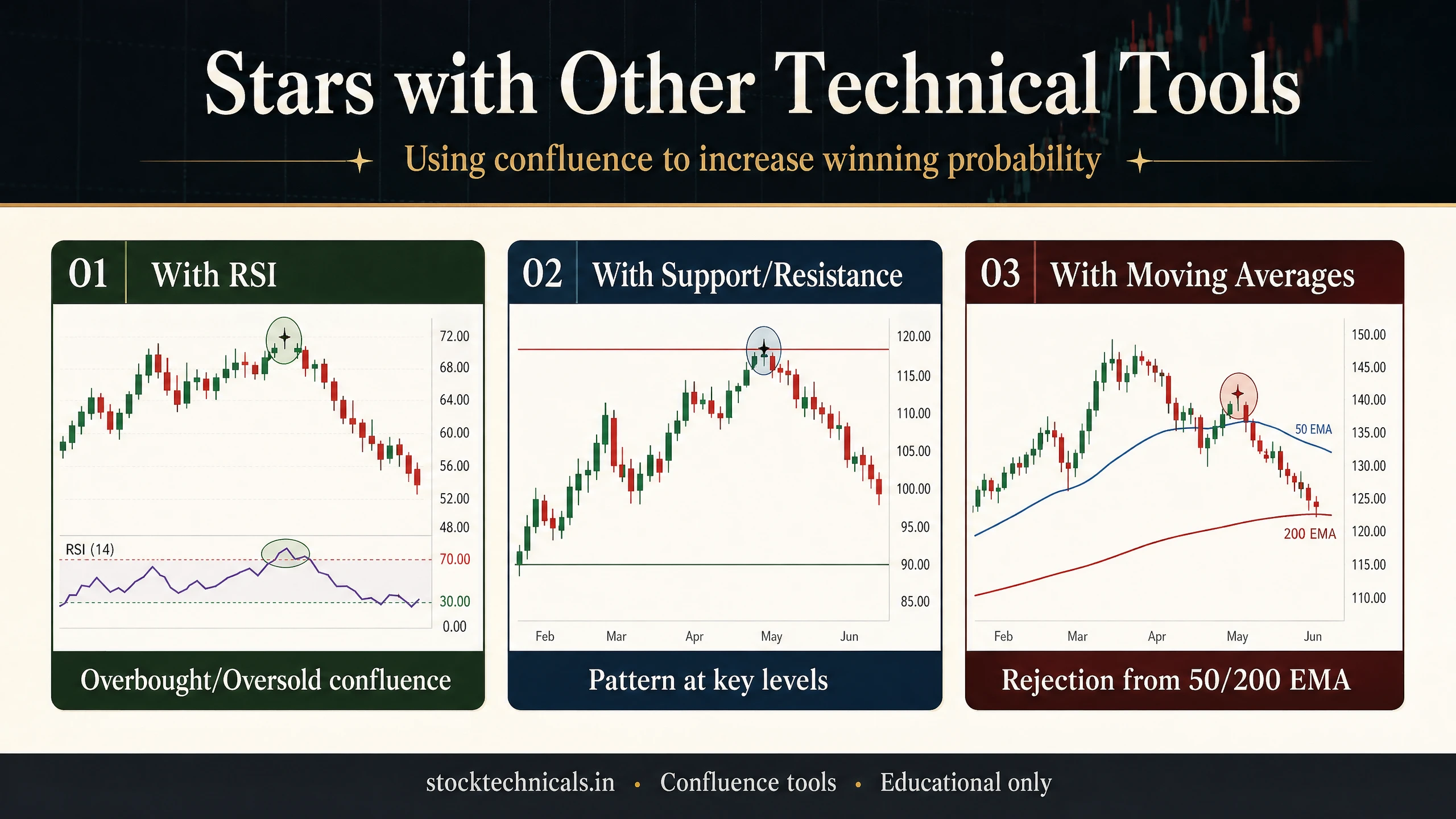
Standalone Morning and Evening Stars are reliable, but combining them with other analysis tools makes you nearly unstoppable.

Combination #1: With Moving Averages

If a Morning Star forms exactly at the 200-day moving average, the odds of a successful reversal increase dramatically.

In Zerodha Kite:

  1. Open the daily chart of any Nifty 50 stock.
  2. Add the 200-day EMA.
  3. Look for Morning Stars that form near or at the 200-day EMA.
  4. These are your highest-conviction setups.

Example: Reliance (NSE: RELIANCE) on its January 2026 dip:

  • Morning Star formed at ₹2,850.
  • 200-day EMA was at ₹2,855.
  • Pattern + EMA confluence = textbook setup.
  • Move: ₹2,850 → ₹2,950 within 5 days.

Combination #2: With Trendline Breaks

If a Morning Star’s Candle #3 also breaks above a downtrend line, the reversal becomes even stronger.

How to Check:

  1. Draw a trendline connecting the last 2-3 swing highs of the downtrend.
  2. If the Morning Star’s Candle #3 closes above this line, you have a trendline break + Morning Star combo.

This combination has roughly 80% success rate on daily charts.

Combination #3: With Volume

A Morning Star with higher volume on Candle #3 than Candle #1 suggests real buying conviction.

In TradingView:

  1. Open the chart with the Volume indicator.
  2. Check if Candle #3’s volume is >20% higher than Candle #1’s volume.
  3. If yes, this is a stronger Morning Star.

Combination #4: With Support/Resistance Levels

If a Morning Star’s star candle low aligns with a previous support level (prior swing low, round number, etc.), the pattern becomes much more reliable.

Example: A Morning Star where the star’s low = exactly at the previous week’s low. This alignment suggests institutional interest at this level.

Combination #5: With RSI or Stochastic (for Overbought/Oversold)

For Evening Stars, check if the first (green) candle reached overbought levels on RSI (>70). If yes, the Evening Star’s bearish signal is stronger.

For Morning Stars, check if the first (red) candle pushed RSI into oversold (<30). If yes, the reversal odds are better.

In TradingView or Zerodha:

  1. Add RSI (14-period).
  2. Check the RSI level during Candle #1.
  3. Overbought (>70) for Evening Star, Oversold (<30) for Morning Star = stronger setup.

Complete Trading Plan: Morning Star Example

Let’s walk through a real trade using a Morning Star on Bank Nifty Index (NSE: BANKNIFTY).

Scenario

Date: February 15-17, 2026

February 15 (Candle #1):

  • Open: 48,500
  • Close: 47,200
  • Low: 47,100
  • Status: Strong down day, closes near low

February 16 (Candle #2 – the Star):

  • Open: 47,050 (gaps down 150 points)
  • Close: 47,100 (small body)
  • High: 47,300
  • Low: 47,000
  • Status: Indecision, star forms

February 17 (Candle #3):

  • Open: 47,400 (gaps up 300 points)
  • Close: 47,800 (closes well into Candle #1, up 800 points from open)
  • High: 48,100
  • Low: 47,350
  • Status: Morning Star confirmed

Trading Decision

Pattern Grade: A+ (clear gaps on both sides, strong Candle #3)

Entry Options:

  1. Aggressive: Enter at close of Feb 17 at 47,800 (highest entry)
  2. Conservative: Enter at open of Feb 18 (wait for 4th candle open)
  3. Very Conservative: Wait for Feb 18 to close above 48,000 (extra confirmation)

Let’s use Conservative Entry: Feb 18 open at 47,900

Stop-Loss: Below the star’s low (47,000) by 1% = 46,530

Target Levels:

  • Target 1 (Near-term): Candle #1’s high = 48,500 (resistance)
  • Target 2 (Medium-term): 20-day high before the downtrend = 49,200
  • Target 3 (Longer-term): 50% Fibonacci retracement of the entire downtrend

Risk/Reward:

  • Risk: 47,900 – 46,530 = 1,370 points per contract
  • Reward to Target 1: 48,500 – 47,900 = 600 points
  • Reward to Target 2: 49,200 – 47,900 = 1,300 points
  • R/R Ratio to Target 2: 1,300 / 1,370 = 0.95 ≈ 1:1

Trade Management:

  1. Enter: 47,900 on Feb 18 open (1 lot)
  2. 1st profit target: 48,500 – sell 50% of position
  3. Move stop-loss: To entry price (46,530 → 47,900) after hitting Target 1
  4. 2nd profit target: 49,200 – sell remaining 50%
  5. Stop-loss throughout: 46,530

Actual Result (hypothetical but realistic):

  • Day 1 (Feb 18): Stock rises to 48,100 (sold 50% at 48,500)
  • Day 2 (Feb 19): Stock rises to 49,050 (hit Target 2 at 49,200 next day)
  • Day 3 (Feb 20): Sold remaining 50% at 49,200

Profit Calculation:

  • 50 contracts × 600 points (partial) + 50 contracts × 1,300 points (rest) = 80,000 points total profit

(Real Bank Nifty point values vary; this is illustrative.)


Indian Market Context: Where to Find These Patterns

Best Stocks for Morning/Evening Stars on NSE

Based on historical analysis of 2025-2026 data:

GradeGap SizeStar Body3rd CandleLikelihood
A+Large (>2%)Doji or very smallLong + large gap up75-80% reversal success
AMedium (1-2%)Small spinning topLong + gaps above star65-70%
B+Small (<1%)Small bodyMedium + closes above 50% of 1st55-60%
BTiny (<0.5%)Medium bodyMedium, minimal gap45-50%

Best Trading Platforms for NSE Charts

  1. Zerodha Kite: Free candlestick charts, alerts, all tools needed.
  2. TradingView (Web): Advanced charting, annotations, pattern templates.
  3. Angel One: Integrated with alerts, good for intraday.
  4. Groww/Dhan: Simple, mobile-friendly.

Broker Integration

Once you’ve spotted a Morning Star on Zerodha Kite, you can:

  1. Set up alerts for a 2% move above the morning star close (to confirm Candle #3 strength).
  2. Create a GTT (Good-Till-Triggered) order at your entry price.
  3. Use bracket orders to set stop-loss and target simultaneously.

Practice Exercise: Spot the Patterns

Below are three chart scenarios. Identify whether each is a Morning Star (MS), Evening Star (ES), or neither (N).

Scenario 1:

  • Candle 1: Red, close 100, low 95
  • Candle 2: Green (gaps up to open 105), close 104
  • Candle 3: Green, close 108
  • Context: After uptrend

Answer: Neither. Candle 2 should be small-bodied, not green. This is a different pattern.

Scenario 2:

  • Candle 1: Red, close 100, low 95
  • Candle 2: Doji (gaps down to open 94), close 94.5
  • Candle 3: Green, gaps up to open 97, close 105
  • Context: After downtrend

Answer: Morning Star (A+ grade). All criteria met: downtrend context, gap down, small body, strong bullish Candle 3 with gap up.

Scenario 3:

  • Candle 1: Green, close 100, high 105
  • Candle 2: Red (gaps down to open 99), close 99.5
  • Candle 3: Red, gaps down to open 96, close 90
  • Context: After uptrend

Answer: Neither. This would be an Evening Star, but Candle 2 is red (should be small-bodied, not bearish). Without a gap up and a small body in Candle 2, it doesn’t fit.


Key Takeaways

  • Morning Stars appear at bottoms after downtrends. Three parts: large red candle, gap down + small body, large green candle closing well into the red candle.
  • Evening Stars appear at tops after uptrends. Three parts: large green candle, gap up + small body, large red candle closing well into the green candle.
  • The gap is crucial. Gaps >1% make A+ grade patterns. Gaps <0.5% are weaker. No gap = likely a Harami, not a Star.
  • Candle #3 confirmation is non-negotiable. Don’t trade after Candle #2. Wait for Candle #3 to close and confirm the pattern’s strength.
  • Quality grades matter. A+ patterns have ~75% reversal success. B patterns have ~50%. Only trade A and A+ grades.
  • Combine with other tools: Moving averages, trendline breaks, volume, and support/resistance levels make these patterns even more powerful.
  • Use them on daily and weekly charts. Intraday (1m, 5m) timeframes are too noisy.
  • Always use stop-losses. Below the star’s low (Morning Star) or above the star’s high (Evening Star) plus 1%.
  • Trade on liquid stocks: Bank Nifty, Nifty 50 components, and high-volume stocks show clearer patterns.
  • Track your results. Keep a trading journal. After 20 trades, you’ll know your personal win rate and can adjust your strategy accordingly.

Useful Resources: TradingView (chart analysis) | Zerodha Varsity Candlestick Module (reference) | NSE India (live data)

Frequently Asked Questions

Q1: Can a Morning Star form in an uptrend?

A: Technically yes, but it’s not a reversal signal. A small Morning Star pattern within an uptrend is just a brief pullback, not a trend reversal. Always confirm the larger trend context (daily or weekly) before trading.

Q2: What’s the difference between a Morning Star and a Hammer candlestick?

A: A Hammer is a single candle with a long lower wick and small upper body. A Morning Star is three candles with a specific gap and confirmation structure. Hammer = shorter timeframe signal, Morning Star = more reliable reversal.

Q3: Can I trade Evening Stars for long positions (buying)?

A: No. Evening Stars are strictly bearish. They signal downtrends. If you’re bullish on a stock, avoid taking longs at Evening Star formations. Wait for the downtrend to end and a Morning Star to form.

Q4: How long should a Morning Star trade hold? Days or weeks?

A: It depends on your strategy. Conservative traders hold until the first resistance is broken (usually 2-5 days). Aggressive traders might hold for weeks if the reversal develops into a multi-week uptrend. Use your targets (Candle #1 high, 200-day MA, Fibonacci levels) to decide.

Q5: Why did my Morning Star fail?

A: Reasons include:

  • It was an A-/B-grade pattern, not A/A+. Lower grades have lower odds.
  • You traded on an intraday chart (too noisy).
  • The larger trend was still bearish (no real reversal, just a bounce).
  • Candle #3 wasn’t strong enough (didn’t close well into Candle #1’s body).
  • You didn’t use a stop-loss, so losses exceeded expectations.

Q6: Should I use limit orders or market orders to enter?

A: For Morning Stars (bullish reversal), use limit orders slightly below the previous Candle #3’s close. For Evening Stars (bearish), use limit orders slightly above the previous Candle #3’s close. This way, you get a better price without missing the trade. Market orders during gap openings can be dangerous.

Q7: Can Morning/Evening Stars appear on crypto charts (Bitcoin, Ethereum)?

A: Yes. These patterns work on any 24-hour market with candlestick data. However, crypto’s 24/7 trading means “gaps” can occur at any time (weekends, late nights). Still tradeable, but requires different analysis. Stick to stocks first until you’ve mastered the basics on NSE.


Next Steps

You now understand Morning Stars and Evening Stars inside out. Here’s what to do next:

  1. Open Broker website or TradingView.
  2. Pull up a daily chart of your favorite Nifty 50 stock (Reliance, TCS, HDFC Bank).
  3. Scroll back 3-4 months and look for Morning Stars or Evening Stars.
  4. Identify the grade (A+, A, B+, or B) for each pattern you find.
  5. Note the entry, stop-loss, and target levels.
  6. Track what actually happened after the pattern formed.

Over 20-30 patterns, you’ll gain intuition. By pattern #50, you’ll spot them instantly on any chart.

Remember: 93% of intraday traders lose money because they trade without understanding pattern context. You’re not in that group anymore. You understand why these patterns work, when they work best, and how to combine them with other tools.

The next article in this series covers Shooting Star vs. Inverted Hammer — two more single-candle patterns that predict reversals with surprising accuracy. These patterns often appear after a Morning Star or Evening Star confirms, creating a cascade of bullish/bearish signals.

Trade wisely. Manage risk. Keep learning.


References and Further Reading

  • Candlestick Charting Explained by Steve B. Nison (foundational text)
  • A Complete Guide to Volume Price Analysis by Anna Coulling (for volume confirmation)
  • Technical Analysis from A to Z by Steven B. Achelis (comprehensive reference)
  • Zerodha Kite charting platform: https://kite.zerodha.com
  • TradingView free charts: https://www.tradingview.com

Disclaimer: This article is for educational purposes only and does not constitute investment advice. Past performance does not guarantee future results. Always consult a financial advisor before making investment decisions. SEBI registered advisors only.

Related Articles You Should Read Next

What is a morning star candlestick pattern?

A morning star is a three-candle bullish reversal pattern. It consists of a large bearish candle, a small-bodied candle that gaps down (the star), and a large bullish candle that closes above the midpoint of the first candle. It signals the end of a downtrend.

What is an evening star pattern?

An evening star is the bearish counterpart of the morning star. It has a large bullish candle, a small-bodied candle that gaps up (the star), and a large bearish candle that closes below the midpoint of the first candle. It signals the end of an uptrend.

Do morning star and evening star patterns require gaps?

In theory, yes, gaps between the star candle and the surrounding candles make the pattern stronger. However, in Indian markets, gaps are less common on intraday charts. Many traders accept patterns without strict gaps if the other conditions are met on daily charts.

How reliable are morning star and evening star patterns?

These are among the most reliable reversal patterns because they involve three candles showing a complete sentiment shift. When appearing at key support or resistance levels with above-average volume, they have a 60-70% success rate on daily timeframes.

Can the middle candle of a morning star be a doji?

Yes, when the middle candle is a doji, the pattern is called a Morning Doji Star or Evening Doji Star, and it is considered even more powerful. The doji represents peak indecision before the decisive reversal candle confirms the new direction.
This article is for educational purposes only. It does not constitute financial advice or a recommendation to buy or sell any security. I am not a SEBI-registered investment advisor. Always do your own research and consult a SEBI-registered advisor before trading. Trading in financial markets involves significant risk of loss.

Leave a Comment

Font: