
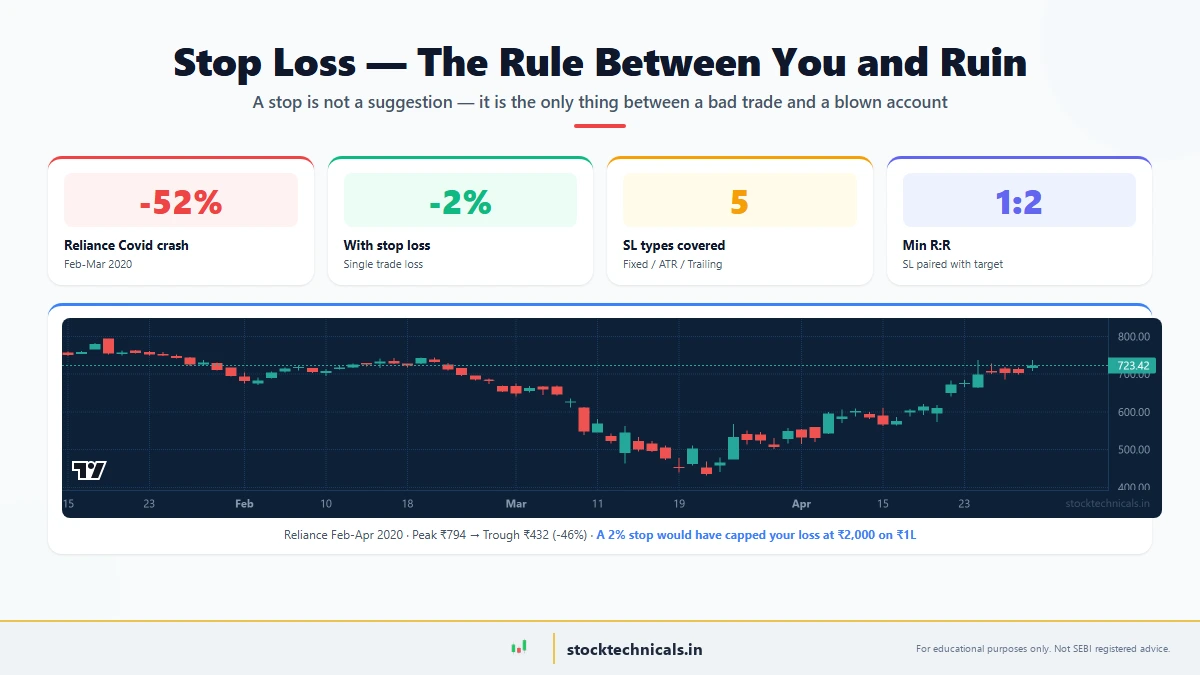
Quick Answer: A stop loss is a pre-set exit order that limits your loss on a trade if price moves against you. It must be placed before you enter, based on chart structure — not how much loss you’re comfortable with emotionally. The 5 main strategies: Fixed Percentage, Support-Based, ATR-Based, Trailing, and Hybrid.
Published March 9, 2026 · Last refreshed April 27, 2026. Prices and data are compiled with reasonable care but — always confirm against your broker before trading.
Stop Loss Strategies: Protecting Your Trading Capital
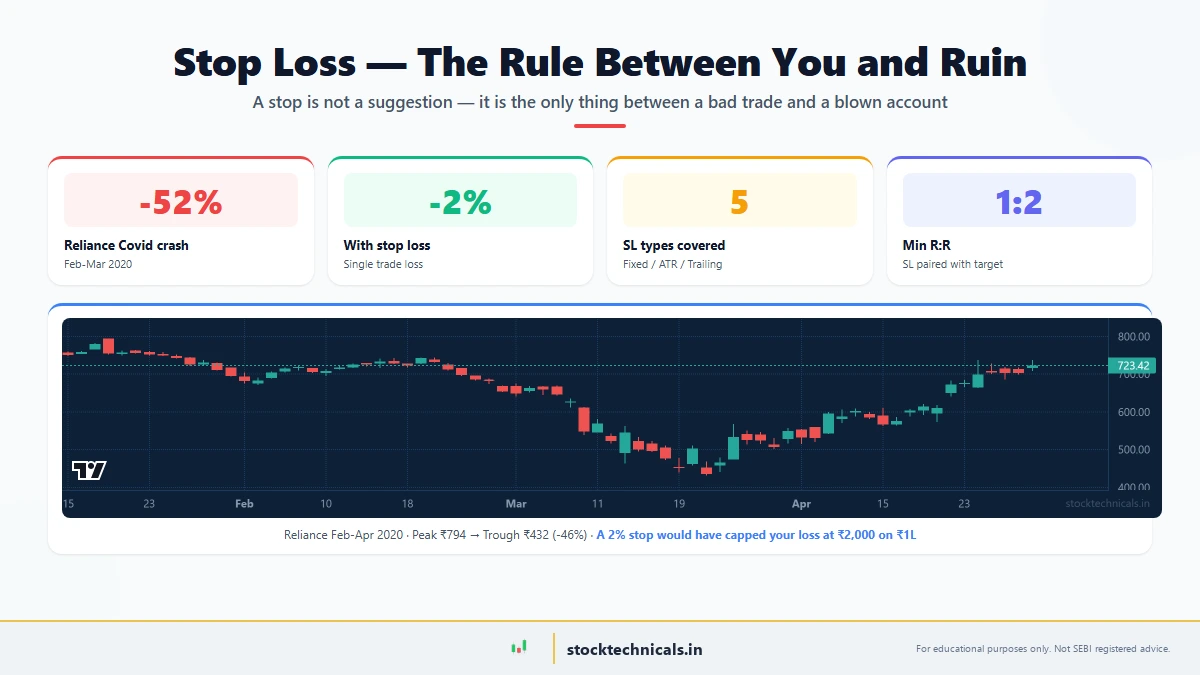 NSE: RELIANCE) Covid -52% vs 2% stop, 5 SL types, 1:2 R:R minimum." class="wp-image-13919"/>
You just entered a trade on Reliance. The stock climbs 2% in your favor. You're excited. Then the market turns, and suddenly you're down 8%. You're frozen. Should you exit? Hold? You didn't plan for this.
This is where stop loss strategies save you—and your capital.
A stop loss isn't optional. It's not a suggestion. It's the seatbelt of trading, and without it, you're driving blindfolded. In this complete guide, you'll learn exactly how to place, manage, and execute stop losses like a pro.
Key Takeaways
- A stop loss defines your maximum risk on a trade — without it, your loss is unlimited
- 5 stop loss types: Fixed Percentage (simple), Support-Based (chart-driven), ATR-Based (volatility-adjusted), Trailing (trend-following), Hybrid (combines methods)
- ATR-based stop losses automatically widen in volatile markets and tighten in calm ones — the most adaptive method
- Never move your stop loss further away once placed — this is the #1 mistake that turns small losses into catastrophic ones
- Zerodha GTT orders and TradingView alerts allow automatic stop loss execution even when you're not watching
- Support-based stop loss placement: place SL 10-15 points below a key support level, not at the exact level
Section 1: What Is a Stop Loss and Why It Protects Your Capital
A stop loss (SL) is a predetermined price level where you exit a losing trade automatically. You set it before entering, and when the price hits that level, your position closes—cutting your loss and protecting your remaining capital.
Here's why this matters:
Without a stop loss, a small loss can become catastrophic. One bad trade can wipe out weeks of profitable trading. A study by SEBI on intraday traders in India found that 93% of retail traders lose money—and most of that is because they didn't have a plan to exit.
Stop losses serve three critical purposes:
1. Capital Preservation — Your most important asset is your capital. Lose it, and you're out of the game. A stop loss ensures that no single trade takes more than you can afford.
2. Emotional Control — Trading without a stop loss forces you to make emotional decisions. With a stop loss, the decision is already made. You follow the plan.
3. Risk Management — A stop loss is the foundation of risk management. It tells you how much you're risking on this trade, which lets you calculate position sizing correctly.
Trading Rule: "A trader without a stop loss isn't trading—they're gambling."
Section 2: Fixed Percentage Stop Loss


The simplest approach: exit when you lose a fixed percentage of your entry price.
What Does This Mean?
A fixed percentage stop loss is placed at a specific distance below your entry price, calculated as a percentage. If you buy at ₹500 and set a 2% stop loss, your SL is at ₹490 (₹500 × 0.98).
This is the most beginner-friendly method because it's mechanical and doesn't require analysis.
How to Set It (Step-by-Step)
Step 1: Decide your risk percentage
Most professional traders risk 1–2% of their account per trade. Never risk more than 2%.
Step 2: Calculate your stop loss price
Formula: Entry Price × (1 − Risk %) = Stop Loss Price
Step 3: Calculate shares/contracts to buy
Use this to ensure your dollar risk matches your account risk.
If your account is ₹50,000 and you want to risk 1%, you risk ₹500 per trade.
- Entry: ₹1,200
- Stop Loss: ₹1,200 − ₹24 = ₹1,176
- Loss per share: ₹24
- Shares: ₹500 ÷ ₹24 = ~20 shares
Step 4: Set the order on your platform
Enter your stop loss price and set a SL or SL-M order.
Example Calculation:
- Entry Price: ₹1,200 (TCS (NSE: TCS) stock)
- Risk Percentage: 2%
- Stop Loss Price: ₹1,200 × (1 − 0.02) = ₹1,176
- Capital at Risk: ₹1,200 − ₹1,176 = ₹24 per share
If you hold 10 shares, your maximum loss is ₹240 on this trade. If your account is ₹30,000, this is 0.8% risk (very safe).
Example 1: TCS Intraday Trade
You're scalp trading TCS on an intraday chart at ₹3,800 per share.
- Entry: ₹3,800
- Risk Percentage: 1.5% (conservative for intraday)
- Stop Loss: ₹3,800 × (1 − 0.015) = ₹3,743
- Loss per share: ₹57
- If your account is ₹1,00,000 and you want to risk 1%, you can hold: ₹1,000 ÷ ₹57 = ~17 shares
- Total loss if stopped: ₹969 (0.97% of account)
Example 2: HDFC Bank Swing Trade
You're swing trading HDFC Bank expecting a 3-5 day hold at ₹1,500 per share.
- Entry: ₹1,500
- Risk Percentage: 2% (more acceptable for longer-term)
- Stop Loss: ₹1,500 × (1 − 0.02) = ₹1,470
- Loss per share: ₹30
- If your account is ₹50,000 and you want to risk 2%, you can hold: ₹1,000 ÷ ₹30 = ~33 shares
- Total loss if stopped: ₹990 (2% of account)
Example 3: Infosys (NSE: INFY) Multi-Day Hold
You're buying Infosys expecting a week-long move at ₹1,900 per share.
- Entry: ₹1,900
- Risk Percentage: 2%
- Stop Loss: ₹1,900 × (1 − 0.02) = ₹1,862
- Loss per share: ₹38
- If your account is ₹75,000, you can hold: ₹1,500 (2% of account) ÷ ₹38 = ~39 shares
- Total loss if stopped: ₹1,482 (2% of account)
What This Tells You
Fixed percentage stops are perfect for day traders and intraday traders who want simple, mechanical stops. They scale with your account size automatically.
Why it works: You never accidentally risk too much. The percentage constraint forces position sizing discipline.
When it works best: Highly liquid, stable stocks like Infosys, TCS, HDFC Bank, and Reliance where daily volatility is predictable.
Weakness: They don't account for market volatility. A 2% stop on a volatile stock like Paytm might be too tight and get hit by normal noise (daily pullbacks of 2–3% are normal on momentum stocks). A 2% stop on a slow-moving utility stock like NTPC might be too loose (daily moves are often 0.3–0.5%).
Trading Rule
"Risk 1–2% maximum per trade. Anything higher, and one bad trade can derail your entire week."
[Chart Suggestion: Show a 5-day intraday chart of a ₹1,500 stock declining 2%, hitting the SL at ₹1,470, with order execution marked]
Section 3: Support and Resistance-Based Stop Loss


Data refreshed Apr 19, 2026 · Source: NSE (daily OHLC)
Logical stops are placed just below support and resistance levels—the price zones where professional traders actually exit.
What Does This Mean?
Instead of a random percentage, you place your stop loss below the nearest support level. If the price breaks that support, the trade idea is wrong, and you exit.
This is how institutional traders think. They look for obvious levels where demand (support) protects the price. When that support breaks, they're gone.
How to Set It (Step-by-Step)
Step 1: Identify support levels on your chart
Look for zones where the price has bounced previously. Use weekly charts to identify major support levels; use daily charts for entry-level precision.
Step 2: Determine the distance below support
Typically 2–5% below support. This accounts for:
- Wicks (temporary dips below support that recover)
- False breaks (price touches support and bounces)
- Slippage (time delay between triggering and execution)
Step 3: Calculate your entry and risk
Once you know support and your SL below it, you can calculate position size.
Step 4: Set the SL order
Use SL (not SL-M) if possible—this gives you control over the exit price.
Distance below support guidelines:
- Strong, multi-year support: 2% below is fine
- Recent support (2–3 months old): 3–4% below is safer
- Weak or single-touch support: 5% below recommended
Example 1: Nifty 50 Index Options
You're trading Bank Nifty (NSE: BANKNIFTY) (the banking index) and identify strong support at ₹44,200.
- Entry: ₹44,500 (short call sold)
- Support Level: ₹44,200
- Distance below support: ₹150 (0.34% below, tight on index)
- Stop Loss: ₹44,050 (defensive exit if support breaks sharply)
- Risk per contract: 450 points × ₹1 = ₹450
This is aggressive but appropriate for index options where support is usually harder (more traders watching the same levels).
Example 2: Reliance Intraday Trade
You're trading Reliance Industries on a 15-minute chart at ₹2,950.
- Entry: ₹2,950 (above intraday support)
- Intraday Support: ₹2,900 (from previous day's low)
- Distance below support: ₹40 (1.4% buffer)
- Stop Loss: ₹2,860
- Risk per share: ₹90
If you hold 10 shares: ₹900 risk. If your account is ₹50,000, this is 1.8% risk (reasonable for intraday).
Example 3: TCS Swing Trade
You're swing trading TCS and identify support from 2 months ago at ₹3,450.
- Entry: ₹3,600 (swing high breakout)
- Support Level (2-month old): ₹3,450
- Distance below support: ₹100 (2.9% buffer, reasonable for older support)
- Stop Loss: ₹3,350
- Risk per share: ₹250
If you hold 20 shares: ₹5,000 risk. If your account is ₹2,50,000, this is 2% risk (professional level).
Example 4: HDFC Bank Multi-Bounce Support
You're buying HDFC Bank which has bounced off ₹1,450 three times in the last 2 months.
- Entry: ₹1,550 (breakout above consolidation)
- Strong Support (3 bounces): ₹1,450
- Distance below support: ₹50 (3.4% buffer for multi-bounce support)
- Stop Loss: ₹1,400
- Risk per share: ₹150
This is a professional-grade setup. You're trading at a level where institutional buyers step in. Your risk is well-defined.
What This Tells You
Logical stops align with actual market structure. You're exiting where other traders are also looking to exit, so you'll likely see better execution (less slippage) and a higher probability of winning trades.
Why it works: Support isn't arbitrary. It's built from hundreds of traders marking the same level. When support breaks, a cascade of stops activates—but you're already out before the worst of it.
When it works best: Any stock in a strong uptrend. The last support level tells you where to exit if the uptrend reverses.
Strength: More professional. Your stop aligns with where the market actually breaks down. Execution is usually cleaner because liquidity clusters around support levels.
Weakness: Requires technical analysis skill to identify support accurately. Sometimes support is ambiguous (is it at ₹1,450 or ₹1,455?). Multiple support levels require you to choose which one to use.
Trading Rule
"Place your stop loss where the trade idea is wrong—typically below key support levels. If support breaks, the trade premise has failed. Exit."
[Chart Suggestion: Show a 3-month weekly chart of a stock with 3-4 support bounces clearly marked, entry point above support, and SL placement 3-4% below the final support level]
Section 4: ATR-Based Stop Loss (Volatility-Adjusted)

ATR (Average True Range) measures volatility. A higher ATR means the stock swings more; a lower ATR means it's stable. Use this to set stops that adjust to the market's mood.
What Does This Mean?
The Average True Range indicator tells you the average price movement range over recent days. If ATR is ₹50, the stock typically moves ₹50 per day. You set your stop loss 1.5–2x the ATR away from your entry.
This is how professional traders adjust for volatility automatically without overthinking.
How to Set It (Step-by-Step)
Step 1: Add ATR indicator to your chart
On TradingView, search for "ATR" and add it to your chart. Default is 14 periods. Leave it as default unless you have a specific reason to change it.
Step 2: Note the current ATR value
Read the ATR from the indicator panel. For example, if ATR is ₹45, the stock moved an average of ₹45 per day over the last 14 days.
Step 3: Decide your multiplier (1.5x or 2x)
- Use 1.5x for calm market conditions or if you want tighter stops
- Use 2x for volatile markets or if you want more breathing room
Step 4: Calculate stop loss
Stop Loss = Entry Price − (ATR × Multiplier)
Step 5: Verify risk is acceptable
Calculate your position size based on the risk. If risk is too large, reduce position size or use a different entry.
When to use 1.5x ATR:
- Strong uptrend (high confidence in your trade)
- Calm market (VIX below 20 equivalent)
- You have a tight stop loss target (like intraday trades)
When to use 2x ATR:
- Breakout trades (more uncertainty)
- Volatile market conditions
- Swing trades (longer holding period)
Example 1: Infosys Swing Trade (Calm Stock)
Trading Infosys on a daily chart at ₹1,800:
- Current ATR (14): ₹40
- You choose 1.5x multiplier (calm stock, strong uptrend)
- Stop Loss: ₹1,800 − (₹40 × 1.5) = ₹1,800 − ₹60 = ₹1,740
- Risk per share: ₹60
- If you hold 15 shares: ₹900 risk
- If your account is ₹45,000: this is exactly 2% risk
This is professional risk management. Your stop automatically adjusts to Infosys's natural volatility.
Example 2: Reliance Volatile Period (High ATR)
Trading Reliance during earnings season at ₹2,950:
- Current ATR (14): ₹120 (elevated due to volatility)
- You choose 2x multiplier (high uncertainty)
- Stop Loss: ₹2,950 − (₹120 × 2) = ₹2,950 − ₹240 = ₹2,710
- Risk per share: ₹240
- If you hold 10 shares: ₹2,400 risk
- If your account is ₹1,20,000: this is 2% risk
Notice the stop is much wider than in calm times. This prevents normal intraday noise from hitting your stop.
Example 3: Bank Nifty Options (Very Volatile)
Trading Bank Nifty 44,200 call option at ₹180 per contract:
- Current ATR on underlying (14): ₹250 (very high during market stress)
- You choose 2x multiplier (options are already risky)
- Stop Loss on call: ₹180 − (₹250 ÷ 100 × 2) ≈ ₹175 (if ₹250 ATR = ₹2.50 per contract)
- Risk per contract: ₹5 × 10 = ₹50
- If you hold 5 contracts: ₹250 risk
Options require converting the underlying ATR to the option's premium. This is advanced but shows how professionals adapt ATR for derivatives.
Example 4: TCS Intraday Trade (Multiple Timeframes)
Trading TCS intraday on 15-minute chart at ₹3,600:
- 15-minute ATR (14): ₹35 (intraday volatility)
- You choose 1.5x multiplier (tight intraday stop)
- Stop Loss: ₹3,600 − (₹35 × 1.5) = ₹3,600 − ₹52.50 = ₹3,547.50
- Risk per share: ₹52.50
- If you hold 20 shares: ₹1,050 risk
- If your account is ₹50,000: this is 2.1% risk
Now compare to a daily chart ATR for the same stock:
- Daily ATR (14): ₹85
- If you used daily ATR for intraday trading: ₹3,600 − (₹85 × 1.5) = ₹3,472.50
- This would be way too wide for intraday (₹127.50 risk per share)
Key lesson: Use the ATR from the same timeframe as your trade. Intraday traders use 15-min or 1-hour ATR, not daily ATR.
What This Tells You
ATR stops prevent you from being shaken out by normal noise. On a volatile day, your stop is wider (protecting against normal swings). On a calm day, it's tighter (letting you exit faster on genuine reversals).
Why it works: You're trading in harmony with the market's current volatility, not against it. This reduces false exits and improves win rates.
When it works best: Trending markets where you want to ride waves without being stopped out by normal pullbacks. Especially powerful on volatile stocks like Bank Nifty, Paytm, and Reliance.
Strength: Accounts for market conditions dynamically. Professional traders love this method because it's automatic and adapts to changing volatility.
Weakness: Requires access to ATR indicator (all major platforms have it). Understanding volatility context takes experience.
Trading Rule
"Adjust your stops to the market's volatility. Use ATR as your guide—wider stops for volatile stocks, tighter stops for calm ones. Use the same timeframe ATR as your trade."
[Chart Suggestion: Show a 3-month daily chart of Reliance with ATR indicator below, highlighting periods of high ATR (peaks) and low ATR (valleys), with example stop loss placements at both high and low volatility points]
Section 5: Trailing Stop Loss


Instead of a fixed stop, a trailing stop moves up with your profit and only executes if the price reverses.
What Does This Mean?
A trailing stop follows the price upward automatically, staying at a fixed distance below the current price. If the stock goes from ₹100 to ₹110, your stop moves from ₹95 to ₹105 (if trailing by 5%).
If the price dips back to ₹105, you're out with ₹5 profit. But if the stock climbs to ₹120, your stop is now at ₹114.
This is how you let winners run while protecting profits. This is the secret tool of position traders who hold winning trades for weeks or months.
How to Set It (Step-by-Step)
Step 1: Choose your trailing distance
Typically 2–5% for stocks, or 1.5–2x ATR for volatility adjustment. Smaller distances (2–3%) for quick, aggressive exits. Larger distances (4–5%) for long-term holds.
Step 2: Understand how it works
A 3% trailing stop means: "Keep the stop 3% below the highest price the stock reaches." If the stock was at ₹600 high but drops to ₹590, your stop executes because it's 3% below the high (₹582).
Step 3: Set the order on your platform
On Zerodha: Order Type → Trail (you'll enter trail amount). On Angel One: Select Trailing Stop. On TradingView: Use a trailing stop alert (not automated, requires manual execution).
Step 4: Monitor but don't interfere
Once set, let the order work. Don't adjust it manually. The whole point is automatic profit protection.
Example trailing distances and behavior:
- 2% trailing stop on Reliance at ₹2,000 → Stop at ₹1,960
- If Reliance rises to ₹2,050 → Stop moves to ₹2,009
- If Reliance rises to ₹2,100 → Stop moves to ₹2,058
- If Reliance falls to ₹2,055 → Stop executes (only ₹1 profit, but you're protected)
Example 1: SBI Position Trade (Longer Hold)
You buy SBI (a stable, dividend-paying bank stock) at ₹550 expecting a 2-3 week hold with a 3% trailing stop loss.
- Entry: ₹550
- Entry Trailing Stop: ₹550 × (1 − 0.03) = ₹533.50
- Day 1: SBI rises to ₹570 → Trailing stop moves to ₹570 × (1 − 0.03) = ₹552.90
- Day 3: SBI rises to ₹600 → Trailing stop moves to ₹600 × (1 − 0.03) = ₹582
- Day 5: SBI rises to ₹630 → Trailing stop moves to ₹630 × (1 − 0.03) = ₹611.10
- Day 7: SBI correction (normal) falls to ₹620 → Trailing stop still at ₹611.10 (protects profit)
- Day 8: SBI falls to ₹610 → Trailing stop executes at ₹611.10 (automatic exit)
- Your profit: ₹610 − ₹550 = ₹60 per share
Notice: You held for 8 days, captured a ₹80 move, and exited with ₹60 profit. The trailing stop protected you from a late-stage pullback.
Example 2: Infosys Breakout Trade (Fast Mover)
You buy Infosys after a breakout at ₹1,900 with a tighter 2% trailing stop (breakout trades can reverse quickly).
- Entry: ₹1,900
- Entry Trailing Stop: ₹1,900 × (1 − 0.02) = ₹1,862
- 2 hours later: Infosys rallies to ₹1,950 → Trailing stop moves to ₹1,950 × (1 − 0.02) = ₹1,911
- Next day: Infosys hits ₹2,000 → Trailing stop moves to ₹2,000 × (1 − 0.02) = ₹1,960
- Next day afternoon: Profit taking, Infosys falls to ₹1,970 → Trailing stop executes at ₹1,960
- Your profit: ₹1,960 − ₹1,900 = ₹60 per share
In this case, the 2% tight trailing stop saved you from giving back gains during profit-taking.
Example 3: Reliance Swing Trade (With Pullbacks)
You buy Reliance at ₹2,900 expecting a week-long swing with a 4% trailing stop (allowing for normal pullbacks).
- Entry: ₹2,900
- Entry Trailing Stop: ₹2,900 × (1 − 0.04) = ₹2,784
- Day 2: Reliance rises to ₹2,980 → Trailing stop moves to ₹2,980 × (1 − 0.04) = ₹2,860.80
- Day 3 morning: Normal pullback, Reliance falls to ₹2,920 (but trailing stop is at ₹2,860.80, no exit)
- Day 3 afternoon: Reliance rallies to ₹3,050 → Trailing stop moves to ₹3,050 × (1 − 0.04) = ₹2,928
- Day 5: Reliance hits ₹3,150 → Trailing stop moves to ₹3,150 × (1 − 0.04) = ₹3,024
- Day 6: Reversal, Reliance falls to ₹3,000 → Trailing stop executes at ₹3,024
- Your profit: ₹3,024 − ₹2,900 = ₹124 per share
The 4% distance let you ride the pullback on Day 3 without getting shaken out. You captured most of the move.
Example 4: HDFC Bank Multi-Day Hold (With ATR Trailing)
You buy HDFC Bank at ₹1,550 with a trailing stop of 1.5x ATR (more sophisticated).
- Entry: ₹1,550
- Current ATR (14): ₹30
- Entry Trailing Stop: ₹1,550 − (₹30 × 1.5) = ₹1,505
- Day 2, after a strong day: ATR drops to ₹25 (lower volatility)
- You manually recalculate: ₹1,550 − (₹25 × 1.5) = ₹1,512.50 (tighter)
- Day 5, after volatility spike: ATR rises to ₹40
- You recalculate: ₹1,550 − (₹40 × 1.5) = ₹1,490 (wider, allowing more room)
This ATR-trailing method is advanced but gives you automatic volatility adjustment.
What This Tells You
Trailing stops lock in profits while letting winners run. They're excellent for swing traders and position traders who hold for days or weeks. They also work perfectly for momentum/breakout traders who need to capture big moves.
Why it works: You're always protecting your peak profit. If the stock was at ₹3,000 high, your stop stays at 3-4% below ₹3,000. You can't give back more than 3-4% of your best price.
When it works best: Trending markets with clear momentum. Especially powerful on stocks in strong uptrends like TCS, Infosys, and HDFC Bank during bull markets.
Strength: Simple. Protects profits automatically. No manual adjustment needed (unless using ATR). Lets winners run indefinitely.
Weakness: May exit too early if the stock has normal pullbacks. A 3% pullback will close your position even if the longer trend is still up. Not ideal for choppy, range-bound markets.
Trading Rule
"Use trailing stops on winning trades to let profits grow while protecting against reversals. 3-4% trailing is the sweet spot for most traders."
[Chart Suggestion: Show a 2-week daily chart of a stock with clear uptrend, entry point marked, and trailing stop level at multiple points as price rises, showing how the stop follows the price upward]
Section 6: Hybrid Stop Loss (Combining Strategies)

Most advanced traders combine multiple methods for maximum protection.
What Does This Mean?
Use your initial stop loss at support/resistance or ATR-based level. Once you're in profit, switch to a trailing stop to lock in gains.
How to Set It
Phase 1 (Entry):
- Place initial stop loss at support level (or 1.5x ATR)
Phase 2 (Profit Booking):
- Once price rises 2–3%, switch to trailing stop (2% distance)
Example
Trading Tata Motors at ₹900:
- Entry: ₹900
- Initial Stop Loss (support-based): ₹860 (risk ₹40 per share)
- Price rises to ₹925 (profit ₹25)
- Switch to Trailing Stop: ₹925 × (1 − 0.02) = ₹906.50
- Price rises to ₹950: Trailing stop is now ₹931
- Price falls to ₹930: Trailing stop executes
- Final profit: ₹930 − ₹900 = ₹30 per share
What This Tells You
This is professional-grade stop loss management. You protect capital on entry, then protect profits as they grow.
Strength: Best of both worlds—logical entry stop + profit protection via trailing.
Weakness: Requires manual transition from fixed to trailing stop (though some platforms automate this).
Trading Rule
"Protect capital at entry. Protect profits as they grow. Combine fixed and trailing stops for maximum safety."
[Chart Suggestion: Show a 2-week daily chart of Tata Motors with entry at ₹900, fixed SL at ₹860, price rising to ₹925 (profit zone), then stop transitioning to trailing stop at ₹906.50, and finally execution at ₹930 marked with annotation showing "Switch to trailing" point]
Section 7: How to Set Stop Loss on Your Trading Platform

Different platforms have different order types. Here's how to set stops on India's most popular platforms with detailed steps.
Zerodha Kite (SL and SL-M Orders) — Most Popular
Zerodha is the market leader in India. Here's the complete step-by-step process.
For a BUY trade (with stop loss exit):
- Search for the stock (e.g., "INFOSYS" or "NIFTY50") in Zerodha Kite
- Click on the stock to open its detail page
- In the order entry panel, you'll see:
- Quantity: Enter number of shares/contracts (e.g., 10 shares)
- Price: Enter ₹0 for market order, or your limit price
- IMPORTANT: Click on "Order Type" dropdown (currently shows "Regular" or "Market")
- Select "SL" (Stop Loss Limit) or "SL-M" (Stop Loss Market)
- SL: You control the exit price. More precise but may not execute if price moves too fast.
- SL-M: Automatic exit at market price when triggered. Guaranteed execution but less price control.
- Trigger Price: Enter the price level where you want to exit
- Example: If buying Infosys at ₹1,200, enter ₹1,170 as trigger
- For SL only (not SL-M): Enter Limit Price
- This is the minimum price you'll accept on exit
- Example: Trigger ₹1,170, but set limit ₹1,165 (willing to exit at ₹1,165 or better)
- Validity: Select "Day" (cancels at market close) or "IOC/GTC" (Good-Till-Canceled, stays active across days)
- Review the order summary, then click "Place Order"
Example for Infosys:
- Current price: ₹1,200
- You're buying: 10 shares at ₹1,200 (market order)
- Trigger Price: ₹1,170 (your risk level)
- Limit Price: ₹1,165 (minimum acceptable exit price)
- When Infosys hits ₹1,170, a sell order for 10 shares is placed at ₹1,165
- Total risk if filled: (₹1,200 − ₹1,165) × 10 = ₹350
For Trailing Stop Loss in Zerodha:
- After opening the stock, select Order Type → "Trail"
- Enter Trail Amount (e.g., ₹40 for a ₹40 trailing stop)
- Or select Trail % (e.g., 2% for a 2% trailing stop)
- Click "Place Order"
TradingView Alerts (For Swing Traders — Chart-Based Alerts)
TradingView is excellent for technical analysis and alerts. It doesn't execute orders automatically but notifies you to manually execute.
Step-by-step:
- Open your TradingView chart (free or premium account)
- Look for the bell icon (Create Alert) in the top toolbar
- Click it to open the alert creation dialog
- In the dialog:
- Condition: Select "Price" → "Below" (for a stop loss exit)
- Price Level: Enter your stop loss price
- Example: Current at ₹1,200, stop loss at ₹1,170, enter ₹1,170
- Notification method: Select one or more:
- Notify in Browser (green notification in your browser)
- Email (sends to your email—works best for overnight holds)
- SMS (requires premium account, most reliable for traders who aren't watching)
- Expiry: Set when the alert should cancel (e.g., end of day, or 1 week from now)
- Click "Create"
When the alert triggers: TradingView sends you a notification. You then manually log into Zerodha (or your broker) and place a sell order. This is not automatic execution, so it's best for swing trades you monitor daily.
Advantage: You can set complex conditions (e.g., "Price below support AND RSI above 70") that simple broker stops can't handle.
Angel One (Popular Among Scalpers and Intraday Traders)
Angel One is known for fast execution and zero brokerage for intraday trades.
Step-by-step:
- Log into Angel One app or web platform
- Search for the stock (e.g., "TCS")
- Click to open the order ticket
- Quantity: Enter shares (e.g., 20)
- Price: Leave as market order or enter limit
- Select Order Type: Click on "Regular" → choose "Stop Loss"
- Trigger Price: Enter where the order activates
- Example: Buying TCS at ₹3,600, set trigger at ₹3,550
- Target Price: Enter your preferred exit price
- Click "Sell" (or "Buy" if you're covering a short)
- Confirm the order in the next screen
Advantage: Angel One's order confirmation is quick (sub-second execution on SL orders).
Groww (Popular Among Beginner Mobile Traders)
Groww is app-only and very beginner-friendly.
Step-by-step (on Groww app):
- Open the Groww app
- Search for the stock in the search bar (e.g., "HDFC Bank")
- Tap on the stock to open its page
- At the bottom, you'll see "Buy" and "Sell" buttons
- Tap "Sell" (to place a stop loss exit order on a position you own)
- In the order screen:
- Quantity: Already filled from your holdings
- Select Order Type: Tap the dropdown (currently "Market")
- Choose "Stop Loss Order"
- Trigger Price: Enter the price where you want to exit
- Order Price: Enter your target exit price (leave blank for market)
- Tap "Confirm" and then "Place Order"
Advantage: Groww's interface is the most beginner-friendly. Best for first-time stop loss users.
Important Platform Notes
SL vs SL-M Detailed Comparison:
| Feature | SL (Stop Loss Limit) | SL-M (Stop Loss Market) |
|---|---|---|
| Price Control | You set limit price | Market price at execution |
| Execution Guarantee | May not execute if price moves fast | Always executes |
| Slippage | Less slippage (you control it) | More slippage (market price taken) |
| Best for | Stable stocks where you want precision | Volatile stocks, want guarantee |
| Example | TCS, HDFC Bank | Bank Nifty options, Paytm |
Gap Risk Explanation:
If you hold a position overnight with a ₹100 stop loss:
- Normal scenario: Stock falls to ₹100, stop executes at ₹100
- Gap scenario: Stock opens at ₹85 (bad news overnight), stop executes at ₹85 (₹15 worse)
How to manage gap risk:
- Check after-hours news before market opens (use NewsCards or moneycontrol.com)
- Accept that gaps happen; don't blame your stop loss
- Use position sizing so a 5% gap doesn't destroy your account
- For high-risk overnight holds, use SL-M to ensure execution at market price
Time-of-Day Considerations:
- Pre-market (7:00–9:15 AM): Most brokers deactivate stops. They activate at 9:15 AM when market opens.
- Post-market (3:30–4:00 PM): Stops remain active, but liquidity is low. Orders may execute at wider prices.
- Overnight: Stops remain active. If stock gaps, they execute at open price (or next available price).
For Intraday Traders (Day Trades):
- Set "Validity: Day" so stops cancel at 3:30 PM if not hit
- Use SL orders during market hours (best execution)
- Close all positions before 3:15 PM (last 15 minutes are chaotic)
For Swing/Positional Traders (Multi-Day Holds):
- Set "Validity: GTC" (Good-Till-Canceled) so stops stay active across days
- Check overnight news before market opens
- Use SL-M for overnight holds (guarantees execution even on gaps)
[Chart Suggestion: Show side-by-side screenshots of a Zerodha SL order entry (showing quantity, price, order type, trigger price, limit price fields) and a TradingView alert creation dialog]
Section 8: Advanced Context—Time-Based Stops, Mental Stops, Gap Risk, and Adjustment Strategies

Time-Based Stop Loss (Exit by Time, Not Price)
What it means: If your trade doesn't move in your direction within a certain time, exit regardless of price.
Example: You buy Infosys expecting a 3-day breakout (based on earnings catalyst). After 3 days, it hasn't moved up. Exit the position, even if you're only down 0.5%.
Why? Your trade thesis has a time component. The catalyst (earnings) was supposed to drive price movement. If it didn't happen by day 3, the trade premise has failed. Continuing to hold is hoping, not trading.
Real scenario:
- You buy Infosys at ₹1,900 expecting earnings-driven breakout within 3 days
- Time-based stop: Exit by end of Day 3 if price hasn't moved above ₹1,950
- Day 1: Infosys stays at ₹1,900 (no movement)
- Day 2: Infosys at ₹1,895 (slight pullback)
- Day 3: Infosys at ₹1,900 (still no breakout)
- Action: Exit at market (₹1,900), even though you're breakeven
Without a time-based stop, you might have held for 2 more weeks hoping, then lost ₹100 per share. The time-based stop saved you.
Best for: Event-driven trades (earnings, dividend announcements, regulatory decisions, breakout trades based on technical chart patterns).
How to implement: Use a calendar alert on your phone. When the timer goes off, exit—don't think about it.
Mental Stops vs Hard Stops
Hard Stop (Correct): An actual order placed on your broker's system (SL or SL-M order on Zerodha, Angel One, etc.)
- Executed automatically when price hits trigger
- No emotions involved
- Guaranteed execution (with SL-M)
Mental Stop (Dangerous): An exit plan that exists only in your mind
- You plan to exit at ₹1,170, but hold it in your memory
- When price approaches ₹1,170, emotions kick in
- You talk yourself out of the exit: "Maybe it will bounce back"
- You hold, and lose 3x more than planned
The truth: Never use mental stops for positions held overnight or when you can't monitor 24/7.
Emotions will override your plan 9 out of 10 times. The human brain is designed to avoid losses, and your brain will create reasons to hold a losing trade.
The only exception: Day traders who actively monitor positions second-by-second can use mental stops because they're at the screen 100% of the time and can react immediately. Even then, it's risky.
Real scenario (why mental stops fail):
- You decide to hold TCS with mental stop of ₹3,500
- You can't watch the screen all day (meetings, work)
- TCS falls to ₹3,500 around 2:00 PM
- You're in a meeting. You miss the exit window.
- TCS continues falling to ₹3,400 by close
- You lost ₹100+ per share because you didn't execute the mental stop
Hard stop would have solved this: Place SL order at ₹3,500 when entering. Forget about it. Broker executes automatically.
Gap Risk (The Hidden Killer)
What it is: The price gaps below your stop loss without touching it first, usually overnight or at open.
Why gaps happen:
- Earnings surprises (announced after market close)
- RBI/SEBI announcements (policy changes, rate cuts)
- Dividend announcements (ex-dividend date, price drops automatically)
- News events (company scandals, accidents, regulatory action)
- Global crashes (US market crash affects Reliance, TCS on next open)
- Supply chain disruptions (geopolitical events, war)
Example 1 - Bank Nifty Options:
- You hold Bank Nifty 44,500 call option with ₹50 stop loss
- After market close: RBI announces surprise rate cut (bearish for banks)
- Next morning: Bank Nifty opens down 3% at 44,500
- Your ₹50 stop translates to roughly ₹2,500 loss on the option (options have delta exposure)
- Instead of losing ₹500 (your planned risk), you lose ₹2,500+
Example 2 - Reliance Stock:
- You hold Reliance at ₹2,900 with ₹100 stop loss (₹2,800)
- Overnight: Geopolitical tension rises, oil prices spike down
- Reliance opens at ₹2,700 (4% gap down)
- Your stop executes at ₹2,700, not ₹2,800
- Loss: ₹200 per share instead of ₹100 per share
How to manage gap risk:
- Check after-hours news (5-minute exercise):
- At 3:50 PM (after market close), visit moneycontrol.com
- Search for news on your holdings
- Check RBI website for any announcements
- 5 minutes of checking saves ₹10,000+ in gap losses
- Use SL-M for overnight holds:
- SL-M (stop loss market) executes at market price
- Even if gap down to ₹2,700, order executes (doesn't wait for your limit)
- Guarantees execution, accepts whatever price is available
- Adjust position sizing for gap-prone stocks:
- Bank Nifty: Size positions for 5% gap risk
- Reliance: Size positions for 3–5% gap risk
- TCS: Size positions for 2–3% gap risk (more stable)
- Example: Instead of 50 shares of Reliance, hold 40 shares (10% smaller) to absorb 3% gap
- Avoid overnight holds on gap-prone stocks during high-risk periods:
- Avoid RBI meetings (scheduled quarterly)
- Avoid earnings season for volatile sectors
- Avoid geopolitical tensions (watch news for 5 minutes daily)
- Use wider stops for gap-prone stocks:
- Bank Nifty 44,500: Place stop at 44,000 (11% gap room)
- Reliance at ₹2,900: Place stop at ₹2,700 (7% gap room)
- This absorbs normal gap risk
Stop Loss Adjustment (Moving Your Stop)
The Golden Rule: Never move your stop loss further away from your entry. That's how traders turn small losses into large ones.
Acceptable adjustment: Tighten stops (move closer) to protect profits. Never widen stops (move further away).
Correct approach:
- Phase 1 (Entry): Set initial stop loss at your planned level (support, ATR, or percentage)
- Phase 2 (In Profit): Tighten to break-even (no loss if exited now)
- Phase 3 (More Profit): Tighten to lock in 50% of gains
- Phase 4 (Winner): Use trailing stop to ride the trend
Example with Infosys:
- Entry: ₹1,900
- Initial Stop: ₹1,850 (₹50 risk per share)
- Price rises to ₹1,950 (+₹50 profit)
- Tighten stop to ₹1,900 (break-even) — Now you can't lose money on this trade
- Price rises to ₹2,000 (+₹100 profit)
- Tighten stop to ₹1,950 (lock in ₹50 profit) — Worst case, you walk away with ₹50 gain
- Price rises to ₹2,050 (+₹150 profit)
- Switch to trailing stop (2% below peak) — Let it run indefinitely, protect against late reversals
This is professional trade management. You go from "risking ₹50" to "can't lose money" to "locked in ₹50 minimum" to "catching the full move."
When widening stops is acceptable (rare):
- You identify a hidden support level you missed
- Example: Entry at ₹1,900, planned stop at ₹1,850, but you later discover strong support at ₹1,800
- You can widen stop from ₹1,850 to ₹1,795 (5% below the hidden support)
- Condition: This requires visible chart evidence. Not "I feel like there's support here."
When widening is NOT acceptable:
- Price is approaching your stop, and you're scared
- You're holding a losing position and hoping
- You've moved your stop 3+ times already
- Any widening without technical evidence
[Chart Suggestion: Show a time-series chart (1-week intraday) with overnight gap marked, original SL level shown, actual open price marked far below SL, and the gap-adjusted execution point labeled]
Section 9: Five Core Rules for Stop Loss Placement
- Never Risk More Than 2% Per Trade
- Even professionals stick to 1–2% risk. 3%+ and you're gambling.
- Example: ₹50,000 account = max ₹1,000 risk per trade (2%)
- This rule lets you survive 10 losing trades in a row without going broke
- Set Your Stop Before Entering the Trade
- Never calculate it after entry. Your emotions will make it too wide. Plan everything beforehand.
- Workflow: Identify stock → Find entry level → Calculate stop → Calculate position size → Enter trade → Place stop order (all 5 steps before buying)
- Improves decision quality by removing emotional bias
- Place Stops at Logical Levels (Support, Resistance, or ATR-Based)
- Not at random percentages. Align with where the market structure breaks down.
- Logical stops = better execution + fewer false exits + cleaner chart setups
- Professional traders cluster around the same support levels, so your stop gets filled better
- Accept Gap Risk and Plan for It
- Know that overnight gaps are possible. Use position sizing to ensure gaps don't destroy your account.
- Size positions 10% smaller for gap-prone stocks (banks, Reliance)
- Check after-hours news for 5 minutes before market close
- Use Hard Stops (Actual Orders), Not Mental Stops
- Discipline through automation. Mental stops fail when emotions run high.
- Hard stop (SL/SL-M on broker) = order executed automatically, removes emotion
- Mental stop = only works if you're monitoring 100% of the time (unrealistic)
Bonus 6th Rule (Pro traders follow this): "Tighten stops as you make profit. Never widen stops on losing positions."
Section 10: Stop Loss Checklist (Pre-Trade Verification)
Before entering any trade, verify all items. Don't skip this—it's the difference between a controlled trade and a disaster.
Pre-Entry Checklist:
- [ ] Trade thesis clear? Do I know why I'm entering this trade? (support bounce, breakout, trend following)
- [ ] Stop loss level identified? (support, ATR, or percentage)
- [ ] Risk per share/contract calculated? (Entry price − Stop loss price)
- [ ] Position size determined? (Risk amount ÷ risk per share = shares to buy)
- [ ] Risk as % of account calculated? (Position loss ÷ account size × 100) Max 2%
- [ ] Profit target set? (Risk-to-reward ratio at least 1:2, ideally 1:3)
- [ ] Time horizon confirmed? (Intraday? Swing? Positional?)
- [ ] Stop loss order placed on platform? (Hard stop, not mental)
- [ ] Order type confirmed? (SL vs SL-M? SL for price control, SL-M for guarantee)
- [ ] Validity set correctly? (Day trade = "Day" validity, overnight hold = "GTC" or "IOC")
Example Pre-Entry Workflow (2 minutes):
| Step | Action | Example |
|---|---|---|
| 1 | Identify stock & thesis | "Buy Infosys breakout above ₹1,900 support resistance zone" |
| 2 | Find entry price | ₹1,910 (above the key level) |
| 3 | Identify stop | ₹1,860 (support, or 2.6% below entry) |
| 4 | Calculate risk per share | ₹1,910 − ₹1,860 = ₹50 per share |
| 5 | Set position size | Account ₹50,000, risk 2% = ₹1,000. Shares: ₹1,000 ÷ ₹50 = 20 shares |
| 6 | Set profit target | 1:3 ratio: risk ₹50 × 3 = ₹150 profit target → Exit at ₹2,060 |
| 7 | Place BUY order | Zerodha: Buy 20 shares at market (₹1,910) |
| 8 | Place STOP order | Zerodha: Sell 20 shares, SL-M, Trigger ₹1,860 |
| 9 | Set profit alert | TradingView: Price above ₹2,060 notification |
| 10 | Record in journal | "Entry ₹1,910, SL ₹1,860, Target ₹2,060, Time: 2-week swing" |
Don't enter the trade unless all checklist items are checked. Skipping this is how traders blow up accounts.
[Chart Suggestion: Show a side-by-side before/after comparison of a stock entry with and without pre-entry checklist—one trade hits SL cleanly (with checklist, organized), other trade spirals into large loss (without checklist, emotional)]
Section 11: Five Common Stop Loss Mistakes (With Real Scenarios and Fixes)

Mistake 1: Setting Stops Too Tight (Wrong for Volatile Stocks)
The Problem:
A 1% stop loss on a ₹2,000 volatile stock like Paytm will be hit by daily noise—not actual trend reversal. Paytm typically swings 2–4% daily when the bigger trend is still intact.
Real scenario:
- You buy Paytm at ₹800, set 1% stop at ₹792
- Next day: Paytm falls 2% intraday to ₹784 (normal pullback), your stop hits
- You exit at ₹784 (lose ₹16 per share)
- Day after: Paytm rallies to ₹850 (your original thesis was right)
Cost of this mistake: You lose ₹16 per share on a trade that would've been +₹50. Missing out on ₹50 while losing ₹16 = ₹66 total opportunity cost per share.
How to avoid:
- Use ATR-based stops for volatile stocks: Paytm's ATR might be ₹30–40. Use 1.5–2x ATR (₹45–80) as your stop distance.
- Check historical volatility first: Before any trade, ask: "What's the stock's daily swing range?" If it's 2–3%, don't set a 1% stop.
- Test stops on paper trades: Paper trade your stop loss strategy for a week before risking real money. You'll immediately see if stops are too tight.
Fixed example:
- Buy Paytm at ₹800
- ATR (14): ₹35
- Stop Loss: ₹800 − (₹35 × 2) = ₹730 (realistic for Paytm volatility)
- Now normal 2% pullbacks won't trigger your stop
Mistake 2: Widening Your Stop Loss When It Gets Close
The Problem:
The price approaches your stop. Fear takes over. You move it 5% further away. Now you're at -10% instead of -5%. Then it falls another 5%, and you widen again. This is how ₹10,000 losses become ₹100,000 losses.
Real scenario:
- You buy Reliance at ₹2,900 with stop at ₹2,755 (5% risk)
- Price falls to ₹2,770 (your stop is now 0.7% away—feel like it's closing in)
- You panic. You move stop to ₹2,610 (10% below entry)
- Price continues falling to ₹2,610, hits the new stop
- You lose ₹290 per share (10% risk) instead of ₹145 (5% risk)
- Total damage: ₹2,900 per share in losses instead of ₹1,450
Cost of this mistake: You doubled your loss by widening once. Widening twice triples it.
How to avoid:
- Set stops BEFORE entering the trade: Calculate and place them before you hit "Buy." This removes emotion from the decision.
- Write down your stop loss: Many traders take a screenshot or write it in their trading journal. The physical act creates commitment.
- Use automated orders: Don't trust yourself. Use hard SL orders on your broker. Remove the temptation to adjust manually.
- Accept that stops will be hit: 30–40% of your trades will hit stop losses. This is normal. This is the cost of trading.
Right way to think about stops:
- Stop loss hit = trade idea was wrong
- Trade idea was wrong = accept it and move to the next trade
- Don't try to "win" the trade that's already lost
Mistake 3: Not Setting a Stop Loss At All ("I'll Just Exit if It Goes Too Far Down")
The Problem:
You tell yourself: "I'll watch the stock and exit if it goes too far down."
You won't. When you're losing money, emotions override logic. Fear paralyzes you. You'll hold hoping for a recovery. Then ₹5,000 becomes ₹50,000 in losses—all because you didn't have an automated stop.
Real scenario (from SEBI data):
- 93% of retail traders lose money because they don't have stop losses
- Most losses come from 3–4 trades where a trader held through a crash, hoping for recovery
- One trader bought HDFC Bank at ₹1,600 (peak in 2021)
- No stop loss. Just held.
- By 2023, stock fell to ₹1,200
- Total loss: ₹400 per share × 50 shares = ₹20,000
Cost of this mistake: Catastrophic. You lose your entire capital or worse.
How to avoid:
- Place the stop the moment you enter. Do it immediately. Not "after the trade settles." Not "tomorrow." Right now.
- Make it non-negotiable: Tell yourself: "A trade without a stop loss is not a trade. It's a gamble. I don't gamble."
- Use the 30-second rule: After entering a trade, wait 30 seconds for the order to confirm. Then immediately place your stop loss. Make it a habit.
- Review past trades: If you notice you didn't set stops on any trade, review that trade's outcome. See how much money you would've lost if the trade had gone badly. This creates emotional learning.
Real fix example:
- You decide to trade TCS
- Entry price: ₹3,600
- Your planned stop: ₹3,510 (2.5% risk)
- Immediately after buying, place the stop-loss order
- Don't wait. Don't think. Just do it.
- Now you're protected. Even if you walk away from your computer, the broker's system will execute your stop.
Mistake 4: Ignoring Overnight Gap Risk
The Problem:
You place a ₹100 stop on a bank stock. Overnight, a dividend announcement gaps the stock down 8%. Your stop executes at ₹82 instead of ₹100. You lose ₹18 extra per share due to the gap.
If you hold 50 shares, that's ₹900 in unexpected losses.
Real scenario:
- SBI trading at ₹550, you set stop at ₹500 (9% risk)
- Overnight news: RBI cuts rates unexpectedly (bearish for banks)
- Stock opens at ₹450 (8% gap down)
- Your stop executes at ₹450, not ₹500
- Loss: ₹100 per share (₹5,000 on 50 shares) instead of ₹50 per share (₹2,500)
- Gap cost you an extra ₹2,500
Why gaps happen:
- Earnings announcements (surprise profit miss)
- RBI/SEBI policy changes
- Dividend announcements
- Regulatory news (like SEBI ban on a sector)
- Global market crashes (for global-facing stocks like Reliance, TCS)
Gap-prone stocks in India:
- Bank Nifty (sensitive to RBI news)
- Reliance (global oil prices, geopolitical news)
- Infosys, TCS (US earnings, tech sector news)
- Small-cap stocks (less liquid, bigger gaps)
How to avoid:
- Check after-hours news before market opens:
- Visit moneycontrol.com or NewsCards at 8:00 AM
- Check for RBI announcements, earnings, policy changes
- Spend 2 minutes scanning. Prevents ₹10,000+ losses.
- Adjust position sizing for gap risk:
- If your stock has a 5% gap history, size your position so a 5% gap doesn't hurt
- Example: Instead of 50 shares, hold 40 shares (10% smaller position)
- This absorbs gap risk and limits damage
- Use gap-aware stops:
- For gap-prone stocks (banks, Reliance), place stops 5–8% below entry (wider)
- For stable stocks (TCS, Infosys), stops 2–3% are fine
- Use SL-M for overnight holds:
- SL-M (stop loss market) will execute at any price when triggered
- Guarantees execution even on gaps
- Better than SL (limit order) which may not fill on gaps
Mistake 5: Different Stops for Different Trades (No Consistency)
The Problem:
One trade gets a 2% stop, next trade a 5% stop, third trade no stop at all. No system.
This inconsistency breaks trading discipline. You'll subconsciously make stops tighter on trades you're afraid of and wider on trades you're overconfident about. This is backwards.
Real scenario:
- Trade 1 (Infosys): 2% stop (too tight, based on fear)
- Trade 2 (Bank Nifty): 5% stop (too wide, based on overconfidence)
- Trade 3 (Reliance): No stop (worst, based on wishful thinking)
- Result: You hit the tight stop on a winning idea (Infosys) but stay stuck in the losing position (Reliance)
Cost of this mistake: Lower win rate. Inconsistency leads to bad trading outcomes over time.
How to avoid:
- Define your stop loss rules once:
- "I will always risk exactly 2% per trade, using ATR-based stops"
- "I will place support/resistance stops at these rules: ___ % below support"
- "I will use fixed 2% stops on intraday trades, ATR stops on swing trades"
- Write it down. Make it a rule.
- Follow the same rules for every trade:
- Trade 1: Follow the rule.
- Trade 2: Follow the rule.
- Trade 3: Follow the rule.
- Don't make exceptions. No trade is special.
- Review your rules weekly:
- After 10 trades, ask: "Do my stop loss rules work?"
- If win rate is < 40%, adjust stops wider (you're shaking out too early)
- If losses exceed profits, adjust stops tighter (you're holding losers too long)
- Then implement the new rule consistently
- Sample professional rule set:
- Intraday trades: 1.5% fixed stop + market conditions don't matter
- Swing trades: Support/resistance stops or 2x ATR, whichever is wider
- Position trades: 2.5x ATR stops, checked weekly for adjustment
- All trades: Never widen stops. Never break the rule.
[Chart Suggestion: Show a 6-month trading journal mockup with 5-10 trades, highlighting stops that were too tight, stops that were widened, and missing stops—showing the cumulative impact on losses]
Section 12: Stop Loss Types Comparison Table

| Type | Best For | Pros | Cons | Difficulty | Example Trader |
|---|---|---|---|---|---|
| Fixed Percentage | Beginners, day traders | Simple, mechanical | Ignores volatility | Easy | Intraday scalper risking 1% |
| Support/Resistance | Swing traders, active traders | Logical, professional | Requires TA skill | Medium | Position trader using weekly support |
| ATR-Based | All traders | Volatility-adjusted, automatic | Needs indicator knowledge | Medium | Swing trader on volatile stocks |
| Trailing | Position traders, winners | Locks profits, lets winners run | May exit on pullbacks | Easy-Medium | Long-term trend follower |
| Hybrid | Advanced traders | Best of multiple methods | Requires discipline | Hard | Professional using fixed entry + trailing |
| Time-Based | Breakout traders, event traders | Respects trade thesis timing | Needs constant monitoring | Medium | Earnings breakout trader |
Quick Decision Guide:
- First-time trader: Use Fixed Percentage stops
- Learning TA: Use Support/Resistance stops
- Confident trader: Use ATR-Based or Hybrid stops
- Scaling winners: Use Trailing stops
- Event-driven trades: Use Time-Based stops
[Chart Suggestion: Show a 3-month overlay chart comparing 6 different stop loss placements for the same stock (TCS), showing where each method would have exited, highlighting which ones performed best during trends vs. range-bound periods]
Section 13: Frequently Asked Questions on Stop Loss Strategies
Q1: What's the difference between a stop loss and a limit order?
A stop loss is triggered at a price level and then becomes a market order. A limit order is executed at a specific price or better. For stops, use SL-M (stop loss market) for guaranteed execution; use SL (stop loss limit) for price control.
Q2: Can I set multiple stop losses on the same trade?
Most platforms don't allow multiple stops on one position. Instead, you can use a trailing stop with a hard limit, or manually adjust as the trade progresses.
Q3: What if my stop loss gets hit by a wick (temporary price spike)?
This is common on intraday charts. Use SL orders (not SL-M) and set your limit price 2–5% below your trigger to avoid false wicks. Or, place your stop slightly below support, not exactly at support, to give room.
Q4: Should I adjust my stop loss based on profit?
Yes. Once you're in profit, you can tighten your stop to break-even (protect capital) or use a trailing stop (let profits run). The goal is: protect capital first, then protect profits.
Q5: How do I set a stop loss on options trading?
Options are more complex. Set your stop loss on the strike price (e.g., if you bought a 18000 Call, set a ₹50 stop loss on that call's price, not the underlying stock). Some traders also use ATR on the underlying stock to guide options stops.
Q6: What happens if the market gaps below my stop loss overnight?
Your order executes at the next available price (usually worse than your stop level). This is gap risk. Manage it through position sizing—never hold a position so large that a 5% gap destroys you.
Q7: Is a 2% stop loss too tight?
For a swing trade or position trade: possibly. For a day trade: no, 2% is realistic. Use ATR-based stops for context. If ATR is 3%, a 2% stop is tight; if ATR is 0.5%, a 2% stop is loose.
Section 14: Your Next Step—Risk-Reward Ratios
You now know how to protect your capital with stop losses. The next step is understanding how much profit you need to justify the risk.
This is the risk-reward ratio. Learn how to set profit targets that make your risk worth taking. Every trade should have a profit target at least 2x your risk. If not, skip the trade.
Read next: Risk-Reward Ratio Explained (coming soon)
Section 15: Disclaimer
This article is for educational purposes only and should not be considered as financial advice. Trading and investing in stocks, derivatives, or cryptocurrencies involves significant risk of loss.
The examples and strategies discussed—including stop loss placement, position sizing, and platform instructions—are illustrative only. Actual market conditions, broker settings, and gaps may differ.
Past performance does not guarantee future results. Always:
- Define your risk management plan before trading
- Use small position sizes while learning
- Test strategies on paper trades (simulations) first
- Consult with a registered investment advisor (SEBI-authorized) for personal financial advice
The author and StockTechnicals.in are not liable for trading losses. You are solely responsible for your trading decisions.
Key Takeaways:
✓ A stop loss is your capital's primary protector. Set it before every trade.
✓ Five methods: Fixed %, Support/Resistance, ATR-based, Trailing, Hybrid—choose based on your style.
✓ Risk maximum 2% per trade. Never widen your stop loss once set.
✓ Use hard stops (actual platform orders), not mental stops. Discipline through automation.
✓ Combine stops with position sizing to survive overnight gaps and black swan events.
✓ Platform commands: Zerodha SL/SL-M, TradingView alerts, Angel One, Groww—all support stop loss orders.
Start with fixed percentage or support-based stops. As you gain experience, layer in ATR and trailing stops. Most professional traders combine all methods for bulletproof capital protection.
Your capital is your first trade. Protect it.
The Bottom Line
Your stop loss is not a sign of weakness or lack of confidence in your trade. It's the proof that you're a professional. Every trade has a stop loss. Every exit from a losing position is planned before entry. The traders who last 10 years don't have better predictions than everyone else — they have better stop losses. Choose one method from this guide, master it for 3 months, then add a second.
I traded without stop-losses for six months before I learnt the difference between hope and a plan. The first trade that hit my eventual stop felt like a relief — not a defeat.
“The most important rule of trading is to play great defense, not great offense.”
— Paul Tudor Jones, Market Wizards
What is a stop loss in trading?
A stop loss is a pre-set exit order that automatically closes a losing trade at a specific price. It caps your maximum loss per trade and removes emotional decision-making. On NSE platforms like Zerodha Kite or Groww, you place a stop loss when entering — if NSE: HDFCBANK hits your stop, the broker sells automatically. Stop losses are non-negotiable for trading capital preservation.
How do you calculate the right stop-loss level?
Three common methods: (1) Percentage-based — 2-5% below entry for swing trades, (2) ATR-based — 1.5x to 3x the 14-period Average True Range (captures volatility), (3) Structure-based — just below the most recent swing low for long positions. Structure-based stops are most reliable for NSE: NIFTY and NSE: BANKNIFTY positional trades; ATR stops work better for volatile mid-caps.
What is a trailing stop loss?
A trailing stop loss moves up as your trade moves in your favour, locking in profits while giving the trade room to breathe. For example, a 5% trailing stop on NSE: RELIANCE bought at ₹2,800 starts at ₹2,660; if price hits ₹3,000, the stop trails to ₹2,850 (5% below the new high). Trailing stops are ideal for trend-following swing trades and help ride larger moves without early exits.
ATR-based vs percentage-based stop loss: which is better?
ATR-based stops adapt to each stock's volatility — high-volatility NSE: ADANIENT needs wider stops than low-volatility NSE: HDFC. Percentage stops are simpler but can be too tight on volatile stocks (leading to premature stop-outs) or too loose on quiet stocks. For Indian retail traders: ATR-based for swing trades, percentage-based for intraday when speed matters.
Should I use a mental stop or a hard stop?
Always use a hard stop order placed at the broker. Mental stops — "I'll exit if it hits X" — fail because emotion overrides discipline. In Indian markets, a flash crash or news-driven gap can blow past a mental stop before you react. Hard stops execute without hesitation. The only exception: news-driven trades where slippage is almost guaranteed, where you may prefer a market-on-open exit plan.
How does slippage affect stop-loss execution?
Slippage is the difference between your stop price and the actual execution price. In liquid NSE: NIFTY futures, slippage is usually negligible. In mid-caps or during news events, slippage can be 1-3% against you. To reduce slippage: avoid placing stops near round numbers (everyone clusters there), use stop-limit orders for less volatile stocks, and exit manually during announced earnings windows rather than relying solely on stops.
What are the most common stop-loss mistakes in trading?
Top mistakes: (1) Moving the stop further away when price approaches — this converts a small loss into a large one, (2) Setting stops too tight — normal volatility stops you out repeatedly, (3) No stop at all — hoping trumps process, (4) Clustering stops at obvious levels (just below yesterday's low) where algos sweep liquidity, (5) Mental stops that you override in the moment. Discipline beats cleverness.
How to manage stop loss on Indian swing trades?
For Indian swing trades (3-15 day holding period): place the initial stop 1.5-2 ATR below entry OR just below the most recent swing low, whichever is wider. Once the trade moves 1 ATR in your favour, trail the stop to break-even. Once you hit 2R (2x initial risk), trail using the 21-day EMA or prior swing lows. Always size positions so the distance to your stop = 1% of trading capital. This lets you survive 10+ consecutive losses.
RISK NOTICE
Technical analysis is a skill, not a guarantee. Every trade carries risk of loss. The SEBI study shows 93% of intraday traders lose money — most without a systematic risk management framework. Never trade money you cannot afford to lose. Stop losses and position sizing are not optional safety nets; they are the foundation of professional trading. This content is for educational purposes only and is not investment advice. Consult a SEBI-registered investment advisor before trading.