
A trading plan is a written one-page document that locks in — before the market opens — what you will trade, how, with how much capital, at what risk per trade, and when you will stop. It is one of the biggest behavioural differences between consistently profitable retail traders and losing ones. Your plan is not fancy; it is binding.
Traders who have learned indicators and strategies but still make each session’s decisions on the fly. If you can’t answer “what’s your plan for tomorrow?” in 30 seconds with specifics, this guide is your next step.
In my experience, the most common gap between losing and break-even traders on NSE and BSE is not skill — it’s the presence of a written plan. A plan pre-commits your future self to specific behaviours when the emotional brain tries to make on-the-fly decisions. Done right, the plan fits on one page and takes ten minutes to review each morning.

- Six sections on one page: instruments, strategy, capital, risk, rules, daily routine.
- Risk per trade: 0.5–1% of capital. Daily loss cap: 3% of capital. Written, not up for debate.
- Entry and exit rules must be mechanical — if a stranger could execute them from your page, the plan is done.
- Review the plan weekly, edit monthly, rebuild quarterly. Not daily.
- A plan you won’t print and read is a plan that won’t survive contact with a red P&L.
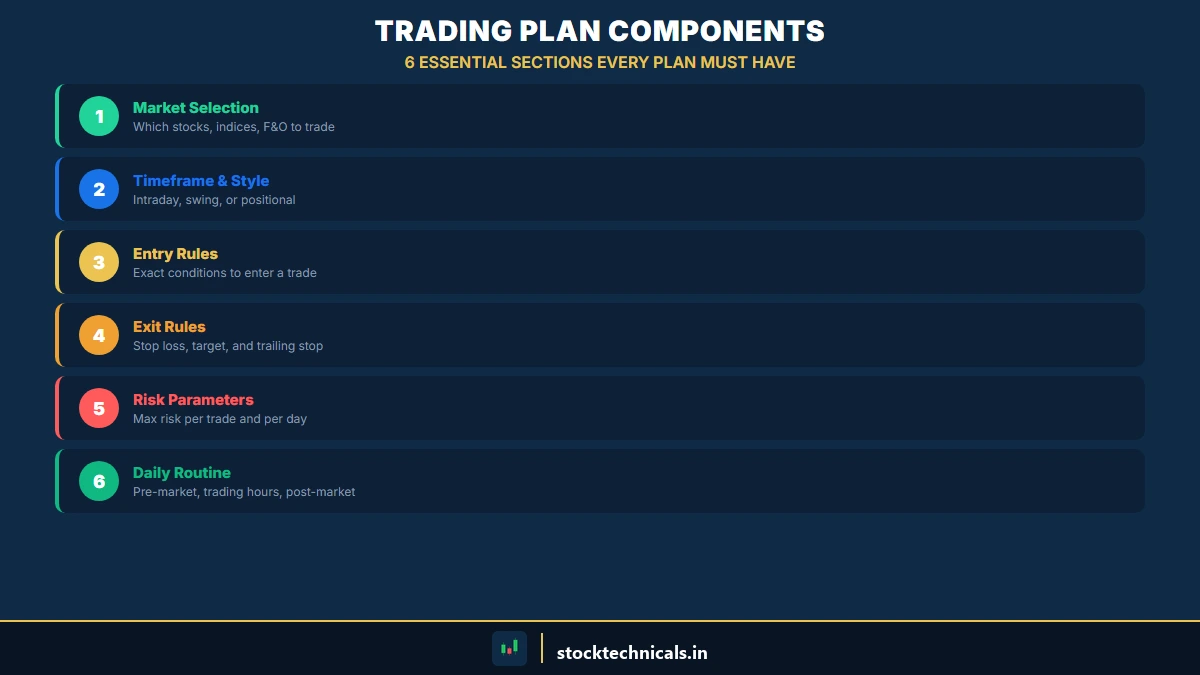
The six sections of a usable plan
1. Instruments
Exactly which instruments you trade. Not “Indian equities.” Specifically: Nifty 50 index futures, Bank Nifty options, or a named list of five large caps (Reliance, TCS, HDFC Bank, Infosys, SBI). The tighter the list, the better the edge.
2. Strategy
The specific setup you’re trading. “50 EMA trend continuation after a pullback to the EMA with RSI bouncing from 40, confirmed by a volume spike on the trigger candle.” One paragraph. No ambiguity.
3. Capital allocation
How much total capital is dedicated to this strategy, what fraction can be deployed at any moment, and what the cash reserve is.
4. Risk parameters
Per-trade risk as percentage of capital (0.5–1%). Daily loss cap (usually 3%). Weekly loss cap (usually 6%). Maximum concurrent positions (usually 2–3).
5. Rules
Entry trigger, stop placement, target placement, exit conditions (including partial profits), position-adjust rules, and non-discretionary shutdowns (e.g. “stop trading after three consecutive losses”).
6. Daily routine
8:15 AM — review plan + India VIX + news calendar. 9:15 AM — market open, execute only planned setups. After every trade — journal entry. 3:30 PM — session review. Sunday — weekly review.
Capital allocation in practice
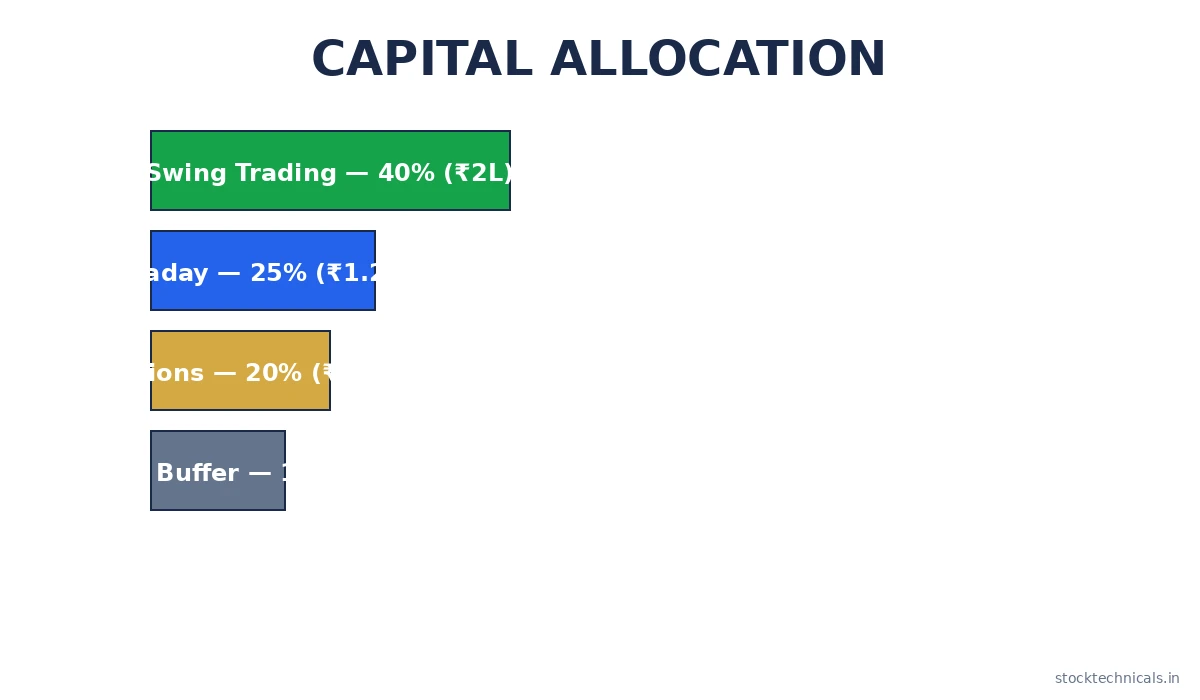
- Active trading capital: ₹7,00,000 (70%)
- Cash reserve: ₹3,00,000 (30%)
- Per-trade risk: 1% of total = ₹10,000 max loss per trade
- Daily loss cap: 3% = ₹30,000
- Max concurrent positions: 2
A trade with a ₹50 stop-loss distance would use ₹10,000 / ₹50 = 200 shares position size. The formula is mechanical, not judgment.
Writing mechanical entry and exit rules
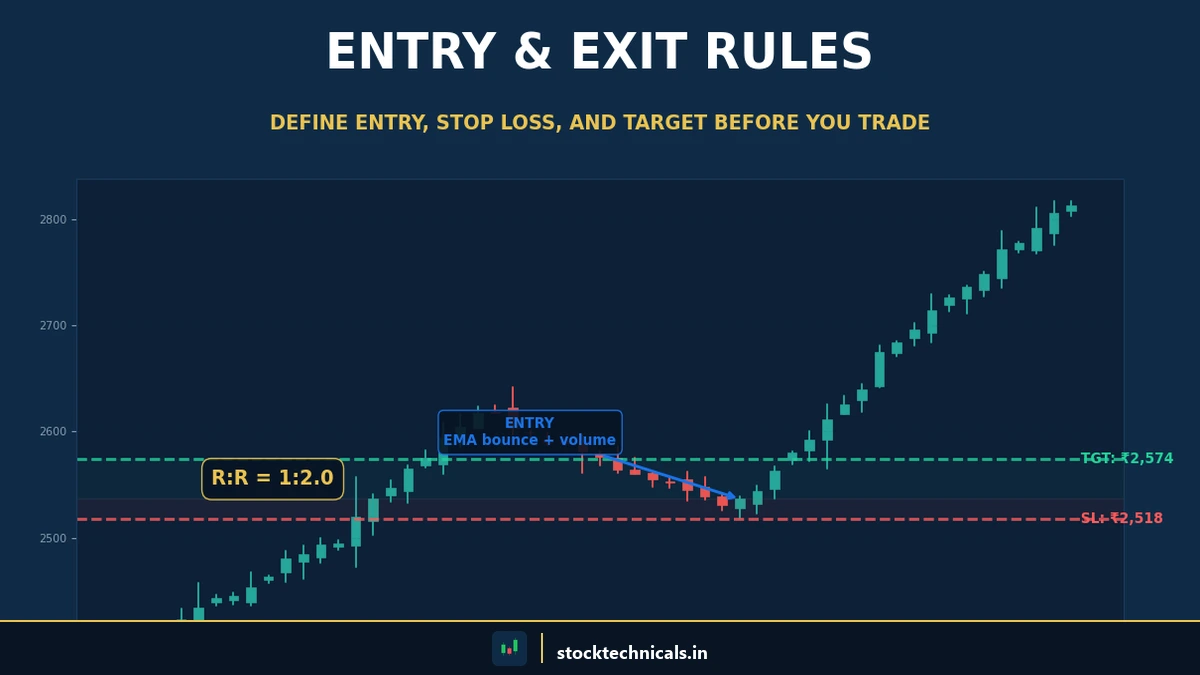
Rules pass the stranger test: another trader should be able to execute your plan from the page without asking you a question. Weak rule: “Buy when it looks good.” Mechanical rule: “Buy on close above 50 EMA when RSI is between 45 and 65 and volume exceeds 20-day average; stop 1.5× ATR below entry; target 3× ATR above.”
Every rule must specify: exact trigger, exact stop, exact target, exact exit condition. Vague language = emotional discretion = drift.
The risk management pyramid
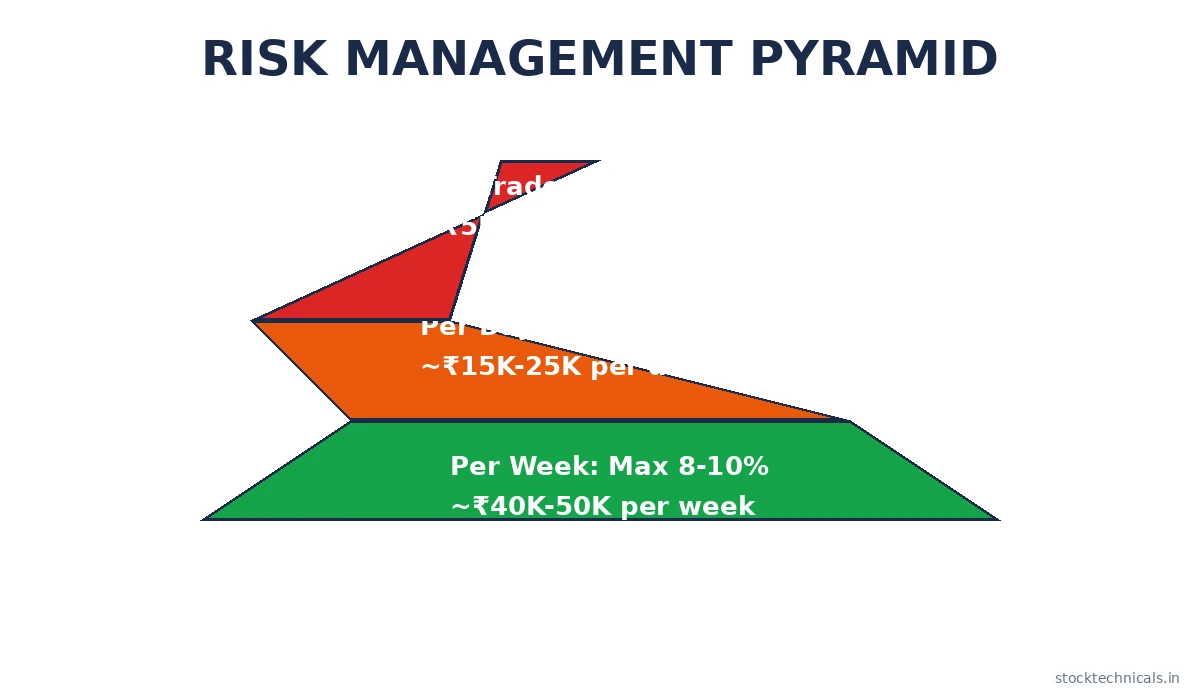
- Layer 1 — per-trade risk: 0.5–1% of capital, mechanically sized using stop distance.
- Layer 2 — daily cap: 3% of capital. Hit = platform closed for the day.
- Layer 3 — weekly cap: 6% of capital. Hit = weekend reset required.
- Layer 4 — monthly review: drawdown > 10% triggers a system review at half-size for 30 days.
- Layer 5 — catastrophic stop: 20% drawdown = full trading pause, external audit of your system by a peer.
These layers compound. Layer 1 prevents Layer 2. Layer 2 prevents Layer 3. Layer 3 prevents Layer 4. Layer 5 is the final firewall — you should never reach it.
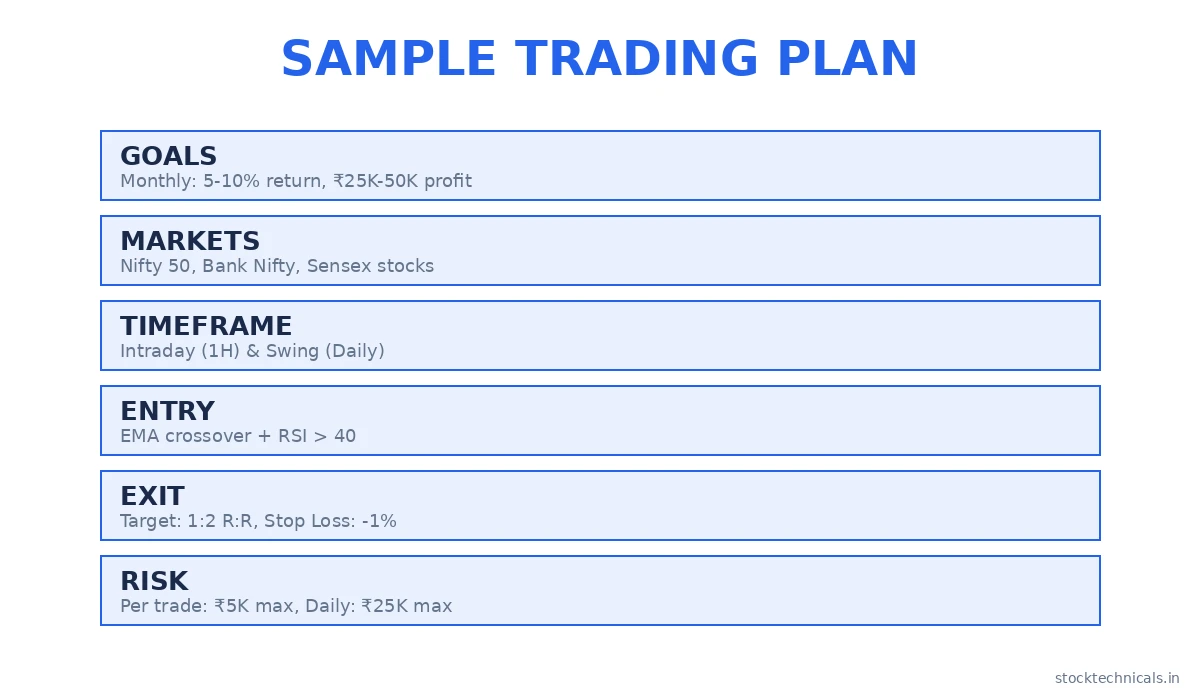
A sample one-page plan
Instruments: Nifty 50 top-10 by market cap; daily chart.
Strategy: 50 EMA pullback with RSI bouncing from 40–50 zone and above-average volume on the trigger candle.
Capital: ₹3,50,000 active, ₹1,50,000 reserve.
Risk: 1% per trade = ₹5,000. Daily cap 3% = ₹15,000. Weekly cap 6% = ₹30,000. Max 2 concurrent positions.
Entry rule: Close above 50 EMA after a 3-candle pullback, RSI turning up from the 40–50 zone, volume > 20-day average on trigger.
Stop: 1.5× ATR(14) below entry.
Target 1: 2× risk, take 50% off. Target 2: previous swing high or 3× risk, whichever is closer. Trail remainder with 50 EMA.
Shutdowns: 3 consecutive losses = day over. Daily loss cap = week review.
Routine: 8:15 AM review; 9:15 AM execute; journal every trade; 3:30 PM session review; Sunday weekly review.
Plan review cadence
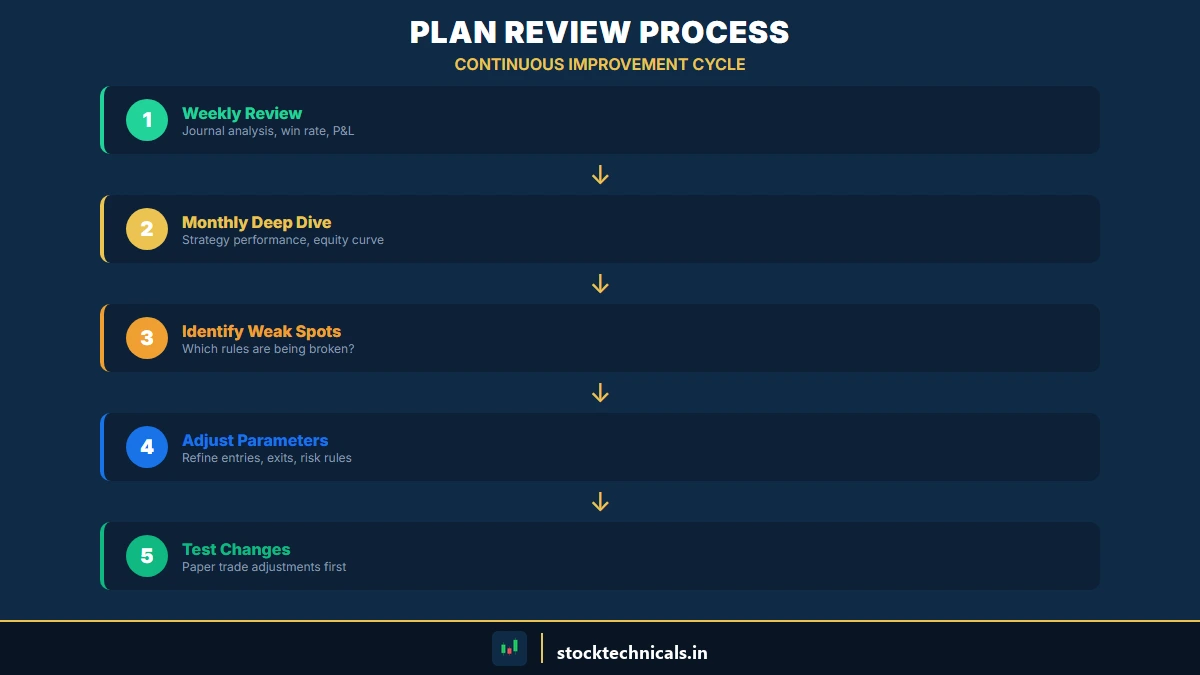
- Daily — read the plan aloud before the session. No edits.
- Weekly (Sunday) — review the journal. Identify rule violations. Add notes, not rule changes.
- Monthly — edit the plan based on four weeks of data, not one losing day.
- Quarterly — rebuild from scratch if performance is flat; reaffirm if performance is positive.
Daily edits to the plan are how traders lose the plan. Weekly and monthly reviews are where real improvement happens.
Five rules for your trading plan
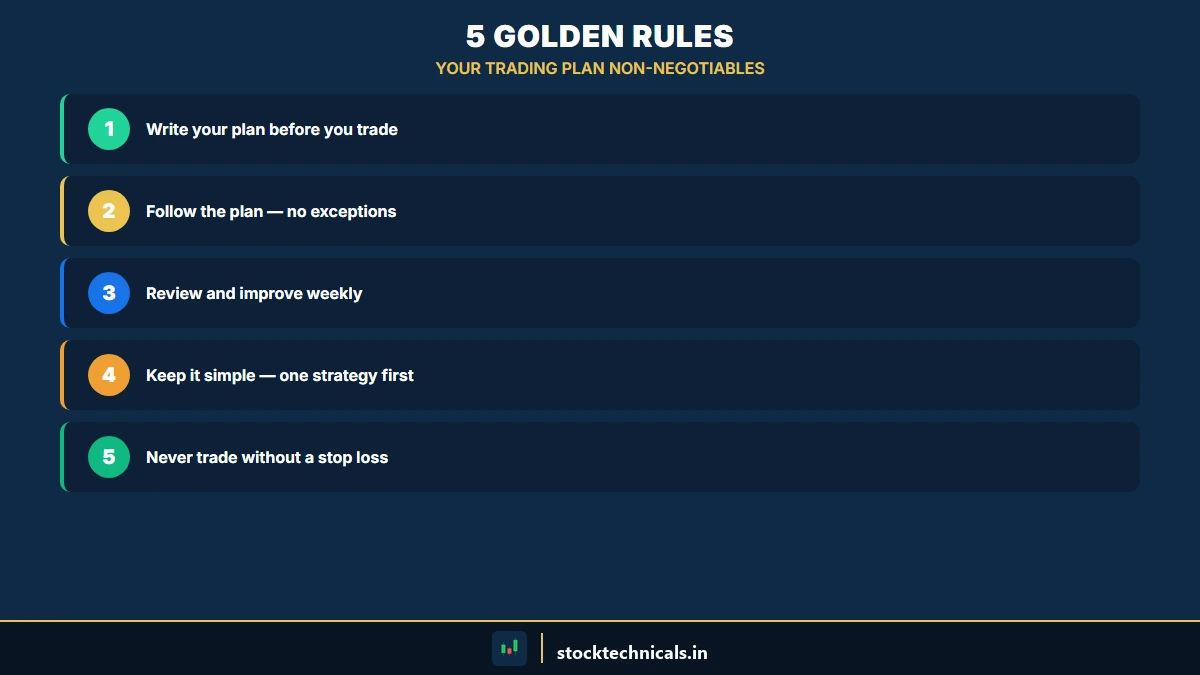
Rule 1 — One page or less
If it doesn’t fit on one page, you won’t read it daily. If you don’t read it daily, you won’t follow it.
Rule 2 — Stranger test
Another trader should be able to execute your plan from the page without asking questions. If not, it’s a wish list, not a plan.
Rule 3 — Written, printed, visible
Digital plans get minimised, ignored. Print it. Tape it next to your monitor. Read it aloud before 9:15.
Rule 4 — Edits only on the weekend
No mid-week edits. No post-loss edits. Edits happen Sunday afternoon with a week of journal data in front of you.
Rule 5 — Attribute every trade to a plan rule
If you took a trade that doesn’t map to a specific rule in your plan, it’s a rogue trade. Track those separately. If more than 10% of your trades are rogue, the plan needs updating to cover the real setups you’re trading.
Plan checklist
- Does the plan fit on one page?
- Does it name specific instruments (not “equities”)?
- Is the strategy described in one mechanical paragraph?
- Is per-trade risk exactly 0.5–1% of capital?
- Are daily and weekly loss caps, plus the monthly drawdown review, written?
- Would a stranger be able to execute the entries and exits from the page?
- Is the daily routine time-stamped?
- Is there a rule for stopping after three consecutive losses?
Any no = rewrite before your first trade on this plan.
Five common plan mistakes
Writing the plan and never reading it
Most traders draft a plan once, file it digitally, and never look at it again. Printed and visible beats digital and filed — every time.
Vague rules that require interpretation
“Buy strong stocks on pullbacks” is not a rule. “Buy stocks in the Nifty 50 above their 50 EMA on a 3-candle pullback to the EMA with RSI between 45–60” is a rule.
Editing the plan mid-week after a loss
Post-loss edits are how plans drift into whatever your emotional brain wanted to do yesterday. Edits happen on weekends, with data, not on Tuesday after a stop-out.
No daily routine
A plan without a routine is a document. A plan with a time-stamped routine becomes a habit. Routine is what converts intention into execution.
Copying someone else’s plan verbatim
Plans have to fit the trader’s actual instruments, capital, time availability, and risk tolerance. A copied plan fails the moment reality doesn’t match. Use templates as starting points, not as finished documents.
Plan vs no-plan — the performance difference
| Dimension | With written plan | Without written plan |
|---|---|---|
| Decision speed | Fast, mechanical | Slow, emotional |
| Position sizing | Consistent | Variable with mood |
| Stop-loss discipline | Pre-committed bracket | Mental stop, often widened |
| Rule violations | Detectable via journal | Invisible (no baseline) |
| System review | Weekly, data-driven | Reactive to last loss |
How long should a trading plan be?
One page. Longer plans don’t get read daily, and unread plans have no behavioural effect.
Should I have different plans for different strategies?
Yes, one per strategy. Swing plan, intraday plan, options plan — separate documents so the rules don’t blur.
How often should I change my plan?
Weekly notes, monthly edits, quarterly rebuilds. Never daily. Daily edits are emotional drift dressed as optimisation.
Is it ok to deviate if a great setup appears?
No. “Great setups outside my plan” is how traders justify trades that blow up accounts. Add it to the plan next weekend, take it next week.
What risk per trade should my plan use?
0.5–1% of total capital. 2% is aggressive. 3% is reckless. Smaller risk makes the rules easier to follow.
Do I need a plan for paper trading?
Yes. Start during paper trading. The plan is the discipline, not the real money. 30 days of paper with a plan before going live.
What if I don’t follow my plan one day?
Journal honestly. If rare, you’ve identified a trigger. If frequent, the plan doesn’t match reality — rewrite it.
Test Your Knowledge
Q1: How many sections should a trading plan contain?
Q2: Maximum recommended per-trade risk?
Q3: When should plan edits happen?
Q4: The stranger test for a rule means:
Q5: A “great setup outside my plan” should be:
Your next step
Before risking real money on a new plan, paper-trade it. Paper Trading covers how to replicate live conditions closely enough that the transition to real capital doesn’t surprise you.
The Bottom Line
A trading plan is one page, six sections, mechanical rules, printed, visible, and read aloud before every session. It is edited weekly, not daily. It fails the stranger test if anyone but you could not execute it. Most retail traders know this and still don’t do it; the ones who do it tend to outperform the ones who don’t.
Educational content only — not SEBI-registered investment advice. Having a plan reduces unforced errors but does not eliminate market risk. Past plan performance does not guarantee future results. Size every trade so a full stop-out costs less than 1% of capital. Never trade with borrowed money.