
Revenge trading is entering an unplanned trade immediately after a loss, usually in larger size, to “win back” what you lost. Overtrading is taking too many trades per session regardless of whether the setup qualifies. Both are predictable emotional loops that a 30-minute cooldown, a daily trade cap, and a pre-committed position-size rule will break. The damage is compounding, not the market’s.
Active intraday and swing traders who have watched a good week evaporate in a single afternoon. If you’ve ever doubled your position size right after a stop-out, or taken “just one more” trade when the session clearly wasn’t working — this is the pattern this guide addresses.
Revenge trading and overtrading are the two specific behaviours that turn a disciplined trader into a blown-up account. They don’t require bad analysis or bad luck — just an ordinary loss and an emotional response that most retail traders have never been taught to recognise in real time.
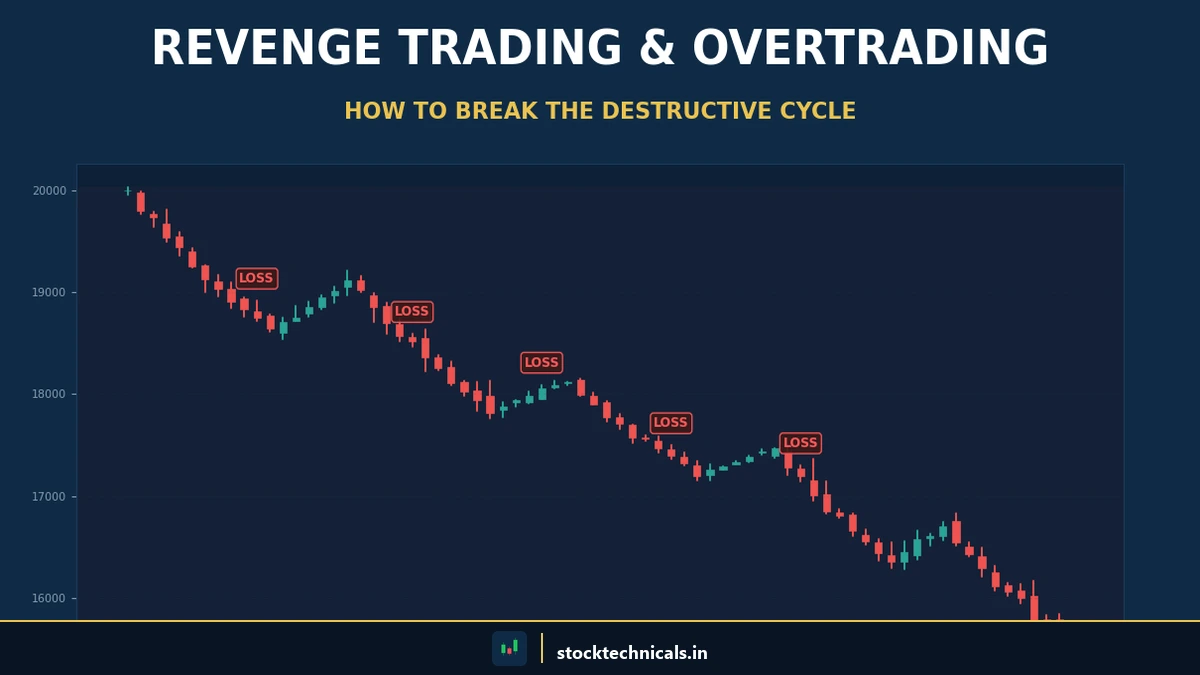
- Revenge trading = unplanned, oversized trade taken immediately after a loss to “get it back.”
- Overtrading = too many trades per session regardless of setup quality, driven by boredom or compulsion.
- Both are cycles — they feed themselves until a circuit breaker stops them.
- Three circuit breakers work: 30-minute cooldown after any loss, daily trade cap (3 for intraday), three-consecutive-loss shutdown rule.
- Recovery from a revenge-trading day requires a mandatory 24-hour reset, not just the next morning’s bell.
Revenge trading vs overtrading — precise definitions
Revenge trading is a trade taken specifically to recover a recent loss. Three tell-tale signs: the trade wasn’t in your plan that morning, position size is 1.5x or more of your normal size, and the thesis is weaker than your usual standards.
Overtrading is taking too many trades relative to the number of genuine signals. Driven by one of three forces: boredom (slow market day), compulsion (trading as emotional stimulation), or making up for a perceived shortfall (behind on monthly P&L target).
The two often show up together: a losing trade triggers revenge trading, revenge trading triggers a chain of desperate extra trades, and the combined spiral destroys a multi-week edge in 90 minutes.

Anatomy of a revenge-trading spiral
The sequence is remarkably consistent across traders:
- 9:45 AM — first trade of the day, setup was valid, stops out for ₹3,000 loss.
- 9:46 AM — feeling immediately rises: “I need to get that back before lunch.”
- 9:55 AM — enter a second trade, weaker setup, 1.5x position size, tighter stop.
- 10:03 AM — stopped out again for ₹4,500 loss.
- 10:05 AM — third trade, even weaker setup, 2x size, random timeframe. Loss: ₹7,000.
- 10:20 AM — fourth trade, wrong instrument, no real setup, size now 3x normal. Loss: ₹15,000.
- 10:30 AM — session P&L: ₹−29,500. Would have been ₹−3,000 if the day had ended at step 1.
Every one of these decisions felt rational at the time. That’s the point. The emotional brain doesn’t announce itself — it takes the wheel while the rational brain thinks it’s still driving.

The hidden costs of overtrading
Overtrading costs more than just losing trades:
- Brokerage and taxes — 10 intraday trades vs 3 can mean 3x the brokerage, STT, and stamp duty. On a ₹5,00,000 account turning over daily, friction alone can eat 15% of gross P&L.
- Cognitive fatigue — each trade makes decision-making worse. By trade 8 of a session, most traders are measurably less disciplined than at trade 1.
- Signal degradation — genuine signals are rare. Forcing extra trades means taking low-quality setups with worse expected value.
- Journal pollution — a journal full of sub-setup trades makes it hard to see if your actual system has edge.

Warning signs you’re about to revenge-trade
- Physical — clenched jaw, leaning toward the screen, breath held during price ticks.
- Cognitive — internal monologue becomes “I need to,” “I have to,” “just one more.”
- Behavioural — scrolling through multiple instruments looking for “anything” to trade, moving to lower timeframes to find faster entries.
- Technical — entry would violate your size rule, stop rule, or timeframe rule that you’d never break on a calm day.
Any two of these happening together = stop. Close the platform. Get up from the chair.

The recovery protocol
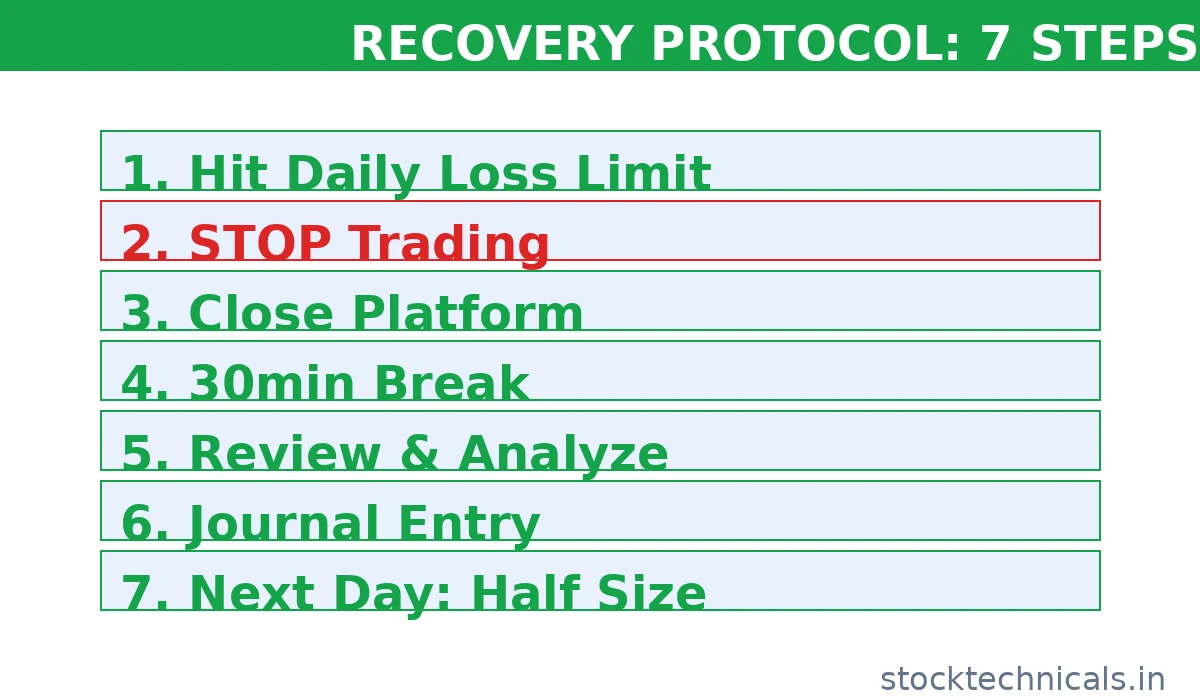
- Close all open positions at market. Accept the P&L as is.
- Close the trading platform for the rest of the session. No “watching” either.
- Journal what happened — triggers, sequence, size violations, emotional state at each step.
- For the next trading day: trade at 25% of your normal position size for all valid signals.
- Return to full size only after five consecutive rule-compliant trading days.
The size reduction is the not up for debate piece. Going straight back to full size the next day is how the spiral restarts within a week.
Broker platform safeguards
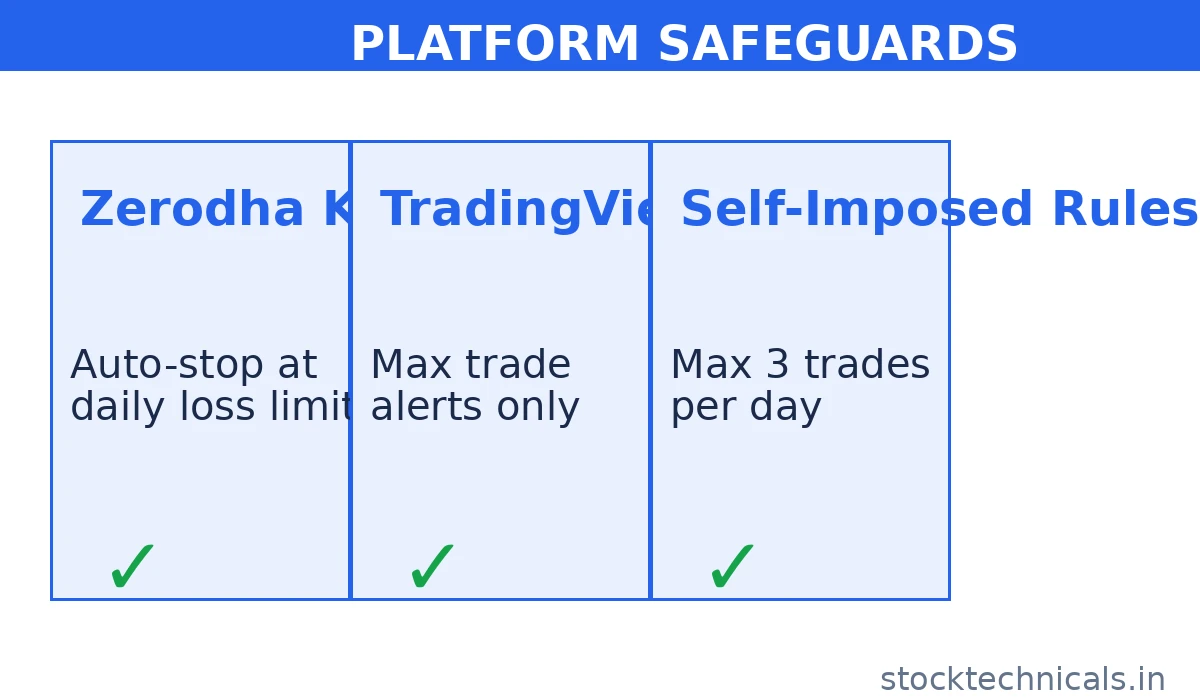
Use the platform against your worst impulses. Specific features worth configuring:
- Bracket orders (Upstox, Dhan) or GTT OCO on Zerodha Kite — entry, stop and target linked together so cancelling the protection requires active intervention.
- Daily loss limits — some brokers allow a maximum daily loss; once hit, the platform blocks new positions.
- Trade alerts — a TradingView or broker-app price alert set at the level where your open position’s loss would equal 2% of capital, forcing you to acknowledge the regime before continuing.
- Two-factor order confirmation — the extra second of “are you sure?” is enough to catch many impulsive entries.
Five golden rules
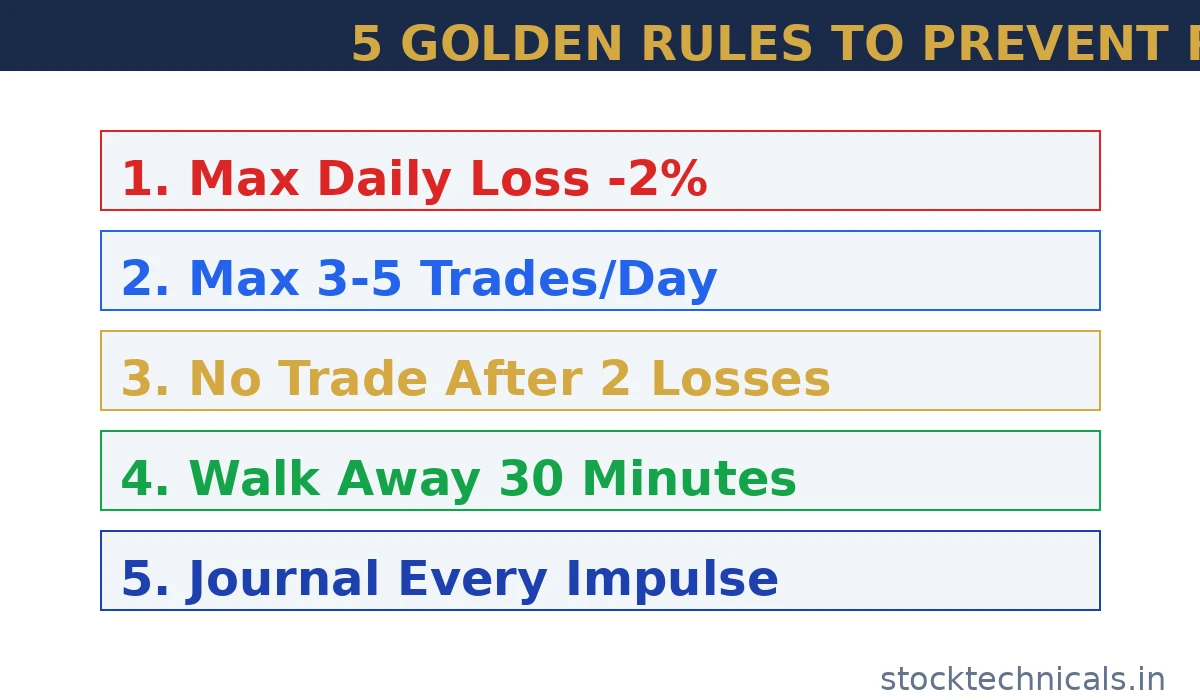
Rule 1 — 30-minute cooldown after any loss
Physical timer, platform closed, away from desk. No exceptions.
Rule 2 — Three-loss shutdown
Three consecutive losses = day is over. No fourth trade, no “just one small one,” no different instrument. Day closed.
Rule 3 — Daily trade cap
Intraday: maximum 3 trades per day. Swing: maximum 1 new position per day. Cap enforced whether you’re winning or losing.
Rule 4 — Fixed percentage position size
0.5–1% risk per trade. Not variable. Not “a bit bigger because this one’s a sure thing.”
Rule 5 — The “would I take this trade at 8 AM?” test
If the setup in front of you right now would have qualified for a trade in your morning pre-market plan, take it. If not, it’s post-loss rationalisation. Skip.
Pre-trade checklist
- Has it been at least 30 minutes since my last loss?
- Is this one of my pre-planned setups from this morning’s prep?
- Is my position size exactly at my normal rule (not larger)?
- Is my emotional state calm (not “urgent” or “determined”)?
- Would I take this same trade tomorrow morning, starting fresh?
- Have I taken fewer than 3 trades today (intraday)?
Any no = walk away. The loss you have is a manageable loss. The next trade is how it stops being manageable.
Five common mistakes
Thinking it’s a market problem, not a trader problem
Revenge trading blames the market for the spiral. The market doesn’t care. The spiral is generated entirely by the sequence of decisions after the first loss.
Believing willpower alone will stop it
Willpower is a limited resource. By the time you need it (mid-spiral), you’ve already depleted it. Structural rules and platform-enforced limits do the work willpower can’t.
Changing systems after a losing day
One bad day is not evidence your system is broken. Wait 30 trades before adjusting anything. System changes made under emotional pressure almost always make things worse.
Trading the next morning as if nothing happened
Revenge-trading spirals require recovery. Going back to full size the next day is how small drawdowns become large ones.
Not journalling the spiral
Spirals you don’t document repeat. Spirals you write down start losing power the next time a similar trigger arrives, because you can see the pattern.
How do I know if I’m revenge trading vs just taking another valid trade?
Three tests: Was this trade in your morning plan? Is size exactly your rule? Has 30 minutes passed since the last loss? Any no = revenge trading.
Is it always wrong to trade more on high-opportunity days?
Not if the extra trades match your system’s criteria. Test: would you have planned this setup at 8 AM? Yes = extra signal; no = overtrading.
How long does recovery take?
Minimum five consecutive rule-compliant days at 25% of normal size. Skipping recovery restarts the cycle within a week.
What if my daily cap is hit but I see an obvious setup?
Skip it. The cap is unconditional. Post-cap “obvious setups” are usually rationalisations from a fatigued brain.
Can I paper-trade after hitting my daily cap?
Yes. Paper-trading extra setups gives you data on whether the cap costs you edge or protects you from noise.
What if my broker doesn’t have a daily loss limit feature?
Use price alerts in your broker app set at the price where your position’s loss equals 2% of capital, so an alert forces an acknowledgment. No alerts? Phone timer or sticky note — any external prompt works.
Is overtrading always emotional?
Mostly yes. Boredom, compulsion, financial pressure, FOMO — all four produce “more trades than signals.” The fix is the same hard cap.
Test Your Knowledge
Q1: The primary trigger for revenge trading is:
Q2: Recommended cooldown after any loss:
Q3: After three consecutive losses in a session you should:
Q4: Recovery protocol after a revenge-trading day requires:
Q5: Biggest hidden cost of overtrading:
Your next step
If you recognised yourself in any of these patterns, the most productive next read is How to Build a Trading Plan — a written plan is the single strongest counter-force to revenge trading and overtrading.
The Bottom Line
Revenge trading and overtrading are not character flaws — they are predictable emotional loops triggered by normal losses. The defences are mechanical: 30-minute cooldown, three-loss shutdown, daily trade cap, fixed position size, and the 8 AM test for every post-loss trade. The single loss you started with is manageable. Every trade after the loop starts is how manageable becomes catastrophic.
Educational content only — not SEBI-registered investment advice. Emotional discipline reduces but does not eliminate losses. Recovery protocols help but require honest self-observation to work. Size every trade so a full stop-out costs less than 1% of capital. Never trade with borrowed money.