
Fear and greed are the two emotions that explain most of the damage in a retail trading account. Fear cuts winners early, freezes you at valid setups, and triggers panic exits. Greed oversizes positions, cancels pre-set targets, and chases extended moves. The defence is not willpower — it’s measurable tools like India VIX, pre-set bracket orders, and small position sizes that keep each trade too small to trigger the emotion in the first place.
Indian retail traders who’ve read general “trading psychology” content and still struggle with the specific moments: the panic exit at the bottom, the greedy entry at the top, the size-up after wins. This guide is about those exact moments and the tools that break the loop.
Every other topic on this site is about what to trade — which setup, which indicator, which timeframe. Fear and greed are about who’s actually making the trade. On an average day that “who” is you. On a stressful day it’s the part of you that responds to a red P&L screen like it’s a physical threat.
This guide treats fear and greed as market inputs — observable, measurable, tradeable — not character flaws. You’ll see how to read India VIX as a proxy for fear, the Fear & Greed Index as a broader gauge, and the specific situations where each emotion makes you the exit liquidity for a smarter trader.
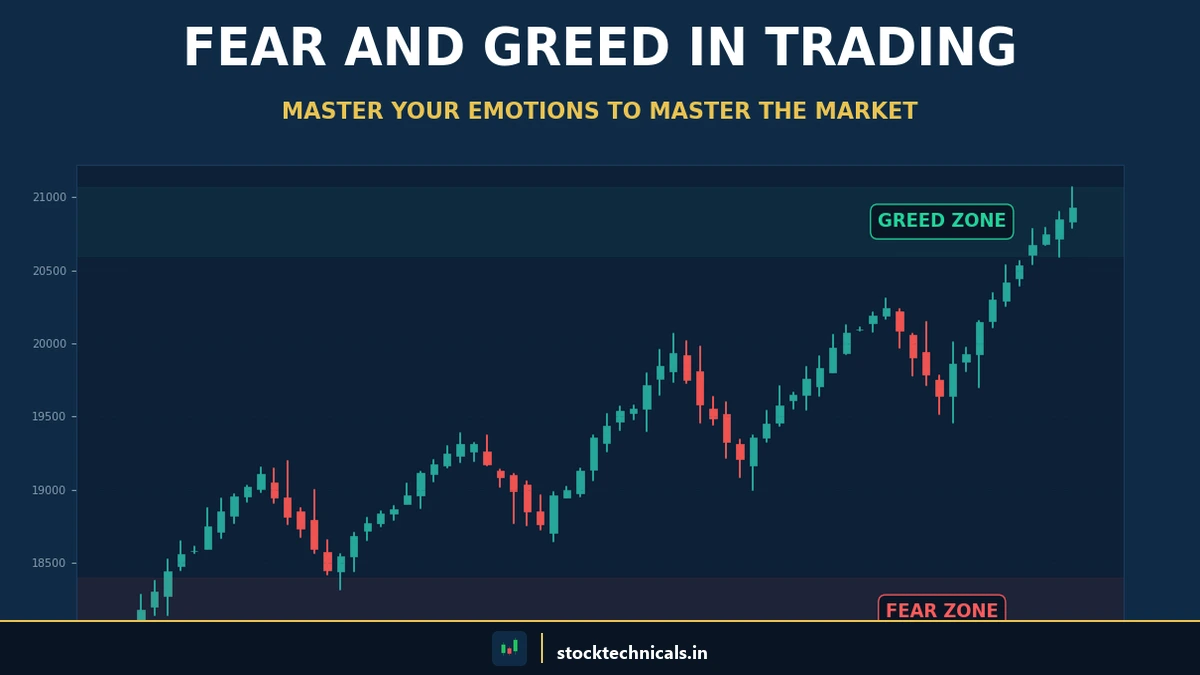
- Fear in trading shows up as panic exits, skipped setups, and tight stops that get hit on noise.
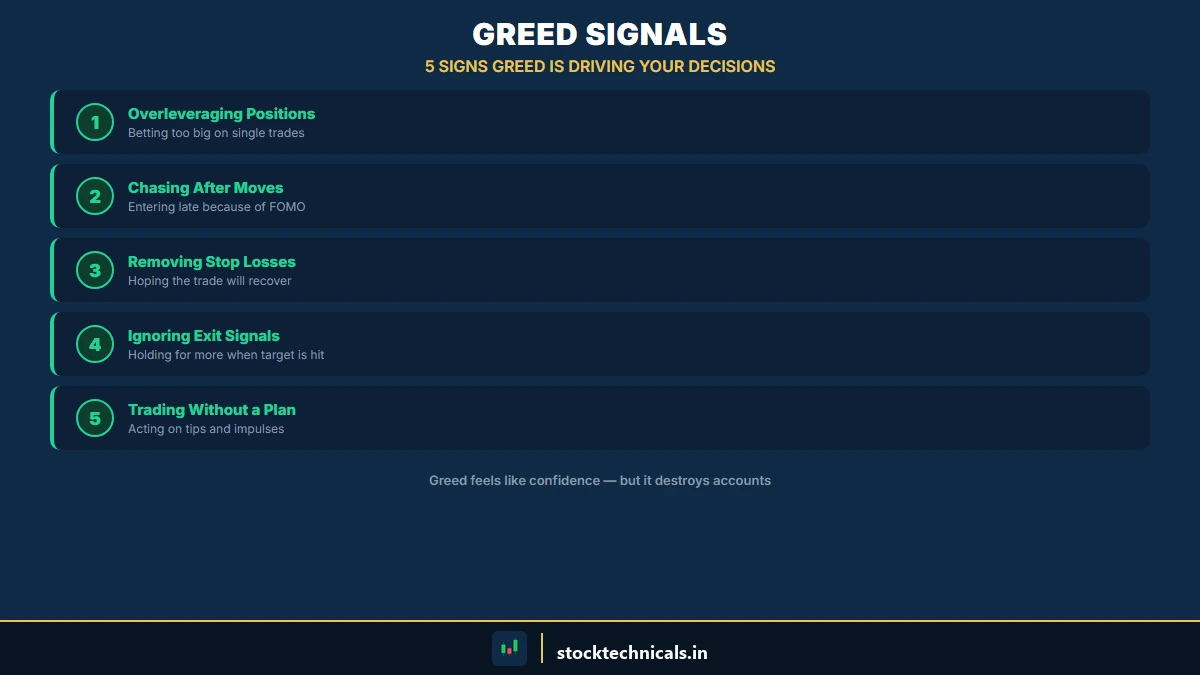
- Greed shows up as oversized positions, cancelled targets, and chasing late entries on extended moves.
- India VIX below 12 = complacency/greed regime. India VIX above 25 = panic/fear regime. Below 10 or above 30 = extremes worth fading with process.
- Position size is the master variable. At 0.5–1% risk per trade, neither emotion has enough fuel to take over.
- Contrarian rule: when the crowd is extremely greedy, tighten risk. When the crowd is extremely fearful, look for quality setups most traders are too scared to take.
Defining fear and greed precisely
Fear is the anticipation of loss. In a trade, it shows up in three specific moments:
- The moment a valid signal fires, and you hesitate until the move is gone.
- The moment a trade moves 0.3% against you and you exit at a tiny loss rather than wait for your stop.
- The moment price dips in your direction and you take a smaller profit than planned, “just to be safe.”
Greed is the anticipation of reward. Its three canonical moments:
- The moment your target hits and you cancel it — “it’s going higher, I can feel it.”
- The moment after a big winning streak when you double position size on the next setup.
- The moment you chase a move 30 minutes late, after the clean signal has passed, because the rest of the move is “still available.”
None of these are abstract problems. Each one is a specific behaviour at a specific moment, and each one has a specific fix.
The Fear & Greed Index — a crowd temperature gauge
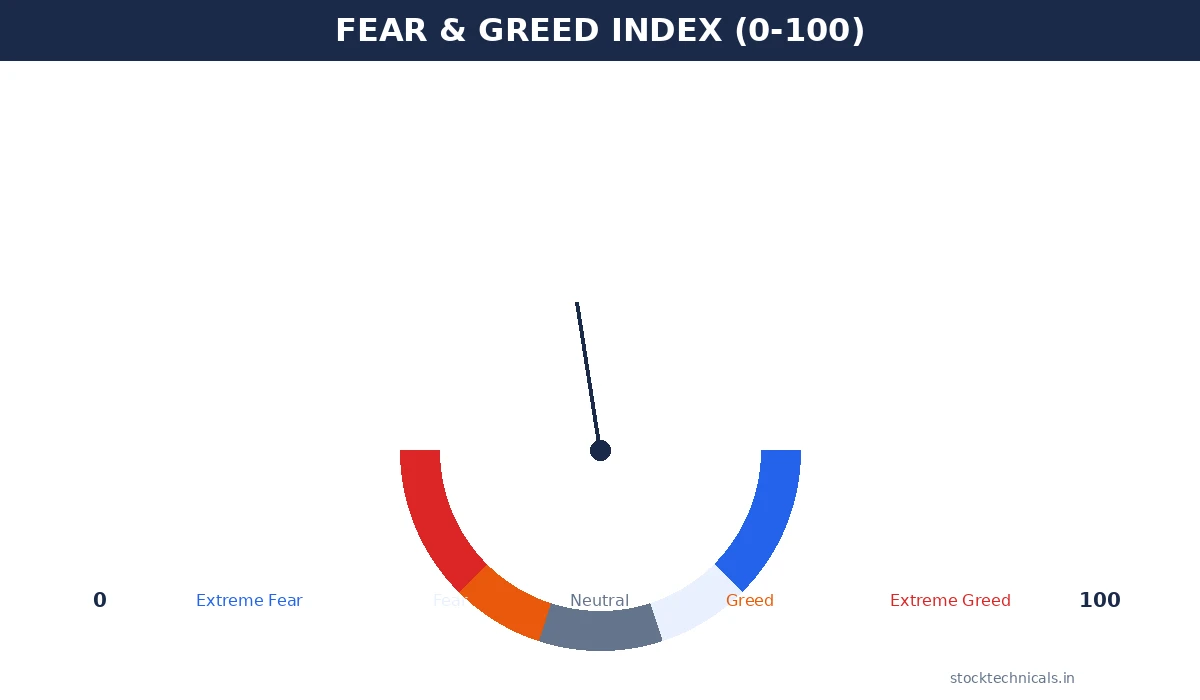
CNN’s Fear & Greed Index and similar composite indicators combine several market signals — momentum, volatility, breadth, safe-haven demand, junk-bond spreads — into a single 0–100 reading. Below 25 is extreme fear; above 75 is extreme greed.
For Indian markets, the practical equivalent is India VIX. It tracks the 30-day implied volatility of Nifty 50 options. Rough regime map:
- VIX < 12 — complacency. Traders are aggressive, leveraged, and underestimating risk. Setups look cleaner than they really are.
- VIX 12–18 — normal. Business as usual.
- VIX 18–25 — elevated fear. Wider stops needed, size down.
- VIX > 25 — panic. Most retail traders are exiting at the worst prices; some of the best long-term entries happen here.
Keep India VIX pinned in the corner of your chart workspace. When it spikes, you’re in a fear regime whether you feel it yet or not — plan accordingly.
The market cycle mapped to emotion
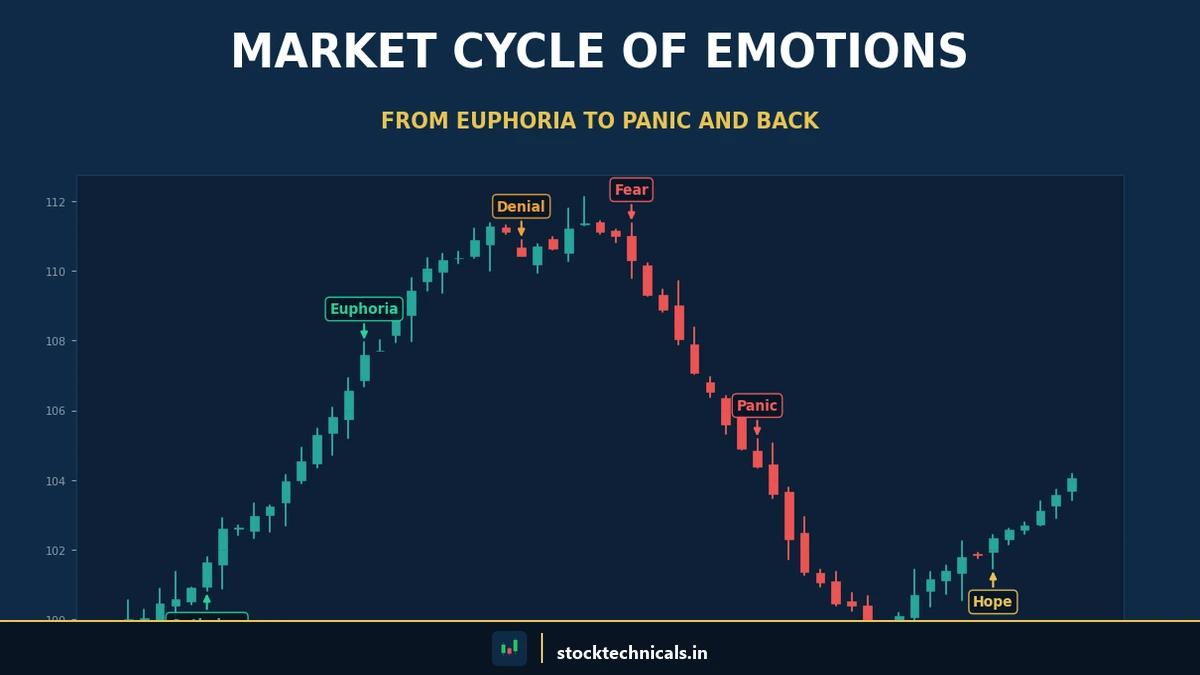
A full market cycle travels through predictable emotional regimes:
- Stealth phase — institutions accumulate quietly, retail is still on the sidelines from the last selloff.
- Awareness — first trends build, media starts running bullish stories.
- Mania — retail piles in, leverage explodes, VIX collapses, “this time is different” narratives peak.
- Blow-off — vertical rally on narrow breadth, institutional distribution begins.
- Denial — early correction is bought aggressively; VIX rises modestly.
- Panic — capitulation selling, VIX spikes, margin calls, retail exits at the low.
- Despair — price stabilises but sentiment stays awful for weeks or months.
- Stealth phase — cycle begins again.
Knowing which phase you’re in is not about prediction — it’s about context. A signal that works beautifully in stealth/awareness will get you chopped in mania. A signal that fails in mania will work cleanly in awareness.
Fear signals and how to counter them
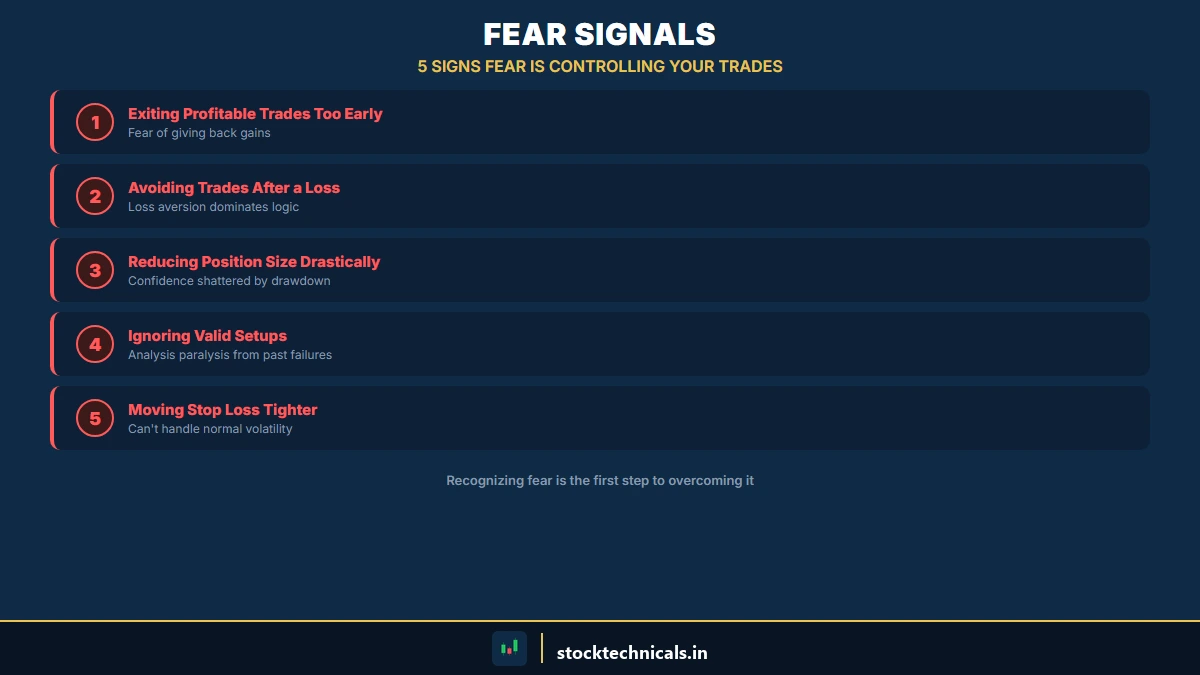
Specific fear signals you’ll recognise in yourself:
- Hesitating on a valid setup — “what if this one fails” — usually right after a previous loss.
- Closing a winner at 0.5R — anything more than a tiny profit feels unsafe.
- Watching the stop-loss instead of the target — mental focus is on what can go wrong.
- Refusing to take news-day setups — even when the setup is the same one you took yesterday.
Counters: smaller position size (0.25% of account for one week to desensitise), bracket orders placed automatically, mandatory rule to take the next three valid signals regardless of the previous trade’s outcome.
Greed signals and how to counter them
Specific greed signals:
- Cancelling the pre-set target because “it’s going higher.”
- Doubling size after three wins in a row.
- Chasing late entries 20+ minutes after the clean signal passed.
- Adding to losing trades — “averaging in” — when the original thesis is already broken.
Counters: fixed position-size formula (same percent per trade, not dollar amount), pre-committed target execution via broker order, 30-minute cooldown after any setup you chose not to take on time.
The fear-greed loop and how it traps retail
The classic retail loop:
- Three wins → greed: size up, ignore rules.
- Big loss from oversized position → fear: step aside, skip valid setups.
- Miss three winning moves on the sidelines → regret/greed: chase the fourth one late, poorly.
- Loss on chased entry → despair: take a break, return with no plan.
- Cycle repeats, usually in a smaller account each time.
The loop breaks at one specific point: the “size up” decision. If position size is a hard percentage rule, three wins don’t lead to four-times-size; they lead to the same size as trade number one. No oversized loss, no fear spiral, no chase.

The trading journal — the only honest mirror
A journal is not a logbook. It’s a diagnostic tool. Four fields per trade are enough:
- Setup — which system/signal
- Emotion before — calm / excited / fearful / bored
- Rule violations — any (size, stop placement, exit discipline, entry timing)
- Outcome — R-multiple (win size / loss size), not just win/loss
Weekly review looks for patterns across these fields. Example pattern: “rule violations cluster after Monday losses.” That’s an actionable diagnosis — now you know Tuesday needs a half-size cap.

Institutional fear vs retail fear
Institutional traders have the same emotions you do. The difference is the structure around them:
- Risk limits enforced by a risk desk, not by the trader’s own discipline.
- Position sizes automatically calculated from firm-wide exposure, not “feel.”
- Stop-losses executed by an algo, not a clicking trader.
- Performance reviewed in R-multiples and risk-adjusted returns, not dollar P&L.
You can replicate all four as a retail trader: a written risk budget, a fixed position-size formula, broker bracket orders, and a journal that tracks R-multiples. That’s 80% of institutional discipline, available for free.

Five golden rules for fear and greed
Rule 1 — Fixed percentage risk, always
0.5–1% of account per trade. Wins don’t expand it. Losing streaks don’t shrink it to zero. Same risk per trade until you’ve doubled the account, then reassess.
Rule 2 — Bracket orders, not mental stops
Stop and target go to the broker with the entry, as a bracket order (or a GTT OCO order on Zerodha Kite, which stopped offering bracket orders in March 2020). Not “in your head.” Not “I’ll watch and click.” Bracket.
Rule 3 — VIX is a permission slip
VIX below 12: size down, expect tricky unwinds. VIX above 25: step aside unless your setup specifically works in high-vol regimes.
Rule 4 — Take the next three valid signals after a loss
Post-loss hesitation is a documented pattern. Pre-commit to taking the next three signals your system produces regardless of how you feel. This alone breaks most fear spirals.
Rule 5 — Journal the emotion, not just the trade
One word: calm / excited / fearful / bored. Over 30 trades, your R-multiple by emotional state will reveal which state actually produces edge. Usually it’s “calm.” Everything else is noise.

Fear and greed checklist
- What is India VIX reading today? (Size adjustment required if < 12 or > 25)
- Am I coming off a winning streak? (Risk check: size must stay the same)
- Am I coming off a losing streak? (Rule 4 applies: take the next three valid signals)
- Are my bracket orders ready to be placed at entry?
- Have I written down the single pre-market emotion (calm/excited/fearful/bored)?
- Is my daily trade cap set?
No box unchecked = no trade. It’s a five-minute preflight.
Five common emotional trading mistakes
Panic exit on the first pullback
Trade moves 0.3% against you, you close at a tiny loss, the trade then hits the original target without you. Fix: bracket order with the pre-committed stop. Don’t touch it.
FOMO entry after missing a move
Clean signal at 10:15, you didn’t take it, by 10:45 the move is 60% complete. You enter anyway. Predictable bad outcome. Fix: “missed by 30 minutes” rule — skip, wait for the next signal.
Oversizing after wins
Three good trades, you go from 1 lot to 3 lots. One loss wipes the week. Fix: written position-size formula, same percent per trade, reviewed quarterly not daily.
Target cancellation
Trade reaches pre-set target, you cancel the order because “it’s going higher.” It doesn’t. You exit at 50% of original target. Fix: bracket order with hard target. No cancellation.
Averaging into losers
Buying more of a losing trade to “improve the average.” Usually turns a small loss into a large one. Fix: no position adds below your entry price, ever. If the thesis is still valid, it’s a new trade with its own separate risk budget.
Fear-driven vs greed-driven behaviour — quick compare
| Trigger | Fear reaction | Greed reaction | Rational response |
|---|---|---|---|
| Winning trade | Cut early at 0.5R | Cancel target, let it run | Take pre-set target, trail partial |
| Losing trade | Close before stop hit | Add to loser, widen stop | Let bracket order execute |
| Three wins in a row | Step aside “too good to be true” | Double size on next trade | Same size, same system |
| Three losses in a row | Skip all signals for a week | Double down to win it back | Take next three valid signals at normal size |
How can I tell if I’m trading from fear or greed?
Fear feels like hesitation and urgency to exit. Greed feels like euphoria and urgency to enter more. Urgency in either direction = step away for 30 minutes.
What’s the best indicator of market fear?
India VIX. Below 12 is complacency, above 25 is panic. Combined with NSE advance/decline breadth you have a simple two-input fear gauge.
Is being fearful always bad?
No. Fear is information — your system detects risk. The failure mode is letting fear override a pre-committed rule, not feeling it.
How do I trade during extreme greed regimes?
Reduce size, tighten stops, take partials faster, avoid late entries. The bull market doesn’t kill accounts — the final week does.
Can meditation or journaling help?
Journaling produces the biggest measurable effect by making patterns visible. Meditation helps with baseline reactivity. Neither replaces structural rules.
What’s the single most profitable behaviour change?
Fixed percentage position sizing. Not entry skill, not indicator choice, not timeframe.
Should I avoid high VIX days entirely?
Depends on system. Trend-following systems benefit from high VIX. Mean-reversion systems struggle. Know which yours is.
Test Your Knowledge
Q1: India VIX is reading 10. Market regime is:
Q2: Three winning trades in a row. Correct position-size response:
Q3: You’re in a losing streak. According to Rule 4, you should:
Q4: “Cancelling a pre-set target because it’s going higher” is:
Q5: The single biggest break-point in the fear-greed loop is:
Your next step
Revenge Trading and Overtrading covers the two specific failure modes that follow most fear-greed loops — how to spot them live and how to stop them before they compound.
The Bottom Line
Fear and greed aren’t opponents to defeat — they’re inputs to measure. India VIX tells you the crowd temperature. Your own journal tells you your personal temperature. Match your position size to both, enforce bracket orders, take the next three valid signals after losses, and review weekly. Everything else is noise. The edge is in making each individual trade too small for the emotion to matter, then doing it a thousand times.
Educational content only — not SEBI-registered investment advice. Emotional discipline reduces losses but cannot eliminate them. Market regimes shift and past fear/greed signals do not guarantee future ones. Size every trade so a full stop-out costs less than 1% of capital. Never trade with borrowed money.