Marubozu Candlestick Pattern: The Naked Candle That Signals Complete Dominance

This article is for educational purposes only. It does not constitute financial advice or a recommendation to buy or sell any security. I am not a SEBI-registered investment advisor. Always do your own research and consult a SEBI-registered advisor before trading. Trading in financial markets involves significant risk of loss.

"In This Article"

Introduction: The Power of the Naked Candle

When you’re scanning through a price chart on Zerodha Kite or TradingView and you spot a candlestick with absolutely no upper shadow, no lower shadow, just a thick body from open to close—you’re looking at one of the most powerful single-candle signals in technical analysis: the Marubozu.

Quick Answer: A Marubozu has no wicks, showing one side dominated entirely. Bullish Marubozu = all green, maximum buying conviction. Bearish Marubozu = all red, maximum selling pressure.

The word “Marubozu” comes from Japanese and literally means “bald” or “shaved head.” Just like a bald head has no hair, a Marubozu candle has no shadows (or wicks) sticking out on either side. This isn’t just a cosmetic difference—it tells a complete story about buyer vs. seller dominance during that entire time period (whether it’s a 1-minute, 5-minute, 15-minute, hourly, or daily candle).

In this article, you’ll learn what makes a Marubozu so special, how to identify the different types, the psychology that creates these patterns, and most importantly—how to use them in your actual trades. By the end, you’ll understand why experienced traders watch for Marubozu candles like hawks, because they often signal the start of a strong move or confirm a reversal with clarity that other patterns can’t match.

What you’ll learn:

  • The exact definition and anatomy of a Marubozu
  • The 3 main types and their bullish/bearish versions
  • Why buyers or sellers had complete control during that candle
  • How to grade Marubozu quality (Grade A vs. Grade C)
  • Entry points, stop losses, and risk-reward calculations
  • The 5 best locations to find high-probability Marubozu trades
  • 6 mistakes that trap even intermediate traders
  • How to combine Marubozu with volume, moving averages, and support/resistance

Let’s dive in.


What is a Marubozu? Understanding the No-Wick Candle

Marubozu Anatomy

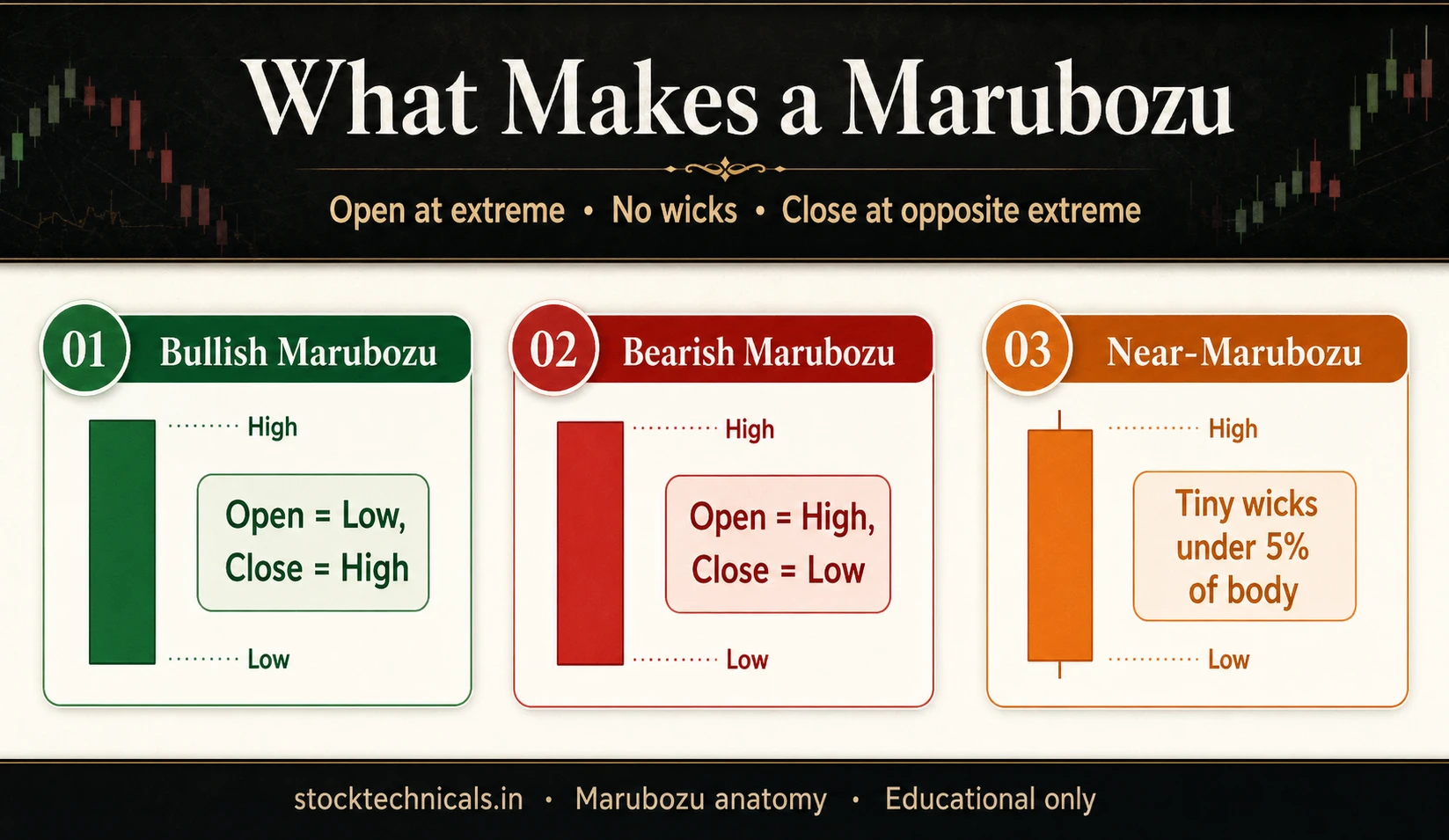
A Marubozu is a candlestick that opens at or very near one extreme and closes at or very near the opposite extreme, with little to no wicks (shadows) on either end.

Let’s break down the anatomy:

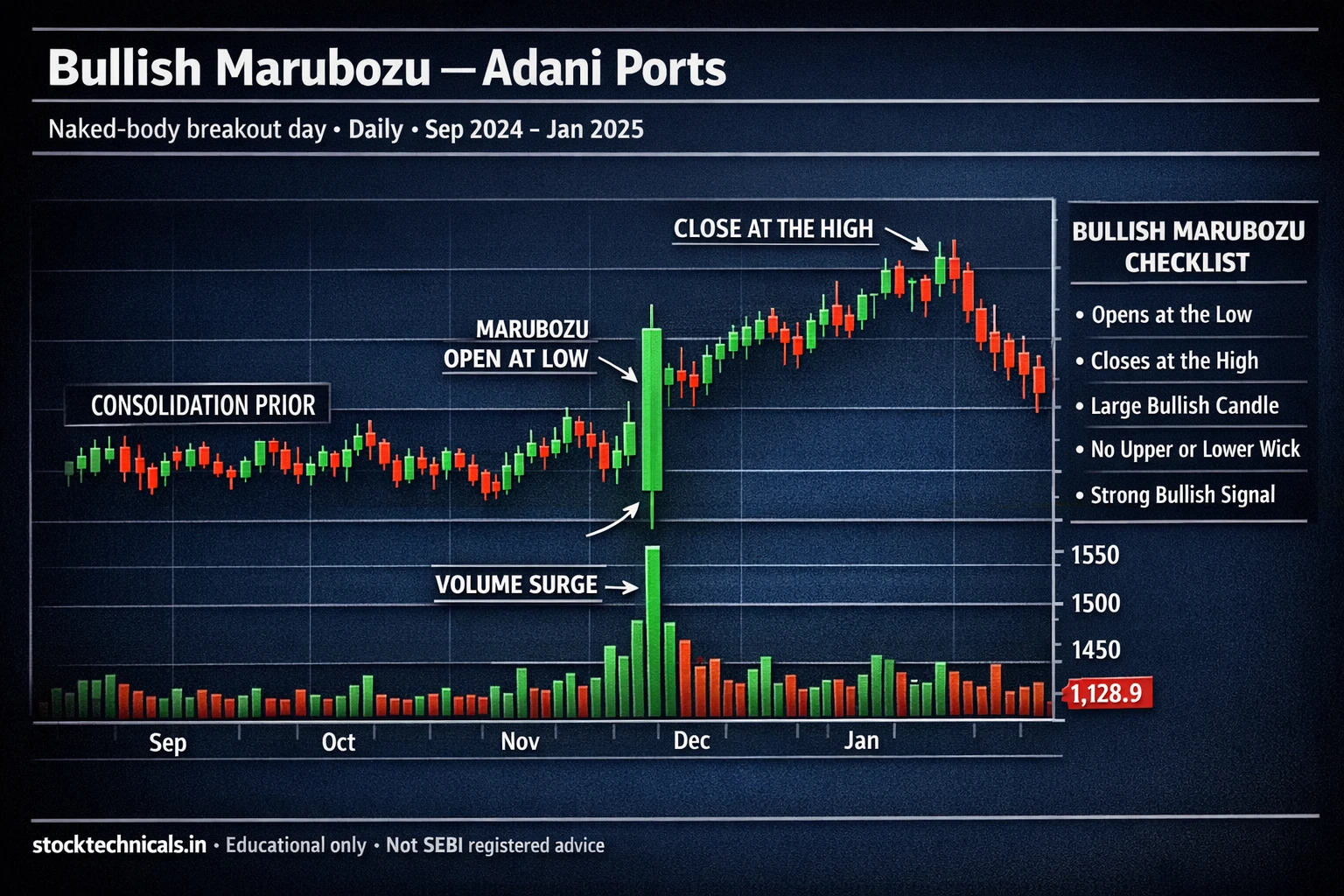
Bullish Marubozu (Green/White candle):

  • Opens at or near the low of the period
  • Closes at or near the high of the period
  • Little to no lower shadow (buyers controlled from the start)
  • Little to no upper shadow (no selling pressure at the top)
  • Result: Buyers were in control from open to close with no hesitation

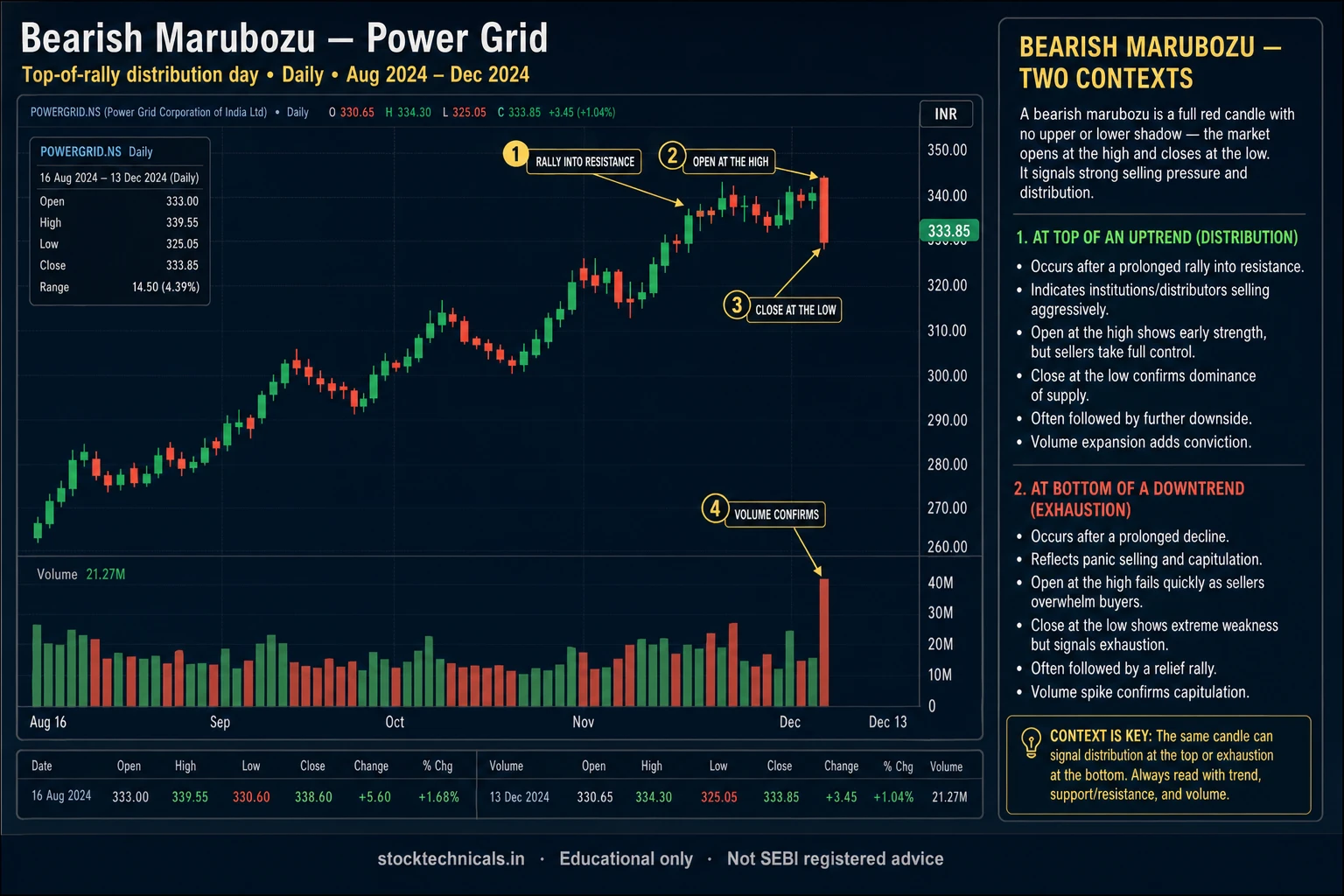
Bearish Marubozu (Red/Black candle):

  • Opens at or near the high of the period
  • Closes at or near the low of the period
  • Little to no upper shadow (sellers controlled from the start)
  • Little to no lower shadow (no buying pressure at the bottom)
  • Result: Sellers were in control from open to close with no recovery attempt

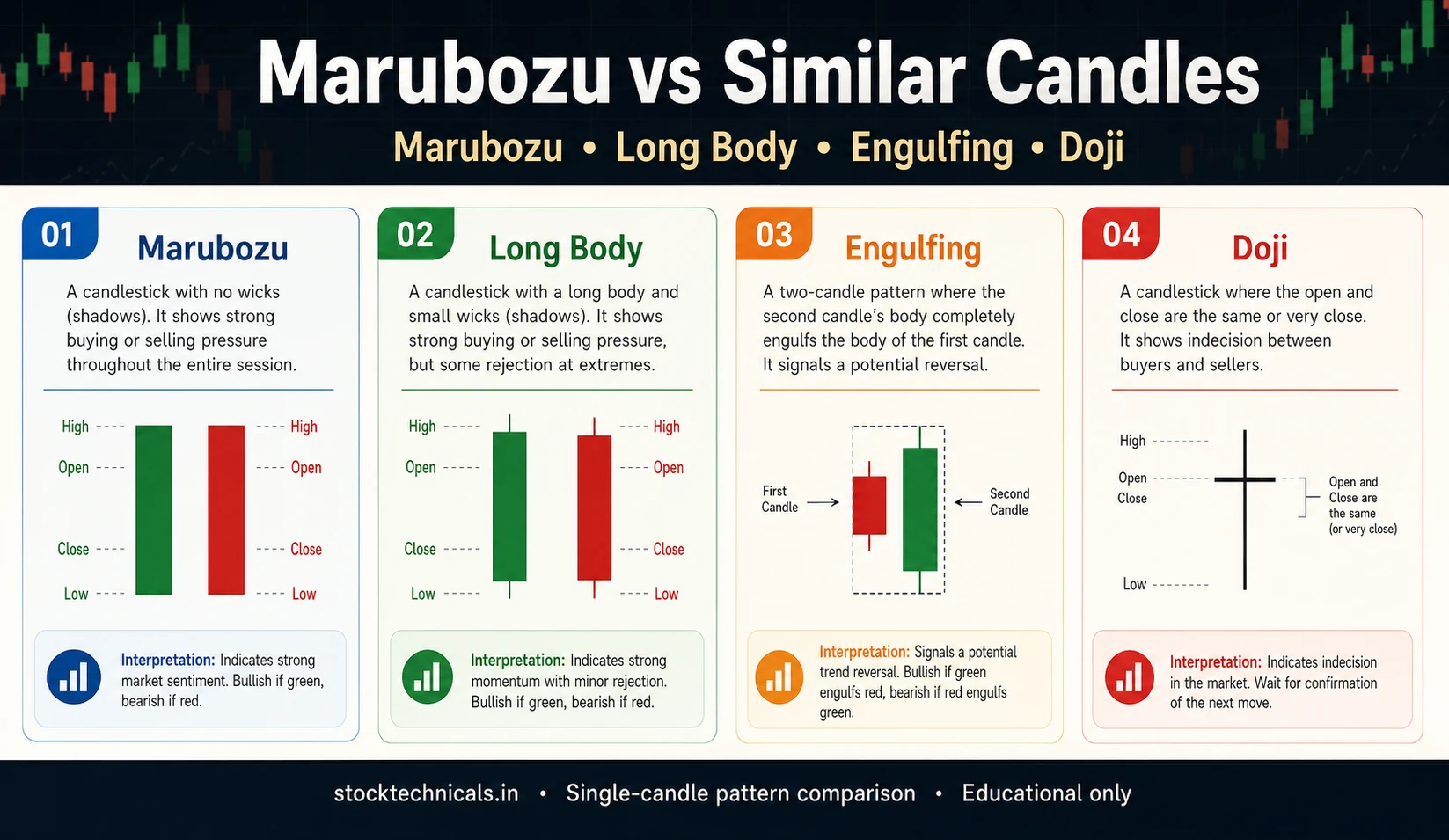
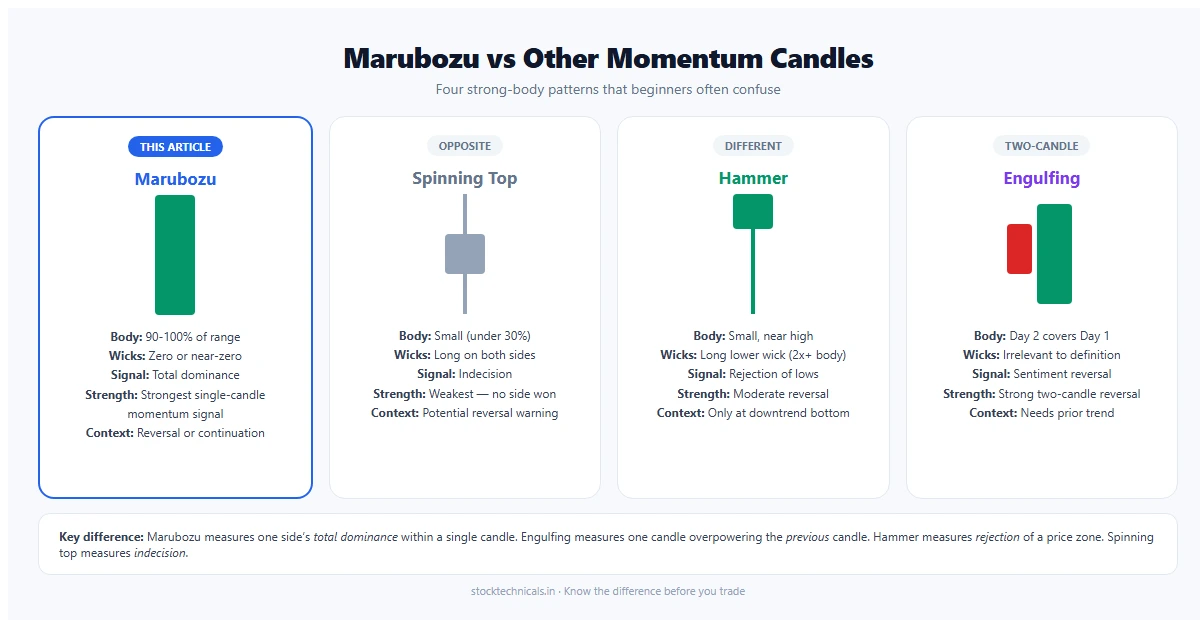
The key difference between a Marubozu and a normal bullish or bearish candle is conviction and control. A regular candle might show some back-and-forth (upper and lower shadows indicate rejection at price levels). A Marubozu shows one side was so dominant that the other side never even got a foothold.

Why does this matter for trading?

In the stock market, candlesticks represent price battles. Every candle is a war between buyers and sellers. When you see a long upper shadow on a candle, it means buyers pushed the price higher, but sellers came in and pushed it back down. When you see a lower shadow, it means sellers tried to push the price down, but buyers stepped in and recovered.

A Marubozu has no negotiation. No retreat. Just pure dominance by one side over the entire period.

Think of it this way: if you see a Bullish Marubozu on HDFC Bank’s daily chart, it means throughout that entire day (9:15 AM to 3:30 PM IST), buyers were continuously in control. Every time sellers appeared, buyers absorbed their selling and pushed higher. By closing time, the price was at the day’s high. That’s strong conviction, and institutional traders respect that.


Types of Marubozu: The Three Main Variations

Types Of Marubozu

Not all Marubozu candles are identical. There are three distinct types based on where the shadows appear—and understanding the difference helps you grade their strength.

Full Marubozu (Perfect Marubozu)

04 Bullish Marubozu

Definition: No shadows on either end. The candle body runs from the absolute low to the absolute high (or vice versa for bearish).

Bullish Full Marubozu:

  • Open = Low of the period (or within 0.2-0.3%)
  • Close = High of the period (or within 0.2-0.3%)
  • No upper shadow, no lower shadow
  • Looks like a solid rectangle

Bearish Full Marubozu:

  • Open = High of the period (or within 0.2-0.3%)
  • Close = Low of the period (or within 0.2-0.3%)
  • No shadows on either side

Strength: Grade A (strongest). A perfect Marubozu is rare and indicates 100% control by one side. Every single tick within that period favored the buyers (or sellers). This is the signal you want to see.

Example: TCS opens at ₹3,200 and by close it’s at ₹3,250 with no upper shadow and no lower shadow = Bullish Full Marubozu. Buyers dominated the entire day.

Open Marubozu (One Side Naked)

05 Bearish Marubozu

Definition: The candle has no shadow on the open side, but has a small shadow on the close side.

Bullish Open Marubozu:

  • Open = Low of the period (no lower shadow)
  • Close = Below the high (has a small upper shadow)
  • Buyers controlled from the start but faced some resistance at the top

Bearish Open Marubozu:

  • Open = High of the period (no upper shadow)
  • Close = Above the low (has a small lower shadow)
  • Sellers controlled from the start but faced some buying pressure near the bottom

Strength: Grade B (strong, but slightly less than Full). The Open Marubozu tells you one side had complete control at the open, but mild resistance appeared near the close. Still very bullish or bearish, but not quite as clean.

Example: Reliance opens at ₹2,500 and by close it’s at ₹2,540, but there’s a small ₹10-15 wick at the top showing some seller resistance in the final moments. Still very strong bullish signal because buyers controlled the entire session from the open.

Close Marubozu (Close Side Naked)

06 Quality Grades

Definition: Small shadow on the open side, no shadow on the close side.

Bullish Close Marubozu:

  • Open = Above the low (has a small lower shadow)
  • Close = High of the period (no upper shadow)
  • Sellers tried early but buyers recovered and closed at the top

Bearish Close Marubozu:

  • Open = Below the high (has a small upper shadow)
  • Close = Low of the period (no lower shadow)
  • Buyers tried early but sellers recovered and closed at the bottom

Strength: Grade B (strong, but the timing of conviction is different). The Close Marubozu shows that one side took control later in the session. There was brief resistance early, but by the close, one side was in complete command.

Example: ITC opens and early traders try to push it down (small lower shadow), but buyers step in and buy aggressively, closing near the top with no upper shadow. This shows conviction came mid-session or late, not from the start. Still strong, but different psychology than an Open Marubozu.


Bullish Marubozu: When Buyers Are In Complete Control

07 Continuation Vs Reversal

A Bullish Marubozu is one of the most straightforward bullish signals on a chart. Here’s the psychology:

What’s happening during a Bullish Marubozu:

  • The open rings, and buyers step in immediately. Maybe there’s bad news from yesterday, or the market opened slightly below expectations. But buyers saw value and started buying.
  • Throughout the period, every dip gets bought. If the price tries to pull back 5-10 paise, institutional money and retail traders step in and absorb the selling. The lower shadow never develops because there’s just too much buying pressure.
  • Sellers give up. After trying to push lower early and failing repeatedly, sellers realize the trend is strongly against them. Some cover their short positions (which adds more buying). Others just stay on the sidelines.
  • The close arrives at the high. The candle closes at or very near the high of the period because buyers had uninterrupted control.
  • The message: “We own this price level now. We’re not going back down.”

Real example from NSE:

Let’s say Bank Nifty (NSE’s banking index) closed at ₹50,000 yesterday afternoon. Today, it opens at ₹49,950—slightly down. But throughout the trading session (9:15 AM to 3:30 PM), institutional traders aggressively buy. Every dip to ₹49,900 gets bought. By lunch, it’s at ₹50,050. By close, it’s at ₹50,150 with barely any upper shadow and no lower shadow. That’s a Bullish Marubozu. And institutional traders watching this know: “Okay, the smart money is aggressively accumulating. This trend is likely to continue tomorrow.”

Why traders trust Bullish Marubozu:

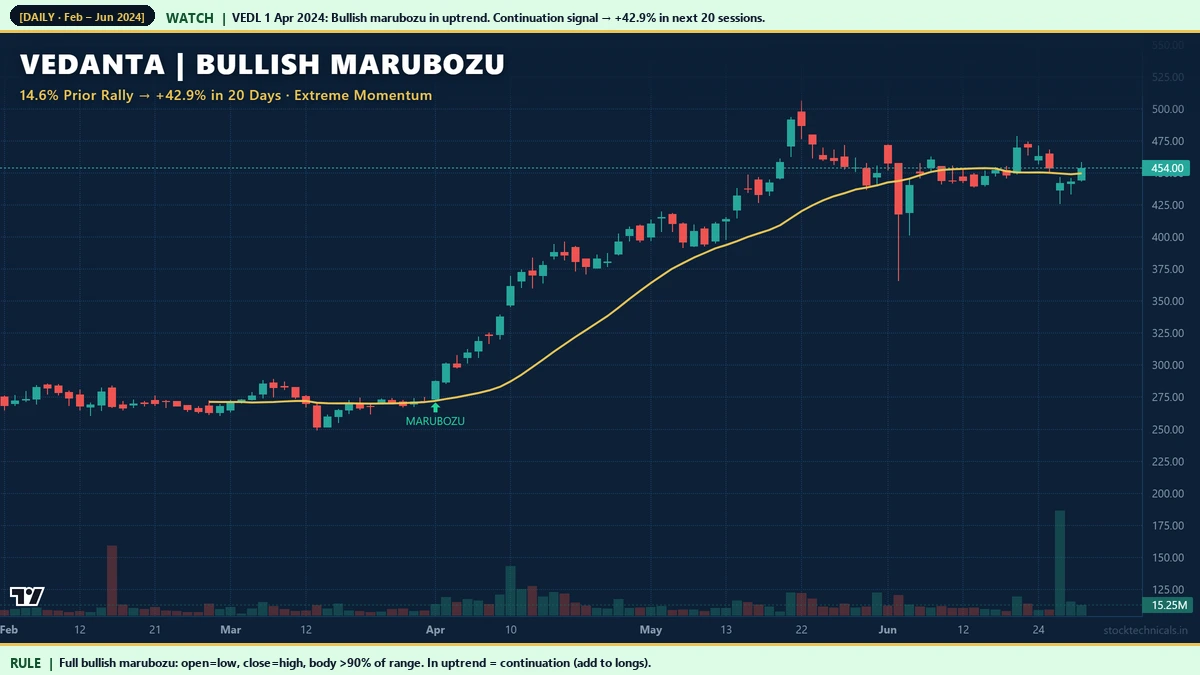
  • It shows continuation strength if you’re already in an uptrend (the trend just proved it can push higher with power)
  • It shows reversal conviction if it appears at the bottom of a downtrend (strong hands bought aggressively despite the downtrend)
  • It shows breakout strength if it appears right after breaking above resistance (the breakout wasn’t a fake-out; real money is backing it)


Bearish Marubozu: When Sellers Control the Entire Period

11 Marubozu Continuation Chart
08 Trading Rules

A Bearish Marubozu is the exact opposite story—but equally powerful for confirming downward moves or reversals.

What’s happening during a Bearish Marubozu:

  • The open arrives with selling pressure. Maybe earnings came out negative, or there’s bad macro news. Sellers are aggressive from the open.
  • Buyers keep getting trapped and trapped. Every attempt to buy the dip fails. If the price tries to bounce ₹5-10 above the open, sellers hammer it back down. The lower shadow gets minimal because there’s no buying conviction.
  • Panic accelerates the decline. As traders see Sellers in control, some try to exit long positions. This adds more selling pressure. Short-sellers pile in. By mid-day, it’s clear who’s winning.
  • The close arrives at or near the low. Sellers took control from open to close with no meaningful recovery.
  • The message: “We’re pushing this price lower, and there’s nothing you can do about it today.”

Real example from NSE:

Infosys stock was up 15% last week. Today, disappointing Q3 guidance hits the market. The stock opens at ₹1,450 but immediately gets sold. By 10:30 AM, it’s at ₹1,430. Traders who bought yesterday try to exit but find no buyers. By noon, it’s at ₹1,400. By close, it’s at ₹1,380 with no lower shadow (no buying support) and barely any upper shadow (sellers had complete control). That’s a Bearish Marubozu. Traders watching this know: “Smart money is exiting or shorting. This could continue lower tomorrow.”

Why traders respect Bearish Marubozu:

  • It confirms trend continuation in a downtrend (the decline just proved it can push lower with force)
  • It signals reversal strength if it appears at the top of an uptrend (significant selling on a day that looked like it should be bullish)
  • It confirms breakdown commitment if it appears right after breaking below support (the breakdown is real; panic-selling is underway)


How to Identify Quality Marubozu: Grade Your Candles

11 Trading Rules Detail
09 Best Locations

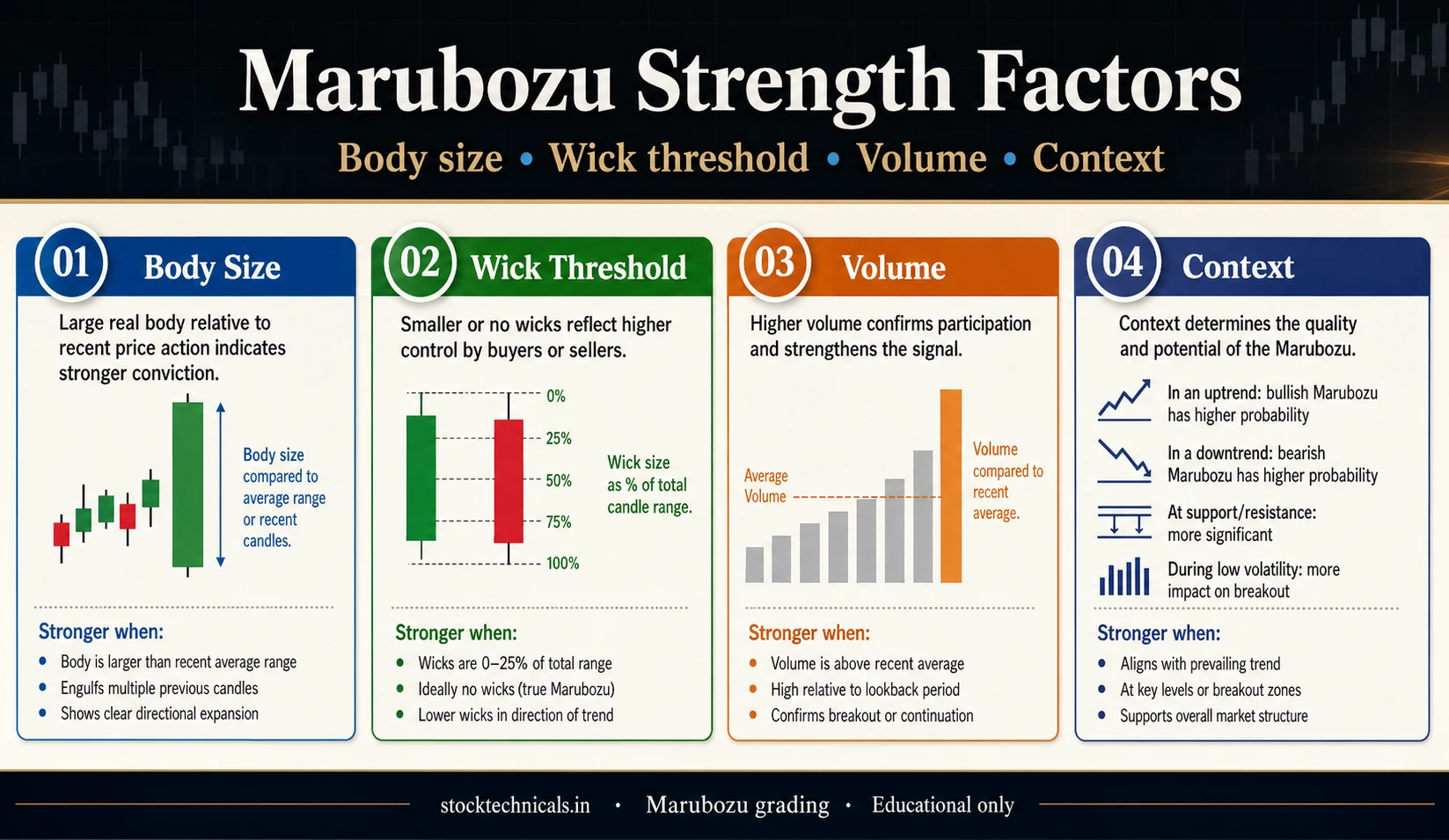
Not every Marubozu is equally strong. Some are textbook-perfect; others are borderline. Here’s how to grade them:

Grade A Marubozu (Strongest)

10 Common Mistakes

Criteria:

  • Shadows are nearly zero (within 0.1-0.2% of the body)
  • Body size is large relative to the last 10 candles (at least 1.5x the average)
  • Volume is significantly above average (at least 1.5x to 2x normal)
  • Close is at the absolute extreme (high or low of the period)

Example: Reliance has been ranging for 5 days with average body size of ₹20. A Bullish Marubozu appears with a ₹35 body, no shadows, and volume 2x normal. Grade A. This is the signal traders are hunting for.

Trading action: This is a legitimate entry signal on its own, especially if it appears at support or breakout levels.

Grade B Marubozu (Strong)

12 Common Mistakes Detail

Criteria:

  • Shadows are small (0.3-0.5% of the body)
  • Body size is 1.2-1.5x the average
  • Volume is above average (1.2-1.5x normal)
  • Close is near the extreme but not at it

Example: TCS shows a Bullish Open Marubozu (no lower shadow, small upper shadow) with a ₹25 body vs. ₹15 average body. Volume is 1.4x normal. Grade B. Still very strong.

Trading action: A very tradeable signal, but wait for additional confirmation (next candle follow-through or a move above the Marubozu high).

Grade C Marubozu (Borderline)

Criteria:

  • Shadows are noticeable (0.5-1% of the body)
  • Body size is only 1.1-1.2x the average
  • Volume is only 1.1-1.2x normal
  • Close is somewhat near the extreme but not conclusive

Example: HDFC Bank shows a Bullish Close Marubozu with a ₹18 body vs. ₹16 average, small upper shadow, and volume only 1.15x normal. Grade C. This is borderline.

Trading action: Needs multiple confirmations. Don’t trade on the Marubozu alone. Wait for price to break above it with volume, or confirmation from an indicator.

How to grade quickly:

On your chart (Zerodha, TradingView), ask yourself:

  1. How big is this body vs. the last 10 candles? (Small = weak, Large = strong)
  2. How clean are the shadows? (No shadows = strongest, visible shadows = weaker)
  3. Is volume noticeably above normal? (Yes = stronger, not much above = weaker)

If all three are strong = Grade A. If two are strong = Grade B. If one is strong = Grade C.


Marubozu as Continuation vs. Reversal: Context Matters

A Marubozu isn’t inherently bullish or bearish. Its meaning depends on where it appears on the chart.

Bullish Marubozu as Continuation Signal

Setup: You’re in an uptrend. Prices have been rising for 5-10 candles. Then a Bullish Marubozu appears.

Meaning: The uptrend is strong. Buyers are still aggressively in control. No hesitation. The trend will likely continue higher.

Psychology: Even after the uptrend, buyers aren’t losing conviction. They’re still dominant. This is confirmation that the buying pressure is sustainable.

Example: Nifty 50 has been up for 8 days. On day 9, a Bullish Marubozu appears at ₹21,500. This tells traders: “The uptrend still has strength. Fresh buying is happening.” Traders add to long positions.

Bullish Marubozu as Reversal Signal

Setup: You’re in a downtrend. Prices have fallen for 5-10 candles. Then a Bullish Marubozu appears at or near the bottom.

Meaning: The downtrend is reversing. Buyers have stepped in aggressively despite the downtrend. This signals a potential bottom.

Psychology: Even with the trend against them, buyers stepped up and took control. This shows conviction from strong hands. The selling exhaustion might be over.

Example: Bank Nifty has been down for 7 days, losing ₹500. On day 8, a Bullish Marubozu appears at ₹49,500—right where previous support exists. This tells traders: “Smart money is buying. The downtrend may be ending.” Traders start covering shorts and entering long positions.

Bearish Marubozu as Continuation Signal

Setup: You’re in a downtrend. A Bearish Marubozu appears.

Meaning: The downtrend is confirmed. Sellers are still in control with no hesitation. The decline will likely continue.

Example: Sensex has been down for 5 days. A Bearish Marubozu appears. This confirms the sellers are still strong, and lower prices might come.

Bearish Marubozu as Reversal Signal

Setup: You’re in an uptrend. A Bearish Marubozu appears near the top.

Meaning: The uptrend is reversing. Aggressive selling has appeared despite the uptrend. This could be a top.

Example: Reliance has been up for 6 days. A Bearish Marubozu appears at ₹2,700—the recent high. This tells traders: “Strong selling is appearing. The uptrend may be exhausting.” Traders take profits and exit long positions.

Key insight: The same pattern (Marubozu) means different things depending on context. Always ask: “Where on the chart is this appearing? Are we in a trend or at a turning point?”


Trading Rules: Entry, Stop Loss, and Targets

Now for the practical part: how to actually trade using Marubozu candles.

Entry Rules

For Bullish Marubozu:

  • Same-candle entry (aggressive): Enter right at the close of the Bullish Marubozu if:
  • It’s Grade A or B
  • Volume is above average
  • It appears at a support level or breakout point
  • Risk: You’re entering after the move has happened; if the next candle reverses, you’re caught
  • Next-candle confirmation (conservative): Wait for the next candle to close above the Marubozu high before entering.
  • Less risk of fake-out
  • You sacrifice some upside if the move accelerates
  • Recommended for beginners

For Bearish Marubozu:

  • Same-candle entry (aggressive): Enter right at the close if:
  • It’s Grade A or B
  • Volume is above average
  • It appears at a resistance level or breakdown point
  • Next-candle confirmation (conservative): Wait for the next candle to close below the Marubozu low before entering.

Stop Loss Placement

For Bullish Marubozu (long position):

  • Conservative: Place stop loss at the low of the Marubozu (or slightly below)
  • Moderate: Place stop loss halfway between the open and close of the Marubozu
  • Aggressive: Place stop loss at the previous support level below the Marubozu

For Bearish Marubozu (short position):

  • Conservative: Place stop loss at the high of the Marubozu (or slightly above)
  • Moderate: Place stop loss halfway between the open and close
  • Aggressive: Place stop loss at the previous resistance level above the Marubozu

Example: You enter long on a Bullish Marubozu on TCS that has a body from ₹3,200 (open) to ₹3,250 (close). Your conservative stop loss: ₹3,199 (just below the low). Your moderate stop loss: ₹3,225 (halfway). Your aggressive stop loss: ₹3,190 (previous support).

Target Setting

General rule: Your target should be at least 2-3x your risk (risk-reward ratio of 1:2 or 1:3).

For Bullish Marubozu:

  • Target 1: Previous resistance level above the Marubozu
  • Target 2: A distance equal to 2x the Marubozu body above the high
  • Example: Bullish Marubozu close at ₹3,250, body size ₹50. Stop loss at ₹3,199 (risk = ₹51). Target 1 at ₹3,280 (profit = ₹30, ratio 1:0.6 — partial take-profit). Target 2 at ₹3,350 (profit = ₹100, ratio 1:2 — full profit target).

For Bearish Marubozu:

  • Target 1: Previous support level below the Marubozu
  • Target 2: A distance equal to 2x the Marubozu body below the low


Best Locations for High-Probability Marubozu Trades

Where a Marubozu appears matters just as much as its quality. Here are the 5 locations where Marubozu signals are most reliable:

Right After a Breakout Above Resistance

Setup: A stock has been consolidating below a resistance level (say ₹500 for Paytm). It finally breaks above ₹500, and the breakout candle is a Bullish Marubozu with high volume.

Why it’s powerful: The Marubozu proves the breakout is real, not a fake-out. Buyers are aggressively pushing higher. Resistance is breaking.

Trade: Enter long on the close of the Marubozu or wait for next-candle confirmation.

Right After a Breakdown Below Support

Setup: A stock has been consolidating above a support level (say ₹1,200 for ICICI Bank). It breaks below, and the breakdown candle is a Bearish Marubozu with high volume.

Why it’s powerful: The Marubozu proves the breakdown is real. Sellers are in control. Support is breaking.

Trade: Enter short on the close of the Marubozu or wait for next-candle confirmation.

At a Key Support Level (Bullish Reversal)

Setup: A stock is falling and approaches a key support level (previous low, moving average, or round number). A Bullish Marubozu appears right at that support.

Why it’s powerful: It shows that even with the downtrend, strong hands are buying at support. Reversal conviction.

Trade: Enter long at the close of the Marubozu or next candle.

At a Key Resistance Level (Bearish Reversal)

Setup: A stock is rising and approaches a key resistance level. A Bearish Marubozu appears right at that resistance.

Why it’s powerful: It shows that sellers are stepping in aggressively at resistance. Reversal conviction.

Trade: Take profits on long positions or enter short positions.

During news/results announcements (Strong Conviction)

Setup: A company releases results or news. If the stock gaps and then forms a Marubozu in the direction of the gap (Bullish Marubozu for good news, Bearish for bad news), it shows institutional conviction.

Why it’s powerful: The gap + Marubozu combo shows the entire market (institutions, retail, algorithms) are aligned in one direction.

Trade: Enter in the direction of the Marubozu. Follow institutional money.

Example: TCS releases Q3 results showing 15% earnings growth. Stock gaps up ₹50. Throughout the session, it forms a Bullish Marubozu with 3x normal volume. This tells you: institutions are buying. Trend is likely strong.


Common Mistakes That Trap Even Intermediate Traders

Chasing After a Large Marubozu Has Already Moved Significantly

The trap: You see a beautiful Grade A Bullish Marubozu on your 3 PM chart review. You’re excited and enter at market price. But the Marubozu already ran ₹40 from open to close. There’s limited momentum left. The next day, it gaps down.

The fix: Don’t chase Marubozu candles after they’ve already moved far. Use them as confirmation for moves you already identified earlier, not as a buy signal after the move.

Ignoring the Next-Day Follow-Through

The trap: A Bullish Marubozu appears, and you enter immediately. But the very next candle opens down and closes down. The Marubozu was a fake signal.

The fix: Always wait for at least one follow-through candle. A genuine Bullish Marubozu should see buying pressure continue the next day. If the next day is bearish, it’s a fake signal. Exit immediately.

Not Adjusting Your Stop Loss for the Candle’s Size

The trap: You place a tight stop loss (like 1% below a large Marubozu) because you’re used to trading smaller candles. The stock has normal intraday volatility, hits your stop, then continues in your intended direction. You’re whipsawed out.

The fix: The larger the Marubozu body, the larger your stop loss needs to be. A Grade A Marubozu with a ₹50 body on Reliance needs a wider stop loss (maybe ₹40-50) than a ₹5 body Marubozu.

Confusing a Near-Marubozu with a Real One

The trap: A candle has a small upper shadow (1% of body) and you treat it like a Grade A Marubozu. But it’s really a borderline Grade C. You risk the same position size on a weaker signal.

The fix: Grade your candles honestly. If it has noticeable shadows, it’s Grade B or C. Adjust position size and confirm with additional signals before trading.

Trading Marubozu on the Wrong Timeframe

The trap: A Bullish Marubozu appears on the 1-minute chart, so you enter. But on the 5-minute chart, it’s showing bearish continuation. Your 1-minute trade gets stopped out in seconds.

The fix: Trade Marubozu signals on the timeframe you’re targeting. If you’re a swing trader, use daily or 4-hour Marubozu. If you’re intraday, use 5-minute or 15-minute. Don’t mix timeframes.

Ignoring Volume on the Marubozu

The trap: A Marubozu appears with normal or below-average volume. You assume it’s a real signal and trade it. But low volume means retail traders are behind it, not institutions. It reverses the next day.

The fix: Always check volume. A Grade A Marubozu must have significantly above-average volume (1.5-2x or more). If volume is normal or below-average, treat it as Grade C. Require additional confirmation before trading.


Combining Marubozu with Other Tools: Boost Your Accuracy

13 Marubozu With Ema Chart

A Marubozu is powerful on its own, but combining it with other technical tools makes your edge even stronger.

Marubozu + Volume

The combination: A Bullish Marubozu with 2x normal volume is much stronger than one with 1.1x normal volume.

How to use it: Ignore low-volume Marubozu. Only trade the high-volume ones. Volume confirms that institutions or algorithms are behind the move, not just random retail trading.

Marubozu + 20-Day EMA (Exponential Moving Average)

The combination: A Bullish Marubozu appearing right at the 20-day EMA (on a daily chart) is a bounce signal. A Bullish Marubozu appearing above the 20-day EMA is a continuation signal.

How to use it: On TradingView or Zerodha, add a 20-day EMA. When a Marubozu forms near or at that line, it’s a higher-probability trade.

Example: Bank Nifty is in an uptrend. The 20-day EMA is at ₹50,200. Price pulls back to ₹50,180 and a Bullish Marubozu forms. This is a bounce setup. Very tradeable.

Marubozu + Support/Resistance

The combination: A Marubozu at a key S&R level is stronger than a Marubozu in the middle of nowhere.

How to use it: Draw your S&R levels on your chart. Look for Marubozu candles that form exactly at those levels. These are your highest-probability entries.

Marubozu + RSI (Relative Strength Index)

The combination: A Bullish Marubozu when RSI is below 40 (oversold) is a reversal signal. A Bullish Marubozu when RSI is above 60 (overbought) might be a fake-out.

How to use it: If you see a Bullish Marubozu and RSI is oversold, that’s confirmation that reversal is likely. If RSI is overbought, wait for RSI to cool off before trading.


Practice Exercise: Identify and Trade Marubozu

14 Practice Exercise

Open your trading platform (Zerodha Kite or TradingView) and do this:

  1. Pick a stock (TCS, Reliance, HDFC Bank, or any NSE stock)
  2. Switch to daily timeframe
  3. Scroll back 30 days and identify all Marubozu candles (both bullish and bearish)
  4. Grade each one (Grade A, B, or C based on body size, shadows, volume)
  5. Note the location — Is it at support, resistance, after a breakout, or in the middle of a trend?
  6. Mark entry and stop loss — Where would you enter if this was a real trade? Where’s your stop loss?
  7. See what actually happened — Did the trade work out? Did the Marubozu confirm a continuation or reversal?

Do this exercise with at least 20 Marubozu candles. You’ll start developing intuition for which ones work and which ones don’t.


Summary: Key Takeaways

  • A Marubozu is a candlestick with little to no wicks, showing complete dominance by buyers or sellers during that time period.
  • There are three types: Full Marubozu (no wicks at all), Open Marubozu (naked on the open side), Close Marubozu (naked on the close side).
  • Grade your Marubozu candles: Grade A (large body + high volume + no shadows) is strongest. Grade C (small body + normal volume + noticeable shadows) requires confirmation.
  • Context matters: A Bullish Marubozu in an uptrend = continuation signal. A Bullish Marubozu at a bottom = reversal signal.
  • Trade with proper risk management: Use conservative stop losses (below/above the Marubozu) and target 2-3x your risk.
  • The 5 best locations are: breakouts, breakdowns, support reversals, resistance reversals, and news/results gaps.
  • Combine with volume, moving averages, support/resistance, and RSI to confirm your Marubozu trades.
  • Avoid 6 common mistakes: chasing late, ignoring follow-through, tight stops, confusing Grade C for Grade A, wrong timeframes, and ignoring volume.
  • Paper trade first: Practice identifying and trading Marubozu patterns on a practice account before real money.
  • Patience wins: Don’t trade every Marubozu. Wait for Grade A candles at key levels. Quality over quantity.

FAQ: 7 Questions About Marubozu Candles

Q1: Can I trade Marubozu candles on intraday charts (1-minute, 5-minute)?

A: Yes, but with caution. Marubozu candles are more reliable on higher timeframes (4-hour, daily, weekly). On 1-minute or 5-minute charts, they’re noisier and whipsawed more easily. If you do trade them intraday, grade strictly (Grade A only) and combine with volume and support/resistance. Beginners should avoid intraday Marubozu trading.

Q2: What’s the difference between a Marubozu and a large regular candle?

A: A large regular candle has visible upper and/or lower shadows, showing some back-and-forth between buyers and sellers. A Marubozu has no (or near-zero) shadows, showing clean dominance with no negotiation. A large candle might move ₹50 but with ₹10 upper shadow and ₹5 lower shadow. A Marubozu moves ₹50 with almost no shadows.

Q3: Is a Bearish Marubozu on a stock I hold a reason to sell immediately?

A: Not immediately, but it’s a warning sign. If it’s Grade A, appears at a resistance level or on high volume during a rally, it suggests a top might be forming. Take at least partial profits or tighten your stop loss. Don’t sell everything in panic, but de-risk your position.

Q4: How common are true Grade A Marubozu candles?

A: They’re rare. Grade A Marubozu candles (perfect body, no shadows, high volume, large size) appear maybe once every 20-30 trading days on a daily chart. That’s why they’re so powerful—markets rarely show such clean conviction. Grade B and C are more common, which is why they need confirmation.

Q5: Can I combine Marubozu patterns with moving averages as my only tools?

A: You can, but it’s not ideal. Marubozu + 20-day EMA + support/resistance is more reliable than Marubozu + EMA alone. Add volume as the third confirmation. The more confirmations, the higher your edge.

Q6: What’s the best timeframe for learning Marubozu trading?

A: Start with daily charts. They’re cleaner, less noisy, and have better volume data. After you master daily, move to 4-hour charts. Only after you’re consistent on 4-hour should you try intraday Marubozu trading. Beginners who jump straight to 1-minute Marubozu trading get whipsawed.

Q7: If a stock gaps overnight, does a Marubozu form differently?

A: Yes. If a stock gaps up (opens significantly higher than close), the low of the candle will be the open, not lower. A Bullish Marubozu on a gap-up day has the gap as the low. This is still a valid Grade A signal if volume is very high and it’s in the direction of the gap. In fact, gap + Marubozu is one of the strongest institutional moves.


Last updated: 7 March 2026

Useful Resources: TradingView (chart analysis) | Zerodha Varsity Candlestick Module (reference) | NSE India (live data)

Frequently Asked Questions

Related Articles You Should Read Next

What is a marubozu candlestick?

A marubozu is a candlestick with no upper or lower wicks, meaning the open equals the high (or low) and the close equals the low (or high). It signals complete dominance by either buyers (bullish marubozu) or sellers (bearish marubozu) during the entire session.

What does a bullish marubozu signal?

A bullish marubozu (green candle with no wicks) signals that buyers were in total control from open to close. The price opened at the low and closed at the high of the session. It indicates strong buying momentum and often precedes further upward movement.

What does a bearish marubozu signal?

A bearish marubozu (red candle with no wicks) signals that sellers dominated the entire session. The price opened at the high and closed at the low. It indicates strong selling pressure and often precedes further downward movement.

How do you trade a marubozu candlestick?

For a bullish marubozu, enter long on the next candle with a stop loss below the marubozu low. For a bearish marubozu, enter short below the next candle with a stop loss above the marubozu high. Target a 1:2 risk-reward ratio minimum.

Are marubozu candles rare?

Perfect marubozu candles with absolutely zero wicks are relatively rare. Most traders accept near-marubozu candles where the wicks are very small (less than 5-10% of the total candle range). These near-marubozu candles carry similar significance and appear more frequently.

This article is for educational purposes only. It does not constitute financial advice or a recommendation to buy or sell any security. I am not a SEBI-registered investment advisor. Always do your own research and consult a SEBI-registered advisor before trading. Trading in financial markets involves significant risk of loss.

Leave a Comment

Font: