
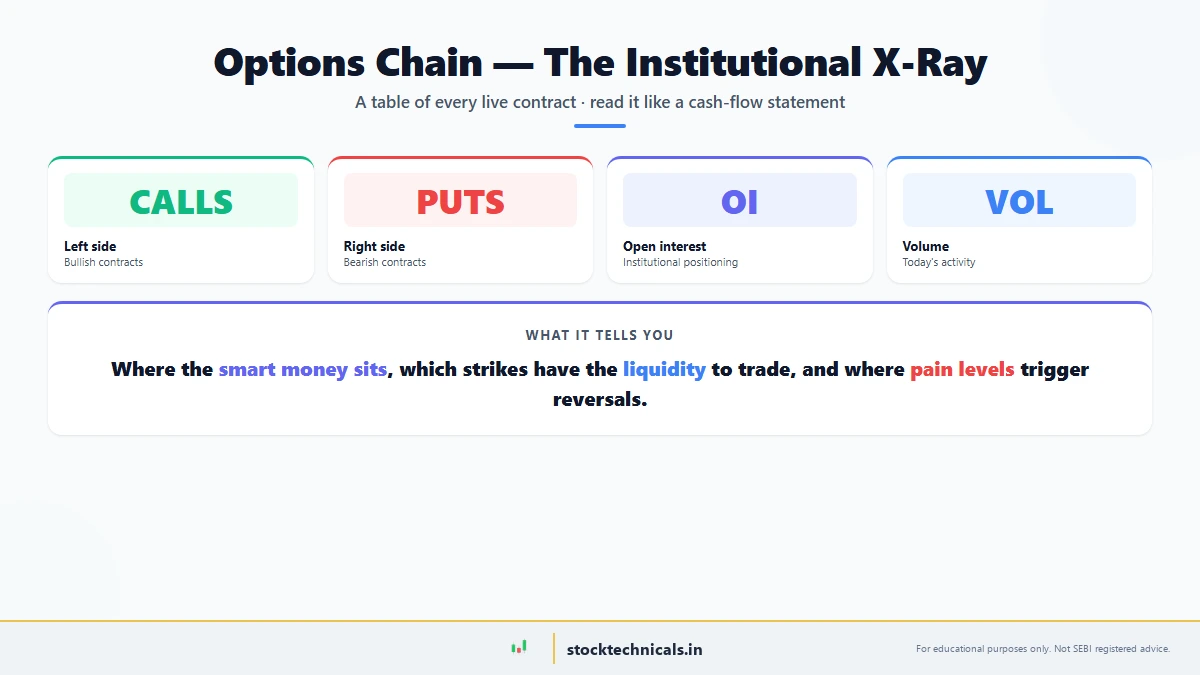
Quick Answer: An options chain is the table showing every available call and put contract for a stock or index at different strikes and expirations. Calls on the left, puts on the right, strike price in the middle. Each row has LTP, volume, open interest (OI), bid-ask spread, and Greeks. Read OI to see institutional positioning. Read volume to see current activity. Read bid-ask spread to avoid illiquid strikes.
Published March 3, 2026 · Last refreshed April 27, 2026. Prices and data are compiled with reasonable care but — always confirm against your broker before trading.
Options Chain: How to Read Open Interest, Volume, and Spread

Article Number: 81
Introduction
If options trading were a foreign country, the options chain would be the map. Without it, you’re wandering blind. With it, you can see where institutional money is positioned, where price might reverse, and which strikes have the highest probability of profit.
Most beginners do one of two things when they first see an options chain: they panic at the wall of numbers, or they ignore it completely and just trade on gut feeling. Both mistakes cost money.
Key Takeaways
- The options chain is your institutional X-ray — OI clusters show where big money is positioned and defending.
- Open Interest is cumulative (all open positions); Volume is daily activity. High OI + high volume = active, liquid strike.
- ATM strikes are closest to current spot; ITM carries intrinsic value; OTM is pure premium and decays fast.
- Wide bid-ask spread (>1%) means illiquid — avoid, your slippage alone can eat half the trade.
- Use Zerodha Kite, Sensibull, or NSE site for the chain. All three show the same data; pick one and learn it well.
The options chain (also called the option board or options ladder) is simply a table showing all available options contracts for a stock or index at different strike prices and expiration dates. Every row represents a different strike price. Every column represents key trading metrics: price, volume, open interest, Greeks, bid-ask spread, and more.
Why does this matter? Because the options chain is where professional traders read the institutional roadmap. Open interest tells you where big money is trapped. Volume shows you where today’s action is happening. The bid-ask spread reveals whether a strike is liquid or a dead zone. The Greeks tell you how sensitive an option is to price movement.
In this complete guide, you’ll learn exactly what each column means, how to interpret what the chain is telling you, and how to use it to make smarter trading decisions.
What is an Options Chain?


An options chain is a complete listing of all available options contracts for a given stock, index, or underlying asset across all strike prices and expiration dates.
Think of it as a marketplace display. Just like a vegetable vendor displays tomatoes at different price points (small tomatoes at ₹20/kg, medium at ₹25/kg, large at ₹30/kg), the stock exchange displays options contracts at different strike prices.
Why is the Options Chain Powerful?
- Transparency — You see every contract available, not just the ones your broker wants to promote. No hidden products.
- Market Positioning — The open interest (OI) in the options chain shows where big institutions have positioned their money. High OI at a strike means many traders/institutions are betting on or defending that level.
- Liquidity Signals — Volume in the chain shows which strikes are being traded actively and which are dead. Trading illiquid options is like trying to sell a house in a ghost town — you’ll get stuck with a bad price.
- Probability Indicators — The Greeks in the chain (especially delta) show you the statistical probability of an option finishing in-the-money (ITM). This is critical for deciding strike selection.
- Institutional Footprints — Options chains reveal where big money is standing. If open interest is extremely high at one strike, institutions are either protecting against that price level or betting heavily on it.
Trading Rule: The options chain is not just a list. It’s a conversation between retail traders and institutions. If you learn to read it, you’re eavesdropping on that conversation.
How to Read Options Chain: The Call Side (Left Half)

Most options chain displays show two halves: calls on the left, puts on the right. This symmetry makes sense because at any given strike, you can either buy/sell a call or buy/sell a put.
Let’s focus on the left side first (calls). Don’t worry if the right side (puts) looks confusing yet — it follows the exact same logic.
The Six Critical Columns (Call Side)
When you open the options chain on Zerodha Kite or any broker platform, you’ll see:
Strike Price (Center) — This is the fixed price at which the call holder has the right to buy the underlying. If Nifty 50 is trading at 23,500, you might see strikes at 23,400, 23,500, 23,600, 23,700, etc.
LTP (Last Traded Price) — The price the call option traded at most recently. If the 23,600 call LTP is ₹45, it means the last buyer paid ₹45 to buy the right to buy Nifty at 23,600.
Open Interest (OI) — The total number of outstanding call contracts at that strike. If 23,600 call has OI of 500,000, it means 500,000 call contracts are currently open (not yet closed or exercised). High OI = liquidity + institutional interest. Low OI = hard to exit quickly.
Volume (V) — How many contracts traded today at this strike. High volume suggests active trading; low volume suggests thin trading.
Bid-Ask Spread — The difference between the highest price a buyer is willing to pay (bid) and the lowest price a seller is willing to accept (ask). A tight spread (₹1 difference) is good. A wide spread (₹5+ difference) means you’ll lose money on entry and exit.
Greeks (Delta) — Most platforms show delta, which represents how much the call price will move for every ₹1 move in the underlying. A delta of 0.50 means the call gains ₹0.50 when Nifty rises ₹1.
Example: Nifty 50 Call Chain at 23,500
Imagine Nifty 50 is at 23,500. You look at the 23,600 call strike (100 points above current price):
“`
Strike: 23,600 | LTP: ₹45 | OI: 800,000 | Volume: 200,000 | Delta: 0.40
“`
This tells you:
- The 23,600 call costs ₹45 per contract (₹4,500 for one lot of 100 shares)
- 800,000 contracts are open (high liquidity)
- 200,000 contracts traded today (active strike)
- For every ₹1 Nifty moves up, this call gains ₹0.40
- Probability of finishing ITM is roughly 40% (based on delta)
Now compare it with the ATM strike (At The Money, same as current price):
“`
Strike: 23,500 | LTP: ₹85 | OI: 1,200,000 | Volume: 500,000 | Delta: 0.55
“`
The ATM call is more expensive (₹85 vs ₹45) but has higher OI and volume, meaning more traders are interested. The delta is higher (0.55), meaning it moves more per point.
Now look at an OTM strike (Out of The Money, higher strike):
“`
Strike: 23,700 | LTP: ₹12 | OI: 300,000 | Volume: 50,000 | Delta: 0.15
“`
The 23,700 call is cheap (₹12) but has lower OI and volume. The low delta (0.15) means it barely moves unless Nifty rallies hard. It’s like betting the stock will surge 200 points. Possible, but with lower probability.
How to Read Options Chain: The Put Side (Right Half)

The put side works identically, but in reverse. Instead of the right to buy, puts give the right to sell.
Understanding Put Columns
Strike Price — Same as calls. If 23,500 is ATM for the underlying, then 23,500 is ATM for both calls and puts.
LTP (Last Traded Price) — The price the put traded at. If 23,400 put LTP is ₹35, someone paid ₹35 to buy the right to sell at 23,400.
Open Interest (OI) — Counts how many put contracts are open. For puts, high OI at a lower strike often indicates bearish hedging (traders protecting against downside).
Volume — How many puts traded today.
Bid-Ask Spread — Same concept. Tight is good, wide is bad.
Greeks (Delta) — For puts, delta is negative. A delta of -0.40 means if Nifty drops ₹1, the put gains ₹0.40. Put delta runs from 0.0 (completely OTM) to -1.0 (deep ITM).
Example: Nifty 50 Put Chain at 23,500
“`
Strike: 23,400 | LTP: ₹35 | OI: 600,000 | Volume: 150,000 | Delta: -0.35
Strike: 23,500 | LTP: ₹70 | OI: 1,100,000 | Volume: 400,000 | Delta: -0.50
Strike: 23,300 | LTP: ₹8 | OI: 200,000 | Volume: 20,000 | Delta: -0.10
“`
The ATM put (23,500) is expensive and highly traded. The 23,400 put (ITM) is a hedge — traders buy it to protect against drops. The 23,300 put is a lottery ticket (high risk, low probability).
Key Insight: Compare OI between call and put sides. If calls have much higher OI, the market is bullish. If puts have higher OI, the market is hedging for downside.
Strike Price Zones: ATM, ITM, OTM Explained

To use the options chain effectively, you need to understand three strike zones. These zones determine the risk and reward profile of any option contract.
ATM (At The Money)
ATM is the strike price closest to the current price of the underlying. If Nifty 50 is at 23,500, the 23,500 strike is ATM (or closest to it).
Characteristics:
- Highest gamma — Most sensitive to price movement
- Moderate theta decay — Time value erodes moderately
- Balanced delta — Around 0.50 for calls, -0.50 for puts
- Highest volume and OI — Most traders flock here
- Highest bid-ask spreads (sometimes) — Lots of activity means competition
When to trade ATM:
- When you expect explosive price movement
- When you want to capture maximum theta decay (selling)
- When you want balanced risk-reward
ITM (In The Money)
ITM is any strike where the option has intrinsic value — where the option is profitable if exercised right now.
For calls: Any strike below current price (e.g., if Nifty is 23,500, the 23,300 call is ITM)
For puts: Any strike above current price (e.g., if Nifty is 23,500, the 23,600 put is ITM)
Characteristics:
- High delta — ITM calls have delta close to 1.0; ITM puts have delta close to -1.0
- Mostly intrinsic value — Very little time value to decay
- Low probability of loss for buyers (but capped upside potential)
- Often wider bid-ask spreads — Lower trading volume on ITM strikes
- Lower OI — Fewer traders interested (why buy expensive calls when ATM is cheaper?)
When to trade ITM:
- When you want high probability of profit (buying ITM)
- When you’re selling deep ITM puts as collateral plays
- When implied volatility is high and time value is fat enough to sell
OTM (Out of The Money)
OTM is any strike where the option has zero intrinsic value — it’s all time value. If Nifty is at 23,500:
- Calls at 23,600 and higher are OTM
- Puts at 23,400 and lower are OTM
Characteristics:
- Low delta — OTM calls have low delta (0.10-0.30); OTM puts similarly low
- All time value — 100% of the premium is time decay (theta)
- Cheap — Costs less than ATM or ITM
- High risk for buyers — Needs big move to profit
- Variable OI — Depends on how deep OTM and how liquid the strike is
When to trade OTM:
- When selling (theta decay is your friend)
- When you expect explosive directional move (lottery ticket mentality, but with defined risk)
- When implied volatility is sky-high and you want to fade it
The Big Picture
OTM options are lottery tickets. ITM options are insurance. ATM options are balanced bets. The options chain lets you see this entire risk spectrum in one screen.
Open Interest (OI) and Volume: Reading Institutional Money


This is where the options chain becomes a treasure map.
What Open Interest Really Means
Open Interest (OI) is the total number of outstanding options contracts at a given strike price. If 23,600 call has OI of 500,000, it means 500,000 call contracts are currently active (someone bought them, and they haven’t been closed yet).
Here’s what’s important: OI tells you how many people are currently in that contract with you.
High OI = Liquid. You can enter and exit easily.
Low OI = Illiquid. You might get stuck or get a bad price.
OI Buildup Patterns
When you scan the options chain, you’ll notice OI is not evenly distributed. Some strikes have enormous OI; others have tiny OI. This distribution reveals where institutional money is positioned.
1. Strongest Support Level (Put OI Buildup)
If you see extremely high put OI at a certain strike (say, 23,400 put has 2,000,000 OI while other puts have 400,000), it means institutions have bought massive protective puts at 23,400. Why? Because they believe Nifty won’t fall below 23,400. That strike becomes a hard floor.
example: During market sell-offs, you’ll see put OI pile up at round numbers or recent support levels. Banks, insurance companies, and hedge funds buy puts as insurance. The mere fact that this insurance is positioned at 23,400 acts as a barrier — it’s a signal that big money is ready to buy if price breaks below.
2. Resistance Levels (Call OI Buildup)
Similarly, if you see high call OI at a strike above current price (say, 23,700 call has 1,500,000 OI), institutions are betting Nifty will go to 23,700 or they’re collecting premium by selling calls there. Either way, that strike becomes resistance. It’s where sellers might emerge.
3. Expiration Quadrant (Max Pain)
On expiration day, the options chain reveals something fascinating: there’s often a “pain point” where maximum number of options expire worthless. This is called max pain. Institutions often push price toward max pain on expiration days to minimize their losses.
You can roughly identify max pain by looking at where combined put + call OI is highest, then finding the strike with highest total OI. That’s often where price clusters on expiration.
Volume vs. OI: The Difference
Don’t confuse these two:
OI = How many contracts are currently open (accumulated over days/weeks)
Volume = How many contracts traded TODAY
A strike can have:
- High OI + Low Volume = Old positions, nobody trading
- Low OI + High Volume = New activity, fresh interest
- High OI + High Volume = Liquid, institutional interest
When you see volume spike on a particular strike while OI is dropping, it means positions are being closed. People are taking profits or cutting losses. When volume spikes and OI rises, new positions are opening. This is the difference between profit-taking and new conviction.
For practical trading: Stick to strikes with OI above 200,000 (for Nifty and Bank Nifty (NSE: BANKNIFTY)). Anything lower is too thin.
Bid-Ask Spread and Liquidity: Don’t Get Whipsawed

One of the biggest mistakes beginners make is ignoring the bid-ask spread. They focus only on LTP and get crushed on entry and exit.
Understanding Bid-Ask Spread
Bid = Highest price someone is willing to buy at right now
Ask = Lowest price someone is willing to sell at right now
If you see: Bid: ₹48 | Ask: ₹50
And you place a market buy order, you’ll buy at ₹50 (the asking price). You’re immediately down ₹2 per contract. On a 100-share contract, that’s ₹200 loss before the trade even moves.
Impact on Your Wallet
Imagine you trade the 23,600 call:
- Spread is tight (₹1): You buy at ₹46, sell at ₹45. Loss on round-trip: ₹200 (₹1 × 100)
- Spread is wide (₹5): You buy at ₹48, sell at ₹43. Loss on round-trip: ₹1,000 (₹5 × 100)
That’s a 5x difference in your costs. Most beginners don’t even track this. Over 10 trades, that’s ₹4,000-₹8,000 in hidden costs.
How to Identify Liquid Strikes
- Check OI — Must be above 200,000 for Nifty/Bank Nifty
- Check bid-ask spread — Should be ₹1-₹2 at most
- Check volume — Should be actively trading (10,000+ contracts today)
- Place limit orders, not market orders — Buy at bid, sell at ask, or split the difference
Rule: Never trade a strike with bid-ask spread wider than ₹3. The friction costs will destroy your edge.
Reading the Greeks: Delta, Gamma, Theta, Vega

The Greeks are fancy names for how much the option price changes based on different factors. You don’t need to memorize the math, but you need to understand the trading implications.
Delta: The Probability Proxy
Delta is how much the option price moves when the underlying moves ₹1.
- Call with delta 0.60 = Option gains ₹0.60 if underlying rises ₹1
- Put with delta -0.40 = Option gains ₹0.40 if underlying falls ₹1
Key insight: Delta also roughly equals the probability of the option finishing ITM (in-the-money).
- Delta 0.70 call = ~70% chance it finishes above strike price
- Delta 0.30 call = ~30% chance it finishes above strike price
For trading: ATM options have delta around 0.50 (balanced risk). If you want high-probability plays, buy ITM or close-to-ATM options with delta 0.60+. If you want cheap (risky) plays, buy OTM with delta 0.20-0.40.
Gamma: The Acceleration Factor
Gamma is how much delta changes when the underlying moves. It’s the “speed” of delta.
- High gamma = Delta changes rapidly when price moves (exciting, unpredictable)
- Low gamma = Delta changes slowly (stable, predictable)
For trading: ATM options have highest gamma. If you’re long near expiration and the stock moves against you, gamma accelerates your losses. If it moves with you, gamma accelerates your gains. This is why ATM long options are thrilling (and dangerous) near expiration.
Theta: The Time Decay Assassin
Theta is how much the option loses per day due to time decay.
- Call with theta -0.05 = Loses ₹0.05 per day if price stays flat
- Put with theta -0.05 = Loses ₹0.05 per day if price stays flat
For trading: If you buy options (long theta), time is your enemy. Every day that passes, you lose money just by holding. If you sell options (short theta), time is your friend. Theta accelerates toward expiration, so short options make money faster in final 5-10 days.
example: You buy a 23,600 call for ₹45 with theta -0.10. If Nifty doesn’t move tomorrow, that call will be worth ₹44.90. You lost ₹10 for doing nothing wrong.
Vega: The Volatility Gamble
Vega is how much the option price changes when implied volatility changes.
- Call with vega 2.5 = Gains ₹2.50 if IV rises 1%
- Put with vega 2.5 = Gains ₹2.50 if IV rises 1%
For trading: When markets are calm, IV is low, and options are cheap. When markets spike (volatility increases), IV jumps, and options become expensive. If you sold options when IV was low, you profit when IV stays low. If you bought options and IV drops, you lose even if the underlying moves in your direction.
Most beginners ignore vega. They buy calls bullishly, but IV collapses, and the option loses money despite the underlying rising. That’s vega in action.
Pro Tip: On the options chain, high OI at one strike often means vega is “trapped.” Many traders are betting on volatility not expanding. If volatility suddenly spikes, those positions explode in both profit and loss.
Practical How-To: Reading Options Chain on Your Broker
Let’s walk through step-by-step. Different brokers show the chain slightly differently, but the principles are the same.
On Zerodha Kite (Most Popular)
- Open the stock/index (e.g., Nifty 50)
- Click on Derivatives tab → Select Options
- Select the expiration date (weekly, monthly, quarterly)
- The chain opens: Puts on left, strikes in center, calls on right
Pro Setting: Change the view to show: Strike, OI, Volume, LTP, Bid-Ask, Delta. Hide unnecessary columns.
On Angel One
- Go to Watchlist → Add the stock/index
- Right-click → View Option Chain
- Select expiration
- Same layout as Zerodha
On TradingView (Web-Based)
- Search for “NIFTY” or the symbol
- Go to Options tab at the bottom
- Select expiration and strike
- Less information than broker platforms, but good for charting
On Groww (Simpler Interface)
- Search stock/index
- Derivatives → Options
- Very beginner-friendly, fewer columns, but still shows OI, volume, Greeks
Quick Scan Routine (30 Seconds)
When you open a chain, do this:
- Identify current price — Is Nifty at 23,500? Mark the ATM strike mentally
- Scan for OI clusters — Where is OI unusually high? That’s a pivot
- Check spreads — Scan bid-ask at 2-3 strikes. Is it tight (<₹2) or wide (>₹4)?
- Compare call OI vs put OI — Which side has higher? Bullish or bearish positioning?
- Spot volume spikes — Is volume on one strike high? Fresh activity or old?
This 30-second scan tells you the market structure without paralysis.
Advanced Concept: PCR Ratio and Institutional Footprints

This is where you start thinking like pros.
Put-Call Ratio (PCR)
PCR = Total Put OI / Total Call OI
A PCR of 1.5 means there’s 1.5x more put contracts open than call contracts. This usually indicates hedging (bearish bias). A PCR of 0.8 means more calls are open (bullish bias).
Market interpretation:
- PCR > 1.2 = Market is hedging, possibly bottoming soon
- PCR < 0.8 = Market is bullish, possibly getting frothy
- PCR = 1.0 = Balanced, neutral
On bad market days, you’ll see PCR spike to 1.5-2.0 as everyone rushes to buy puts for protection. That’s often a contrarian signal — fear is at peak.
OI Buildup at Key Levels
When OI concentrates heavily at a particular strike, it becomes a level. This level acts like support or resistance.
Real-world trading tip: If you see 1,000,000 call OI at 23,700 strike, and Nifty is at 23,500, traders are expecting a rally to 23,700 or are protecting against one. Even if fundamentals don’t justify a move to 23,700, the OI concentration can act as a magnet. Price often moves toward max OI.
Volume Expansion at Low OI Strikes
Sometimes you’ll see huge volume pop up at a strike that usually has zero interest. This reveals smart money positioning. Big traders sometimes quietly accumulate in dull strikes before making a move. If you see volume spike 10x on a normally boring strike, pay attention.
Expiration Clustering (Max Pain)
On expiration Fridays, the options chain is like a battlefield. All those contracts will expire ITM or OTM, and the outcome depends on where price closes. Institutions manage huge positions and often push price toward the max pain strike (where most options expire worthless, minimizing their losses).
Scan the chain 2-3 hours before expiration and find the strike with highest combined call + put OI. Price will often gravitate there.
Practical Rules: 5 Rules for Trading the Options Chain
Rule 1: Only Trade Strikes with OI Above 200,000
Why: Low OI means you’ll struggle to exit. The bid-ask spread widens, and you’ll get a terrible price.
How: Before placing any trade, check OI. If it’s below 200,000 (for Nifty/Bank Nifty), skip that strike. There are always plenty of liquid options. Don’t gamble with illiquid ones.
Profit impact: Avoiding illiquid spreads saves you ₹1,000-₹3,000 per trade.
Rule 2: Never Buy Options with Bid-Ask Spread > ₹3
Why: The spread is a silent tax. A ₹5 spread on a 50-strike call is a 10% loss before the trade moves.
How: Check bid-ask before buying. If it’s ₹4+, either skip the trade or use a limit order (split the difference or better).
Profit impact: Tighter spreads mean you need less price movement to break even.
Rule 3: Use OI to Identify Support and Resistance
Why: OI concentrations at certain strikes act as levels where price clusters.
How: Scan the chain weekly. Find the strike with highest put OI below current price (support candidate) and highest call OI above current price (resistance candidate). Note these levels. Price often respects them.
Profit impact: Better entry points when price approaches OI-defined levels.
Rule 4: Sell Options in Final 5-10 Days (Maximize Theta)
Why: Theta decay accelerates exponentially in final days. A short position makes 50% of its money in the last 10 days.
How: Only sell calls/puts when expiration is < 10 days away. Selling 30 days out is slow money. Selling 5 days out is fast money.
Profit impact: Theta decay is your biggest edge. Don’t waste it by selling too early.
Rule 5: Compare Today’s Volume with Historical OI to Spot Institutional Moves
Why: When volume suddenly spikes on an illiquid strike, it reveals smart money positioning.
How: Notice if a normally quiet strike (low daily volume) suddenly gets 50,000+ volume in one day. That’s a clue that institutions are staking positions. Monitor those strikes over the next few days.
Profit impact: Institutions often lead price. Following their footprints gives you a head start.
Pro Tip Box: The options chain is updated in real-time during market hours. Refresh it every 10-15 minutes if you’re actively trading. Stale data leads to stale decisions.
Common Mistakes: 5 Errors That Cost Money

Mistake 1: Ignoring Bid-Ask Spread and Getting Slapped on Entry
The error: You see a call trading at ₹50 LTP. You feel bullish and place a market buy. You buy at ₹52 (the ask). Next day, it drops to ₹48. You’re now down ₹4 (including your entry spread), even though your analysis was right.
How to avoid: Always check bid-ask. Use limit orders. Buy at bid-1, or at least at the midpoint. This simple discipline saves ₹1,000+ per trade.
Mistake 2: Trading Illiquid Options (Low OI)
The error: You find a super-cheap call at a strike with OI of 10,000. Looks like a bargain! You buy 2 lots. Two hours later, Nifty moves in your direction, but you can’t sell because nobody is buying. You’re trapped.
How to avoid: OI check before trade. Always. No exceptions. For Nifty/Bank Nifty, minimum 200,000 OI. For stock options, minimum 50,000 OI.
Mistake 3: Buying Lottery Ticket OTM Options Near Expiration
The error: Friday before expiration. Bank Nifty is at 45,000. You buy the 45,500 call for ₹10 (delta 0.05). You’re hoping for a 500-point rally in 2 hours. It doesn’t happen. The call expires worthless. You lost 100%.
How to avoid: Buy OTM options only 15+ days before expiration, when there’s time value. Near expiration, OTM options are lottery tickets (90% decay, 10% directional bet). If you want directional exposure, buy ITM or ATM instead.
Mistake 4: Selling Premium Without Understanding Theta Decay Curve
The error: You sell a call 30 days before expiration. Great premium. You collect ₹100 per contract. You feel rich. But for the next 20 days, the theta decay is slow (₹1-₹2 per day). For the last 10 days, decay accelerates and you make ₹80 of that ₹100. You wasted 20 days making 20% of your money.
How to avoid: Sell premium only in final 5-10 days. The payout-per-day is 10x better. You also have less overnight gap risk.
Mistake 5: Ignoring Volume Spikes as Signs of Institutional Activity
The error: A normally quiet strike (average 2,000 daily volume) suddenly trades 50,000 contracts. You ignore it because “it’s just noise.” Next day, Nifty rallies hard and that strike becomes critical support/resistance. You missed the signal.
How to avoid: When you notice volume spike 10x or more on a single strike, pay attention. It’s likely smart money. Update your bias accordingly.
Comparison Table: Strike Selection Guide
| Factor | ATM Strikes | ITM Strikes | OTM Strikes |
|---|---|---|---|
| Premium Cost | Moderate | High | Low |
| Delta (Call) | 0.50 | 0.70+ | 0.10-0.30 |
| Probability Win | 50-50 | 70%+ | 10-30% |
| Time Decay Speed | Moderate | Slow | Fast |
| Gamma | Highest | Lower | Low |
| Typical OI | Highest | Moderate | Variable |
| Bid-Ask Spread | Often tightest | Wider | Wider |
| When to Buy | Explosive move expected | Conservative play | Lottery/Gamble |
| When to Sell | High vol periods | Premium collection | Edge cases |
| Best For Beginners | ✓ Balanced | ✓ High probability | ✗ Risky |
The Bottom Line
The options chain is not mysterious — it is a spreadsheet of every contract on offer, and by Month 3 of trading you should read it faster than a stock chart. Start with liquid indices (Nifty, Bank Nifty) where OI is meaningful, ignore illiquid stock options where one broker can move the whole chain, and always check spread before clicking buy. The trader who respects the chain is the trader who survives expiry.
I read the options chain on Bank Nifty weekly expiry for two years before I learnt to spot the strike where institutions sit. Open Interest tells you where defence will be.
What is an options chain and how do I read it?
An options chain is a table listing all call and put options for one underlying (like NSE: NIFTY) organised by strike price and expiry. Calls on the left, puts on the right, strikes in the middle. For each strike, you see: LTP (last traded price), bid/ask, volume, OI (open interest), and IV (implied volatility). On the NSE website, the at-the-money strike is highlighted. Reading flow: scan OI columns first to find where institutions have placed bets.
What does OI (Open Interest) tell you on the options chain?
OI = number of option contracts outstanding at a given strike. High call OI acts as resistance (many sellers betting price stays below); high put OI acts as support (many sellers betting price stays above). When NSE: BANKNIFTY trades at 48,000 with the highest call OI at 48,500, 48,500 becomes the expected ceiling. Tracking OI change intraday reveals institutional activity — rapid OI build-up signals directional conviction.
How is volume different from OI on the options chain?
Volume = number of contracts traded TODAY. OI = total unsettled contracts across all days. A strike with high volume but low OI means day-traders buying/selling same day. A strike with high OI but low today’s volume means positioning made earlier. Volume change > OI change = short-term trading; OI change > volume = long-term hedging or directional bets by larger players.
What is IV (Implied Volatility) and why does it matter?
IV is the market’s forecast of how much the underlying will move by expiry — 20% IV on NSE: NIFTY means options are priced assuming ±20% annualised movement. High IV inflates premiums (expensive to buy, good to sell); low IV deflates them. Retail traders lose money buying options when IV is extreme-high before earnings or Fed decisions — the event passes, IV crushes, premium collapses even if direction is correct.
What are ATM, ITM, and OTM options?
ATM (At-The-Money) — strike closest to current price. ITM (In-The-Money) — option with intrinsic value: call strikes below spot, put strikes above spot. OTM (Out-of-the-Money) — no intrinsic value, only time value. If NSE: NIFTY is 22,050: 22,000 call is ITM, 22,050 call is ATM, 22,200 call is OTM. ATM has highest time decay; OTM has highest leverage but lowest win rate.
How do I use the options chain to predict support and resistance?
The Max Pain theory: the strike at which maximum number of options expire worthless is the ‘magnet’ price for expiry. Calculate by summing OI × intrinsic value across all strikes — the strike with lowest total loss for option writers is max pain. On NSE: NIFTY expiry days, price often gravitates toward max pain. Combined with high-OI call/put strikes, you get a weekly range forecast.
How do I see the live options chain on NSE?
Visit nseindia.com > Market Data > Derivatives > Option Chain (Equity Derivatives) and select NIFTY, BANKNIFTY, or any F&O stock. For broker-integrated real-time data, Zerodha Kite, Sensibull, Opstra, Quantsapp, and Dhan provide richer chain views with OI change, PCR, IV surfaces, and strategy builders. During market hours the chain updates every few seconds; off-hours shows end-of-day values.
What is Put-Call Ratio (PCR) and how is it used?
PCR = total put OI ÷ total call OI. PCR > 1 means more put buying (bearish sentiment); PCR 1.3 on NSE: NIFTY often marks short-term bottoms, PCR < 0.7 marks tops. PCR is a sentiment indicator, not a timing tool; combine with price action and OI change at key strikes for confirmation.
RISK NOTICE
Options trading involves significant risk. Unlike spot stocks, options can expire worthless, resulting in a 100% loss of the premium paid. The SEBI study shows 93% of intraday traders lose money — a disproportionately higher percentage in derivatives. Never risk money you cannot afford to lose. Always use stop losses. Never sell naked options without understanding pin risk, margin requirements, and assignment risk. This content is for educational purposes only and is not investment advice.