
Trading psychology is the practice of running your trading account like a professional — not like someone whose mood is tied to the P&L. The four emotions that destroy retail traders are fear, greed, hope, and regret. Beating them isn’t about willpower; it’s about pre-committed rules, small position sizes, and process-focused habits that make good decisions easier than bad ones.
Traders who know their indicators, can read a chart, and still lose money. If you’ve ever cut a winner too early, held a loser too long, or “revenge-traded” after a loss — this is the core skill you’re missing. It matters more than any indicator you will ever learn.
Every trader who has survived a few years will tell you the same thing: the edge is not in the indicators. The edge is in how you handle the times your indicators are wrong. That’s trading psychology — the discipline of staying rational when fear, greed, hope, and regret are all trying to make decisions for you.
This is not a motivational article. It’s a functional guide to the specific ways retail traders sabotage themselves and the specific rules professionals use to stop sabotaging themselves. You’ll see yourself in at least two of these patterns. Good — that means you’ll know what to fix first.
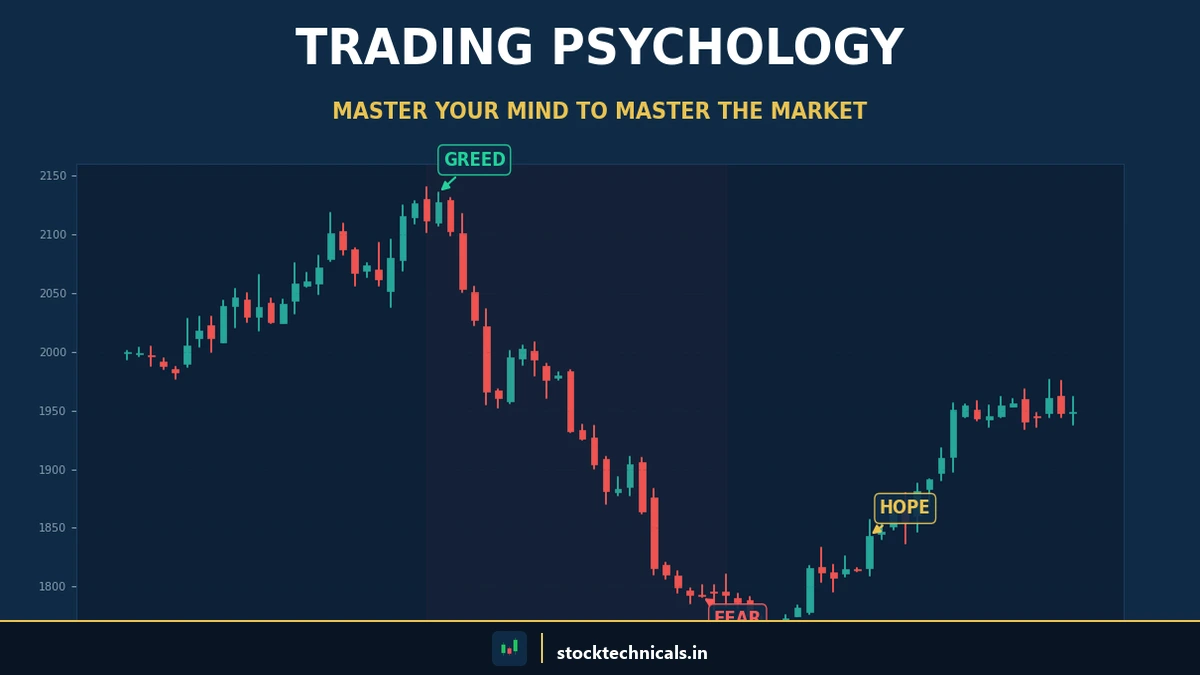
- The four trading emotions that do most of the damage: fear, greed, hope, and regret. Each one pushes you into a predictable wrong move.
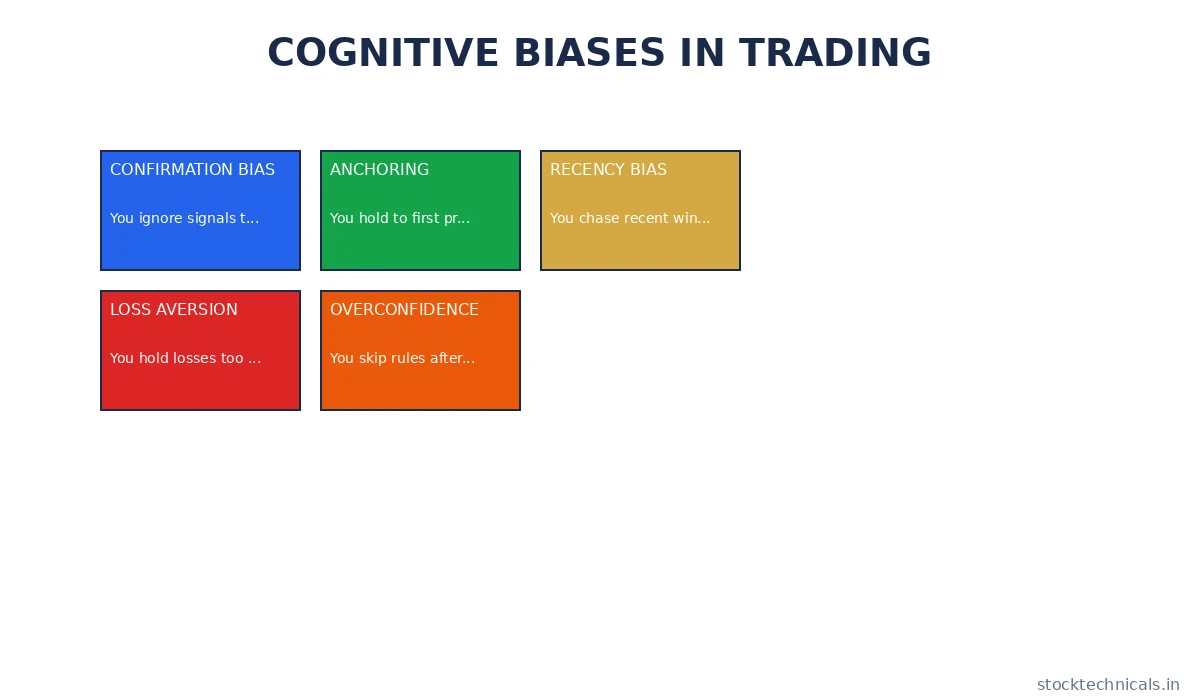
- Six cognitive biases account for most losses: loss aversion, confirmation bias, anchoring, recency bias, overconfidence, and the sunk-cost fallacy.
- Process beats outcome. Over any one trade, a good process can lose. Over 100 trades, a good process almost always wins.
- Position-size discipline is more important than entry skill. A 1% risk rule makes every trade survivable.
- A journal is not optional — it’s how you see patterns in your own behaviour that no mentor can see for you.
What trading psychology really is
Trading psychology is not “controlling your emotions.” You can’t turn them off. It is building a framework so that when emotions show up — and they always show up — they don’t get to decide what you do with capital.
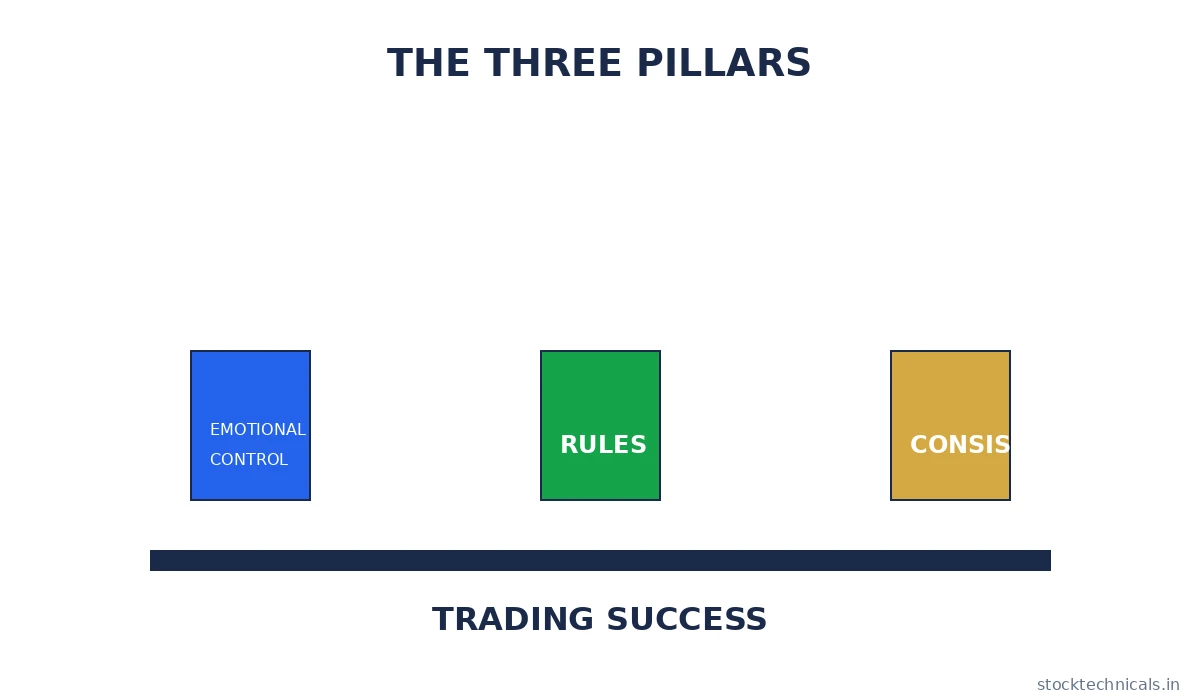
Practically, that framework has three layers:
- Pre-trade rules that pre-commit you to specific entries, stops, and position sizes — so the emotional brain has less to decide.
- During-trade habits that keep you out of the price action between signal and exit — so the emotional brain has less to react to.
- Post-trade reflection — a journal, a weekly review — so patterns get visible and the same mistake doesn’t repeat for the tenth time.
None of these three require special willpower. They require a written plan and a weekly 30 minutes of review. That’s the whole technology.
The four emotions that trade through you
Fear — cutting winners, avoiding valid setups
Fear shows up as “I’ll just take a small profit” on a trade that is working and should be running, or “I’ll wait for more confirmation” on a valid signal that then runs without you. Fear also drives the post-loss withdrawal — skipping three perfectly good setups after one bad trade.
Greed — sizing up, holding too long
Greed’s favourite trick is doubling position size after a winning run. It also whispers “let it run a bit further” when your pre-committed target is already hit. Most of what retail traders call “letting profits run” is just greed wearing a hat.
Hope — holding losers
Hope is what keeps a losing trade open past its stop. The internal monologue: “It’ll bounce. I just need it to come back to break-even and I’ll exit.” Every professional has a horror story about hope. The fix is not “more discipline” — it’s a hard mechanical stop-loss that the broker executes for you.
Regret — revenge trading, chasing the missed move
Regret is the impulse to take a trade because you missed the previous one, or to immediately re-enter after being stopped out to “get it back.” Regret is responsible for more consecutive losses than bad analysis. The fix is a forced 30-minute cooldown after any stop-out.

Six cognitive biases that cost real money
Loss aversion
The pain of losing ₹100 is psychologically twice as strong as the pleasure of making ₹100. This is why traders cut winners fast (to lock in the pleasure) and hold losers long (to avoid the pain). The fix: pre-committed targets and stops that execute whether you want them to or not.
Confirmation bias
Once you’ve taken a trade, your brain searches for reasons you’re right and ignores reasons you’re wrong. The fix: write down the exit scenario that would prove you wrong before entering. If that scenario appears, you exit — no renegotiation.
Anchoring
“I bought at ₹2,500, so that’s the level I need it to come back to.” The market doesn’t know your entry price. Stop using your entry as a reference point. Use structural levels (S&R, Fibonacci, moving averages) and the market’s own logic.
Recency bias
Whatever happened in your last five trades feels like the “new normal.” Three wins and you start oversizing; three losses and you start skipping valid setups. The fix: a journal with rolling 30-trade averages, not last-5 averages.
Overconfidence
Usually strikes after a winning streak. “I’m reading the market perfectly” is the most expensive sentence in trading. The fix: a fixed position-size rule that doesn’t expand just because your recent trades worked.
Sunk-cost fallacy
“I’ve already lost so much on this trade — I might as well hold on.” Wrong. Every moment you hold a losing trade is a fresh decision to hold it. The capital you’ve already lost is gone whether you exit now or tomorrow. Judge each trade on its current merit.
The fear-greed cycle in live markets
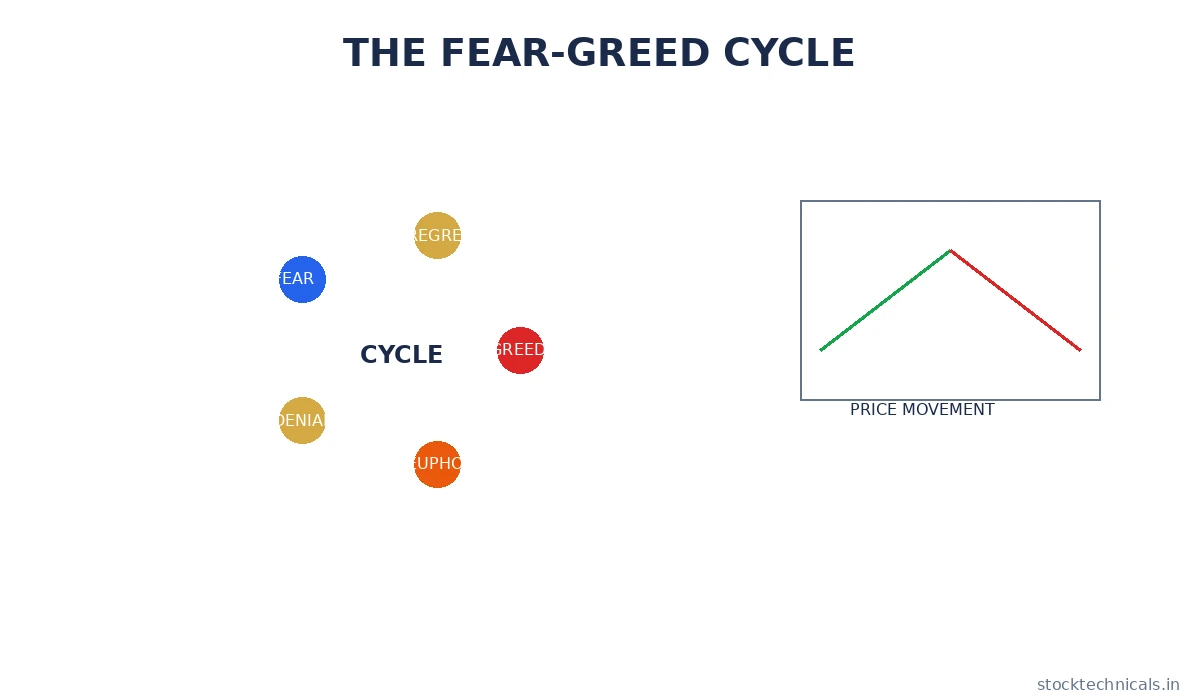
Retail trader emotions move in a predictable loop that tracks market regimes:
- Market trending up for weeks — traders feel confident, size up, ignore risk management.
- First real pullback arrives — positions held too long, losses exceed mental budget.
- Sharp correction — panic selling, stops skipped, positions closed at worst possible prices.
- Market recovers — traders sit out, watching the rally from the sidelines, too burned to re-engage.
- Rally continues for weeks — FOMO builds, traders re-enter right before the next pullback.
This loop is not a character flaw. It’s how human brains respond to uncertainty. The only exit is a position-size rule that makes each individual trade too small to matter emotionally, combined with a written system that doesn’t care how you feel.
Building emotional discipline — the mechanical way
Discipline is not something you summon. It is something you build into your environment so you don’t need to summon it.
The 1% rule
Never risk more than 1% of your total account on a single trade. If you have ₹5,00,000, your maximum stop-out loss per trade is ₹5,000. This single rule makes you immune to most emotional damage, because no single trade is big enough to panic about.
Pre-committed orders
Set your stop-loss and target as bracket orders with the broker the moment you enter. Don’t leave them “in your head.” Your intraday brain is not the brain that set up the trade. The broker’s execution engine is neutral and fast — let it do the closing.
The 30-minute cooldown
After any loss, close your trading platform for 30 minutes. Walk away from the screen. Do anything else. This simple rule kills almost all revenge trading.
Daily trade cap
Set a maximum number of trades per day (three for intraday, one for swing). Once you hit the cap, you’re done — win, lose, or breakeven. Daily caps prevent the “I’ll trade my way out of this slump” loop.
Weekly review
Every Saturday, spend 30 minutes reading your own journal. Which trades followed your rules? Which ones didn’t? The patterns are in the journal, not in your head.

Using your broker to control your emotions
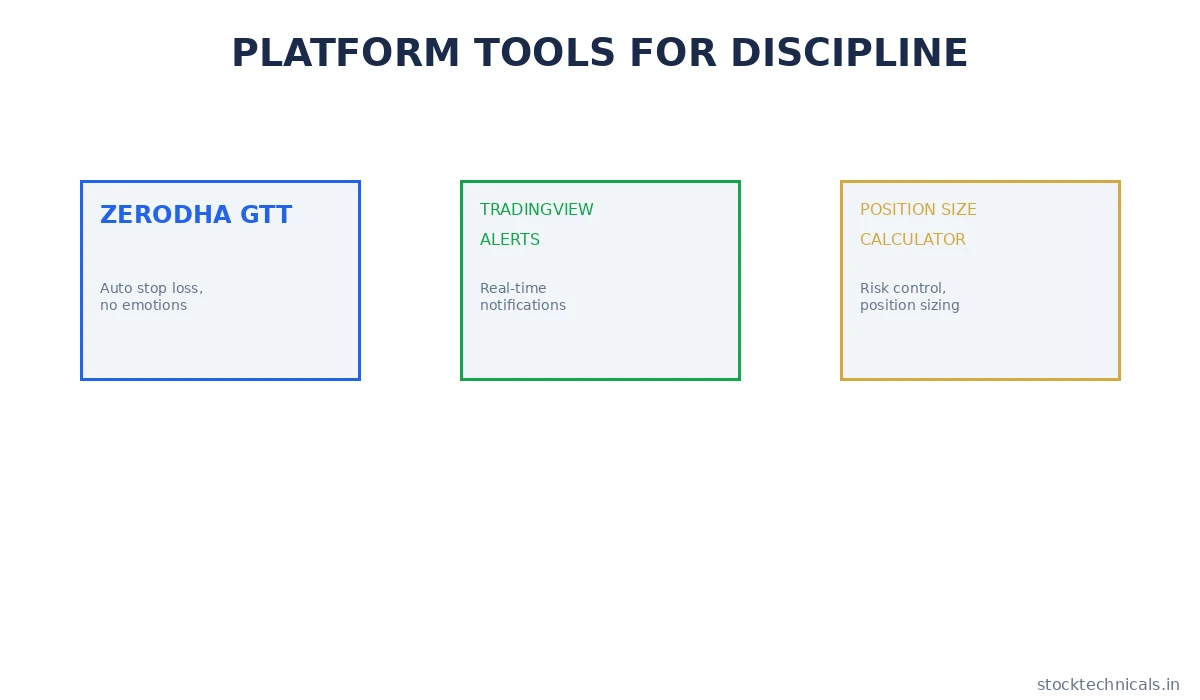
Your broker platform has features designed to automate discipline. Use them:
- GTT OCO on Zerodha Kite — stop-loss and target placed together as one standing order; whichever triggers first cancels the other. Zerodha removed bracket orders in March 2020, but Dhan’s Super Order and Angel One’s Robo order still bundle entry + stop + target in one ticket.
- Alerts on TradingView — set alerts at key levels so you don’t need to stare at the screen between signals.
- Max loss per day — Dhan’s Trader’s Control can auto-exit at a preset loss, and Zerodha’s Kill Switch lets you disable a segment for the rest of the day once your cap is hit.
- Order modify confirmations — leave the “are you sure?” prompts ON, not off. The extra click is a brake on emotional order edits.
Process over outcome — the professional mindset
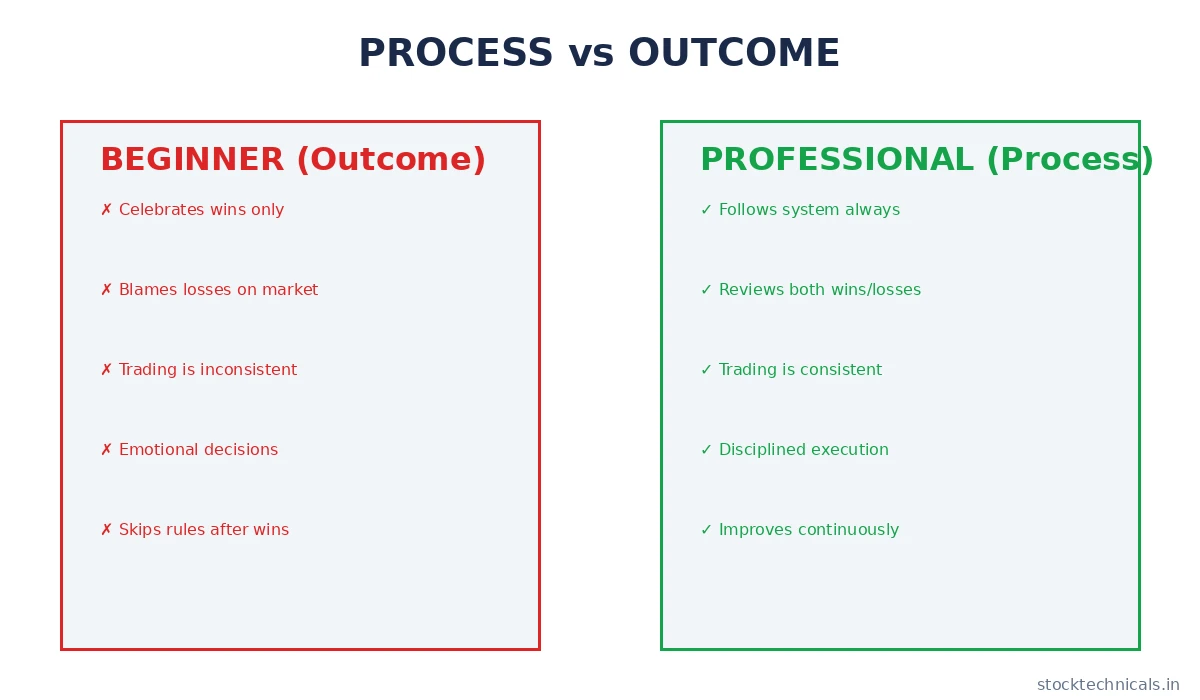
The single most valuable shift retail traders ever make: judging each trade on process quality, not on whether it won or lost.
A trade with perfect process (followed the rules, sized correctly, exited on the stop) is a good trade even if it loses. A trade with sloppy process (entered early, oversized, moved the stop) is a bad trade even if it wins.
Graded this way, roughly 70% of your trades should be “good process” regardless of win/loss. If fewer than 70% are hitting that bar, your problem is not the market — it’s your discipline.
Five rules for mastering trading psychology
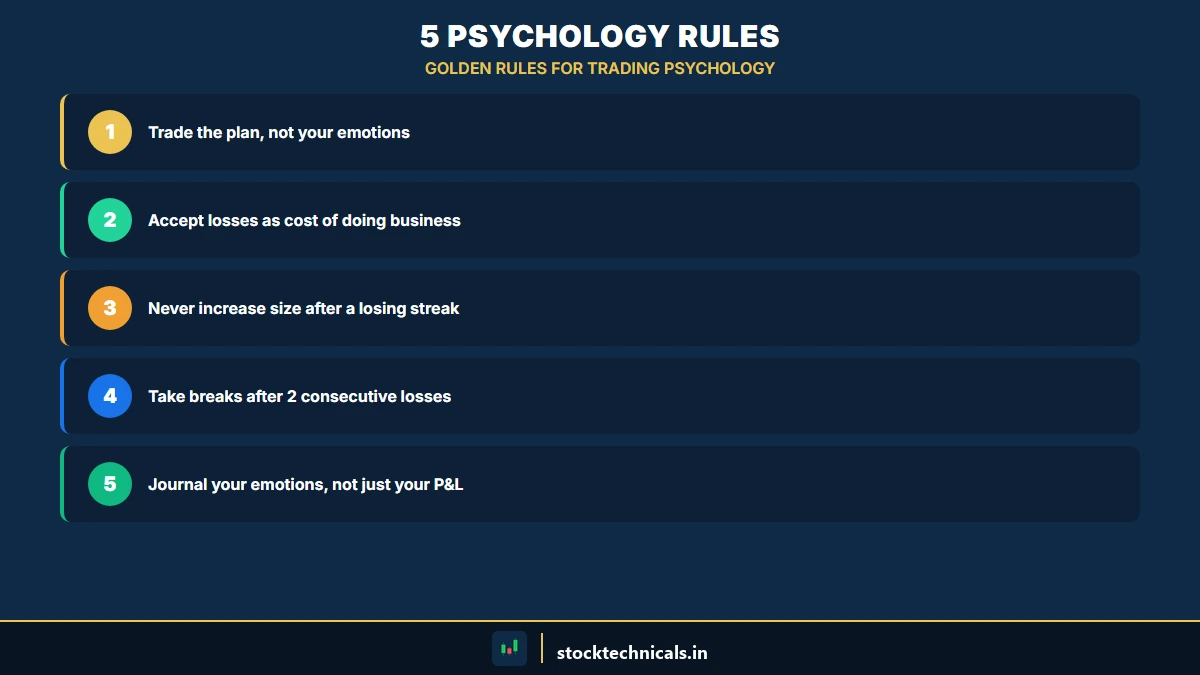
Rule 1 — Never risk more than 1% per trade
The foundation. Every other rule becomes optional if you break this one. Ten consecutive losing trades at 1% each = 10% drawdown, fully recoverable. At 5% risk, the same ten losses = 50% drawdown, barely recoverable.
Rule 2 — Write the plan before the market opens
Entry criteria, stop, target, position size. In writing. Before the 9:15 bell. If you didn’t plan it, don’t trade it.
Rule 3 — Journal every trade
Instrument, entry, exit, reason, emotion. Three lines per trade. Spread of reasons is where your patterns live.
Rule 4 — Cooldown after losses
30 minutes after a stop-out. Two hours after two consecutive losses. Done for the day after three losses in a row. Period.
Rule 5 — Review weekly, not daily
Daily reviews lead to recency-bias-driven rule changes. Weekly reviews see patterns. Monthly reviews catch regime shifts. Quarterly reviews catch system-level problems.
Pre-trade psychological checklist
- Am I following my written plan or improvising?
- Is my position size at or below 1% of account risk?
- Is my stop-loss placed as a bracket order with the broker (not in my head)?
- Am I trying to get back a recent loss? (If yes, stop.)
- Am I trading because the setup is there, or because I’m bored?
- Have I had fewer than three losses today?
- Am I physically calm — slow breath, steady pulse? (If not, walk away.)
Any no = no trade. Your emotional state is part of your edge.
Five common psychological mistakes
Revenge trading after a loss
Taking an unplanned trade immediately after a stop-out, usually in larger size, to “get back” the loss. 30-minute cooldown rule ends this behaviour.
Moving the stop-loss
Widening the stop once price moves against you, always with a plausible excuse. Pre-committed bracket orders remove the ability.
Chasing FOMO entries
Entering late after a big move because “I missed the setup earlier and don’t want to miss it again.” Always ends badly. Accept that you missed it; wait for the next clean signal.
Over-sizing after a winning streak
Three wins in a row and the position size creeps up. One loss and the P&L of a full week vanishes. Fixed percentage rule keeps sizing consistent.
Trading without a journal
Without a journal, you think you’re following your rules even when you’re not. The journal is the only honest witness.
Emotional vs rational behaviour — the differences
| Situation | Emotional trader | Rational trader |
|---|---|---|
| Loss hits stop-loss | Moves stop further away | Accepts the loss, moves on |
| Winner hits target | Cancels target “let it run” | Takes profit, trails the rest |
| Three losses in a row | Doubles size to “win it back” | Stops for the day, reviews journal |
| Missed a big move | Chases late, enters poorly | Waits for the next clean signal |
| Big news event | Trades the noise | Steps aside until structure resumes |
How long does it take to develop solid trading psychology?
Most traders need 6–12 months of consistent journal-based practice. Rules can be learned in a day; internalising them under pressure takes time.
Is trading psychology more important than strategy?
Once you have a decent strategy, yes. Mediocre strategy with disciplined psychology beats brilliant strategy with poor psychology every time.
How do I stop revenge trading?
30-minute platform lockout after any loss, three-loss daily cap. Physical timer, not trust-yourself — the lockout must be real.
What’s the fastest way to get comfortable with losses?
Size smaller. A 0.25% risk trade triggers almost no emotional response. Trade at that size for a month until losses feel routine, then work up to 1%.
Can meditation or exercise help?
Indirectly. Both reduce baseline emotional reactivity, which amplifies your structural rules. They don’t replace the rules.
Do professional traders feel fear and greed?
Yes. They just have a system that makes the emotions operationally irrelevant — pre-committed entries, bracket orders, written rules.
What should I do during a losing streak?
Reduce size by 50%, cap daily trades at one, review journal for rule violations. Rare violations = statistical noise, wait it out. Frequent violations = fix discipline first.
Test Your Knowledge
Q1: Which emotion causes traders to cut winners too early?
Q2: Maximum recommended risk per trade?
Q3: You just hit your stop-loss. What’s the correct next step?
Q4: Process-focused traders judge each trade by:
Q5: The sunk-cost fallacy in trading looks like:
Your next step
Fear and Greed in Trading goes deeper on the two emotions that do most of the damage and shows how to build specific market habits that immunise you against each one.
The Bottom Line
Trading psychology is not a motivational topic. It is an engineering topic. Build the environment right — 1% risk, bracket orders, 30-minute cooldowns, daily trade cap, weekly journal review — and emotional discipline becomes the side-effect, not the goal. You will still feel fear, greed, hope, and regret. They just won’t get to make decisions for you anymore. Fewer decisions mean fewer mistakes.
Educational content only — not SEBI-registered investment advice. Psychological discipline reduces losses but does not eliminate them. Past discipline does not guarantee future execution — every trade is a fresh test. Size every trade so a full stop-out costs less than 1% of capital. Never trade with borrowed money.