
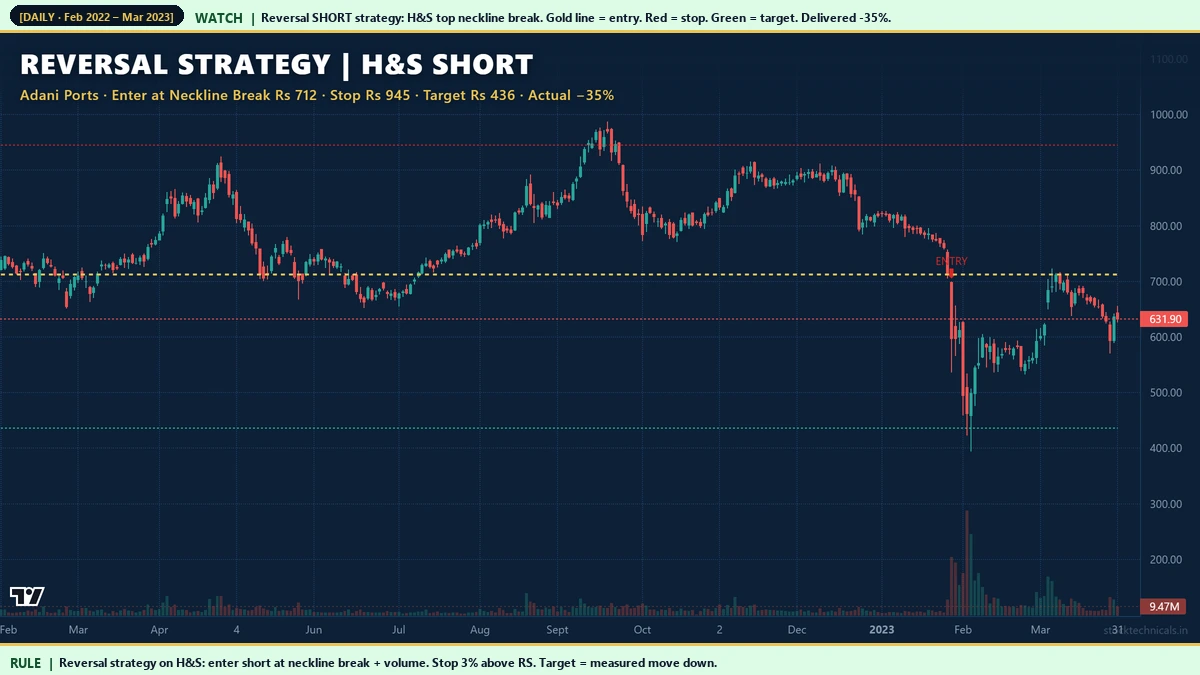
Individual chart patterns are useful. A systematic strategy built around them is transformative. This article synthesizes the eight chart-pattern articles in our technical-analysis series (Head & Shoulders, Double Tops/Bottoms, Triangles, Flags, Wedges, Rounding patterns, Cup & Handle, Gaps) into a unified trading framework. Seven NSE examples show how to classify patterns, match them to market regime, and execute with consistent entry, stop, and target rules.

Chart window: Feb 2022 – Mar 2023 · Data refreshed April 18, 2026 · Source: NSE (daily OHLC)
Key Takeaways
- Reversal patterns trade turns: H&S, Double Top/Bottom, Wedges, Rounding Top/Bottom. Trade in opposite direction of prior trend.
- Continuation patterns trade resumption: Flags, Pennants, Triangles, Cup & Handle. Trade in direction of prior trend.
- Universal trade plan: identify, filter, wait for breakout + volume, execute, manage. Same structure across all patterns.
- Market regime matters. Continuation patterns thrive in trends; reversal patterns work at extremes; range-bound markets produce mostly noise.
- Volume is the universal filter. Breakouts above 30-day average volume succeed ~70%. Below average volume fails ~50%.
- R:R minimum 1:1. Size 1-2% of capital per trade. Expect 30-40% failure rate even with quality filters.
The Universal Trade Plan
Every chart pattern trade follows the same 5-step structure, regardless of the specific pattern. The pattern determines what triggers each step, not whether the step applies.
- Identify the pattern and confirm it meets quality filters (duration, symmetry, volume contraction, etc.).
- Wait for the breakout. Daily close beyond the trigger level (neckline, trendline, resistance, support).
- Confirm volume. Breakout volume must exceed 30-day average — ideally 1.5x or higher.
- Execute entry. Buy (or short) at breakout close or on first pullback to the breakout level.
- Manage the trade. Stop at invalidation level. Take 50-70% profit at measured-move target. Trail remaining runner.
Pattern Cheat Sheet

Chart data: Evergreen reference · Last reviewed April 18, 2026
All chart patterns covered in our series fall into two families:
- Reversal patterns: Head & Shoulders, Double Top/Bottom, Rising/Falling Wedge, Rounding Top/Bottom. Signal a turn in the prior trend.
- Continuation patterns: Flag, Pennant, Ascending/Descending/Symmetrical Triangle, Cup & Handle. Signal resumption of the prior trend after brief consolidation.
The cheat sheet is a reference, not a prescription. Each pattern has its own quality filters and trade rules detailed in the dedicated article for that pattern.
Reversal Long Strategy: Vedanta Double Bottom

Chart window: Dec 2023 – Jun 2024 · Data refreshed April 18, 2026 · Source: NSE (daily OHLC)
Vedanta (NSE: VEDL)’s January-March 2024 Double Bottom illustrates the reversal long strategy. Entry Rs 289 on neckline break. Stop Rs 252, 13% below 2nd trough (3% buffer). Measured-move target Rs 320. R:R at entry: risk Rs 37, reward Rs 31 — just shy of 1:1 at entry. The actual move to Rs 442 delivered massive R:R through the trailing exit process. This is the pattern most chart-pattern traders build their reversal-side edge around.
Continuation Long: Infosys Ascending Triangle

Chart window: Mar – Sep 2020 · Data refreshed April 18, 2026 · Source: NSE (daily OHLC)
Infosys’s post-Covid ascending triangle is the textbook continuation-long setup. Flat resistance at Rs 714 tested 4 times; rising support underpinning. Break above Rs 714 with volume on June 19, 2020. Stop below the rising trendline at Rs 685. Target Rs 800 (height of triangle projected up). Actual move to Rs 894 in 20 sessions exceeded target by 11%. Clean, repeatable continuation strategy.
Pattern Selection by Market Regime

Chart data: Evergreen reference · Last reviewed April 18, 2026
Not every pattern works in every market. Pattern-strategy success depends heavily on matching pattern type to market regime:
- Uptrend: favor continuation patterns (Bull Flag, Ascending Triangle, Cup & Handle). Reversal patterns at extremes (Falling Wedge) work but are rarer.
- Downtrend: favor continuation patterns (Bear Flag, Descending Triangle). Reversal patterns at rallies (H&S on failed bounces) work at sector extremes.
- Range-bound: Double Tops/Bottoms and Rounding patterns thrive. Avoid wedges (high whipsaw risk). Symmetrical triangles are low-conviction in ranges.
Continuation Long: Adani Enterprises Bull Flag

Chart window: May – Sep 2018 · Data refreshed April 18, 2026 · Source: NSE (daily OHLC)
Adani Enterprises’s June-July 2018 bull flag delivered one of the strongest continuation trades in our audit. Pole of 15.57% in 10 days, 6-day consolidation (flag), then breakout on volume. Entry Rs 106. Stop Rs 101 (below flag low). Target Rs 120 (pole height projected). R:R 2.8:1. Actual move to Rs 152 (+44%). Flags are among the best R:R setups available because the consolidation defines the risk precisely.
Long-Base Strategy: Adani Cup & Handle

Chart window: Sep 2019 – Oct 2020 · Data refreshed April 18, 2026 · Source: NSE (daily OHLC)
Position traders prefer long-base strategies like Cup & Handle because they offer exceptional R:R and favourable timing. Adani’s 9-month cup + 4-day handle + breakout at Rs 164 produced a 72% rally in 30 sessions — well past the Rs 187 measured-move target. The long base provides a clear invalidation level (below handle low), and the 2-3x R:R at entry makes position sizing straightforward.
Strategy Decision Tree

Chart data: Evergreen reference · Last reviewed April 18, 2026
The decision process is deterministic once filters are applied. Step 1: classify as reversal or continuation. Step 2: verify volume pattern (contraction during formation, expansion on break). Step 3: wait for the breakout close. Step 4: execute with entry, stop, and target all defined before the trade starts. No emotion, no interpretation — just pattern-triggered action.
Reversal Short: Bajaj Finance Rising Wedge

Chart window: Jan – Apr 2020 · Data refreshed April 18, 2026 · Source: NSE (daily OHLC)
Bajaj Finance’s January-March 2020 rising wedge fired a reversal-short signal 3 weeks before the Covid crash. Both trendlines sloping up but converging, bottom steeper than top — textbook rising wedge. Lower trendline break on 4 March triggered the short. The Covid crash amplified the move to -48% in 20 sessions. Even without Covid, the measured-move target (wedge origin) would have been hit. This is why quality reversal patterns are valuable: they often fire before news confirms the weakness.
Multi-Pattern Sequences

Chart window: Nov 2021 – Sep 2022 · Data refreshed April 18, 2026 · Source: NSE (daily OHLC)
Patterns rarely occur in isolation. A Double Top often leads into a descending triangle or bear flag. A rounding bottom often precedes a cup & handle. A rising wedge often transitions into a Head & Shoulders top. Reading patterns in sequence — anticipating the next one based on the current one — is the hallmark of experienced pattern traders. TCS 2021-2022 shows this sequence: Double Top (Jan-Mar) led to choppy consolidation that formed multiple failed triangles throughout H1 2022.
Interactive Tool: Pattern Strategy Selector
Pick market regime (uptrend/downtrend/range), pattern category (reversal/continuation), and timeframe (swing/position/intraday). The selector recommends the best-fit pattern and outlines the full trade plan (entry, stop, target, notes).
Practical Rule Book
- Master 2-3 patterns first. Do not try to trade all 12+ patterns at once. Pick the 2-3 that match your timeframe and regime.
- Require volume confirmation. Single most important filter. Below-average volume breaks fail ~50% of the time.
- Match pattern to regime. Continuation in trends, reversal at extremes, DT/DB/rounding in ranges.
- Define entry, stop, target before the trade. No discretionary decisions after entry.
- Size 1-2% of capital per trade. 30-40% of pattern trades fail even when quality filters are met. Survive the failures.
- Take 50-70% at measured move. Trail remainder for extensions beyond target.
Common Mistakes
Mistake 2: Ignoring volume. Volume is not optional. Breakouts without volume are 2x more likely to fail.
Mistake 3: Entering before the breakout. Pattern is not confirmed until the close beyond the trigger level. Patience wins.
Mistake 4: Oversizing high-conviction patterns. Even 5/5 quality patterns fail 25-30% of the time. Position-size accordingly.
Mistake 5: Exiting entirely at measured move. Cup & Handle and Flag patterns often extend 2-3x beyond measured move. Always trail a runner.
Related Reading
- Head and Shoulders Pattern
- Double Tops and Double Bottoms
- Triangle Patterns
- Flags and Pennants
- Wedge Patterns
- Rounding Bottom and Top
- Cup and Handle Pattern
- Gaps in Trading
- Volume in Trading — the universal filter.
Quick Quiz: Chart Pattern Strategies
Five questions to check your grasp. No login, no score saved — just instant feedback.
1. The most disciplined entry trigger across classic chart patterns is …
2. A logical stop-loss placement after a pattern breakout is typically …
3. As per SEBI data (FY24-25), the percentage of individual equity F&O traders who lost money was approximately …
4. Which pair are both continuation patterns?
5. The most common trader mistake across chart patterns is …
| Pattern category | Examples | Trade approach | Risk-reward typical |
|---|---|---|---|
| Reversal | H&S, Double Top/Bottom | Counter-trend at major level | 1:2 to 1:3 |
| Continuation | Flag, Pennant, Triangle | With-trend after pause | 1:2 |
| Bilateral | Symmetrical Triangle, Wedge | Trade either breakout direction | 1:1.5 to 1:2 |
| Long-base | Cup and Handle, Rounding Bottom | Add to position over weeks | 1:3 to 1:5 |
“Don't trade the chart pattern. Trade the breakout, the volume, and the follow-through.”
— Linda Raschke, Trading Sardines
What is the best chart pattern for beginners?
Double Tops and Double Bottoms. They have clear geometric structure (two peaks or troughs plus neckline), simple trade rules, and high reliability on NSE when quality filters are respected. Master DT/DB first before expanding to H&S or Wedges.
How do I know which pattern to trade?
Match pattern to market regime. In uptrends, trade continuation patterns (Bull Flag, Ascending Triangle, Cup & Handle). In downtrends, trade bearish continuation. In range-bound markets, trade Double Tops/Bottoms or Rounding patterns. Use the Pattern Strategy Selector widget in this article.
What is the universal trade plan for chart patterns?
Five steps: (1) identify pattern and check quality filters, (2) wait for breakout close, (3) confirm volume above 30-day average, (4) enter at break with stop at invalidation level, (5) target by measured move, trail runner for extensions.
Why does volume matter so much?
Volume distinguishes genuine institutional breakouts from retail noise. Breakouts above 30-day average volume succeed approximately 70 percent of the time; below-average volume breakouts fail roughly 50 percent. Volume is the single most important filter across all patterns.
What position size should I use?
1-2 percent of total capital per pattern trade. Even quality patterns fail 30-40 percent of the time. Proper sizing ensures no single failure hurts badly, and a string of 3-5 failures does not materially impact capital. Scaling up only after consistent profitability across 50+ trades.
Can chart patterns work in intraday trading?
Yes, but intraday patterns are noisier. Use 15-minute or hourly charts. All rules remain the same — volume confirmation becomes even more critical because intraday volume is more volatile. Daily charts remain the highest-conviction timeframe.
What is the average success rate across patterns?
Well-formed patterns (meeting all quality filters) reach measured-move target 65-75 percent of the time on NSE liquid large caps from 2017 to 2025. Poor-quality patterns fail closer to 50 percent. The quality filters are what drive the edge.
Which pattern has the best risk-to-reward?
Cup & Handle and Bull Flag typically offer the best R:R at entry because the consolidation phase defines the risk precisely. Cup & Handle often delivers 2-5x the initial risk in extensions beyond measured move. Flags offer sharp R:R but faster resolution.
The Bottom Line
Chart patterns are not a collection of random shapes. They are the geometric signatures of specific institutional behaviors — distribution (H&S, Double Top, Rising Wedge), accumulation (Double Bottom, Falling Wedge, Rounding Bottom), continuation (Flags, Triangles, Cup & Handle). When you recognize the signature and match it to market regime, you have an edge.
The universal trade plan removes discretion once the pattern is confirmed. Identify the pattern, check the volume, wait for the breakout, execute with predefined entry/stop/target. No emotional decisions. No "is this really the right spot" debates. Just mechanical pattern execution.
Pick one pattern from the 12 covered in our series. Trade it on paper for a month on 3-5 Nifty large caps. Track every setup, entry, stop, target, and outcome. After 15-20 completed trades, you will know whether that pattern fits your personality and whether your execution is consistent enough to deploy capital. Expand to a second pattern only after the first is profitable and stable.
Risk Notice
Trading in equities, derivatives, and index products carries substantial risk of loss. The examples in this article are historical and do not guarantee future returns. Price data is sourced from NSE daily OHLC feeds; back-testing any strategy on your own data is essential before deploying capital. This content is educational only. It is not an investment recommendation, a tip, or a solicitation to trade any specific security. Consult a SEBI-registered advisor before acting on any information here. Size every trade at 1 percent of your total capital and never trade money you cannot afford to lose.