
Market Pulse · Quick Take · Published 23 April 2026 · Last refreshed 23 April 2026. Framework article — applies to any Fed meeting, not a specific one. Prices and data are compiled with reasonable care but — always confirm against your broker before trading.
Quick Answer. On Fed decision day, Nifty moves first. Then it moves again — usually the other way. Roughly two-thirds of initial FOMC moves reverse within 1 to 3 trading sessions. The Fed announces at 11:30 PM IST, long after NSE closes, so the reaction plays out in the next day’s open and the session after that. Three rules handle this: no fresh entries on Day 0 or early Day 1, wait for Day 2 structure to confirm, and if you must play Fed day, halve your size because volatility runs 40-60% wider than normal.
Who this is for. Any Indian trader who holds positions into — or places trades around — a US Federal Reserve (the US central bank) policy announcement. Intraday traders: the effect shows up the next NSE session, not on the day of. Swing and F&O traders: position-sizing rules apply across the Day 0-to-Day 3 window.
After every FOMC meeting, the same pattern plays out on Nifty — and most beginners trade the first move instead of the real one. This article is the framework for not doing that.
The Federal Reserve (the US central bank) announces its rate decision at 11:30 PM IST, followed by the Fed Chair press conference at midnight IST. Both happen after NSE closes. The market reaction in India therefore lands on the next session’s open and the one after that — not intraday on the announcement day. That timing mismatch is where most of the beginner damage happens.
Key takeaways
- Fed decisions announce at 11:30 PM IST (2:00 PM EST); NSE is already closed, so Indian markets react on the next day’s open.
- Two-thirds of initial post-FOMC moves reverse within 3 sessions — the first gap is noise, not signal.
- Day 2 structure (does Nifty reclaim pre-FOMC high? defend the 50-DMA?) is the first real signal worth acting on.
- FOMC day volatility is typically 40-60% wider than normal — halve position sizes or keep stops outside the expected range.
- Sector sensitivity: IT services, NBFCs, and rate-sensitive financials carry the biggest FOMC exposure; defensives like FMCG move less.
The pattern in three phases
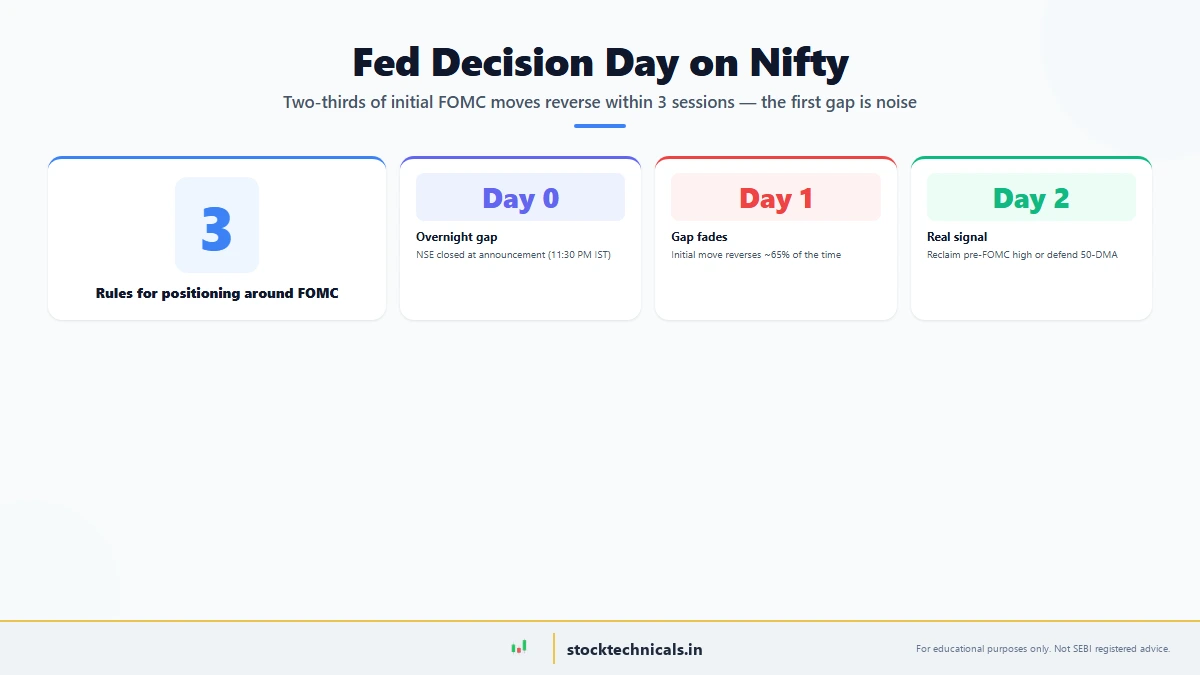
Three consistent findings across every Fed cycle since 2020 on Nifty:
- Day 0 (announcement overnight): Nifty opens with a gap the next morning, direction matching the initial US reaction. This is the move most retail traders react to.
- Day 1 (next NSE session): The gap frequently fades intraday. Initial direction reverses. This is where beginners get hurt — they chase the opening gap and watch it unwind against them.
- Day 2 to Day 3: Markets finally absorb the dot plot and press-conference tone. This is when the real post-FOMC trend shows up — and when traders with discipline can act on the signal.
Academic research plus more than 20 years of Indian-market data point to the same pattern: roughly two-thirds of initial Fed-day moves reverse within 1 to 3 sessions. The directional reaction is almost random on Day 1. The actual signal lives in what happens by Day 2.
Capitalmind’s 20-year study of Fed-cycle impact on Indian markets found that Nifty 50 (India’s benchmark index of 50 large-cap stocks) has outperformed or matched the S&P 500 in rupee terms across every full Fed cycle. The takeaway is not that Fed policy does not matter — it does. The takeaway is that the first 24 hours of noise rarely signals the 1-3 month direction.
Three rules for positioning around FOMC
- No fresh entries on Day 0 or early Day 1. The first gap is a reaction, not a setup. Let it complete. If you are already in a position, your stop-loss handles the volatility; if you are flat, there is nothing you need to do.
- Wait for the Day 2 structure to confirm. If Nifty reclaims its pre-FOMC high or cleanly defends its 50-day moving average on Day 2, that is the first real signal worth acting on. Everything before that is noise dressed up as price action.
- If you must play Fed day, halve your size. FOMC-day volatility runs 40-60% wider than normal. If your normal stop is 1%, you now need 2% — which means you must cut position size in half to keep your rupee risk the same. No setup works without a stop-loss.
Sector sensitivity — which parts of the Indian market react hardest
Not every Indian sector reacts equally to Fed moves. Four carry the heaviest direct exposure: IT services (dollar-earners that respond to rupee moves triggered by DXY shifts), financials (rate-sensitive — both NBFCs and banks move on US 10-year yield changes), pharma (FII-flow sensitive because of the defensive-rotation trade), and metals (global risk-on / risk-off driver).
Defensives — FMCG, select consumer durables, utilities — tend to move less on Fed days. These are the names to hold through the event if you are already in a position and do not want to close into volatility. Aggressive names in the reactive sectors are the ones to size down on or step aside from.
The exact sector mix that moves hardest also depends on the Fed surprise. A dovish surprise (cut larger than expected) typically helps dollar-earners less and rate-sensitive more. A hawkish surprise does the opposite. Read the dot plot and forward guidance before applying the sector-reaction playbook — the headline rate alone is not the signal.
Why this matters
On Fed days, the only reliable edge for a retail trader is patience. The market itself is telling you it does not know yet. Wait until it does.
This is the kind of event where the cost of a bad trade is structurally higher than usual (2x volatility on position size that has not been halved, or a gap against an open position with a tight stop). The cost of sitting out is structurally lower than usual (you miss one day — not the trend). Asymmetry favours patience.
Bottom line
Bottom line. Three rules: no fresh entries Day 0 or early Day 1, wait for Day 2 structure, halve size if you must trade the event. Everything else is the same as any normal setup — just sized for the volatility. Protect your capital. Everything else follows.
Frequently Asked Questions
At what time does the FOMC decision get announced in Indian time?
The Federal Reserve releases its policy statement at 11:30 PM IST (2:00 PM EST), followed by the Fed Chair press conference at 12:00 AM IST. NSE is closed by this time, so the reaction shows up in the next day’s open.
Is a Fed rate cut always bullish for Indian markets?
No. Direction depends on the surprise relative to market expectations, not the absolute move. A 25 bps cut when markets were pricing a 50 bps cut can be bearish. The dot plot and forward guidance often matter more than the headline rate.
Should I hold overnight positions through an FOMC meeting?
Only if you have sized for 2x normal volatility and set stops outside the expected range. For most beginners, being flat ahead of FOMC is the safer call. There is no rule that says you must trade every event.
Which Indian sectors are most sensitive to Fed decisions?
IT services (dollar-earner exposure), financials (rate-sensitive NBFCs and banks), pharma (FII flows), and metals (global risk-on/risk-off). Defensives like FMCG move less on Fed days.
Trading in equities, derivatives, currencies, and commodities carries substantial risk of loss and is not suitable for every investor. SEBI’s 2023-24 study showed 93% of individual intraday traders in the equity segment made net losses. This article is educational content only — not investment advice, not a recommendation to buy or sell any security. Always paper-trade before risking real capital, size positions so a single loss cannot compromise your financial situation, and confirm every example against your own broker terminal before acting.