
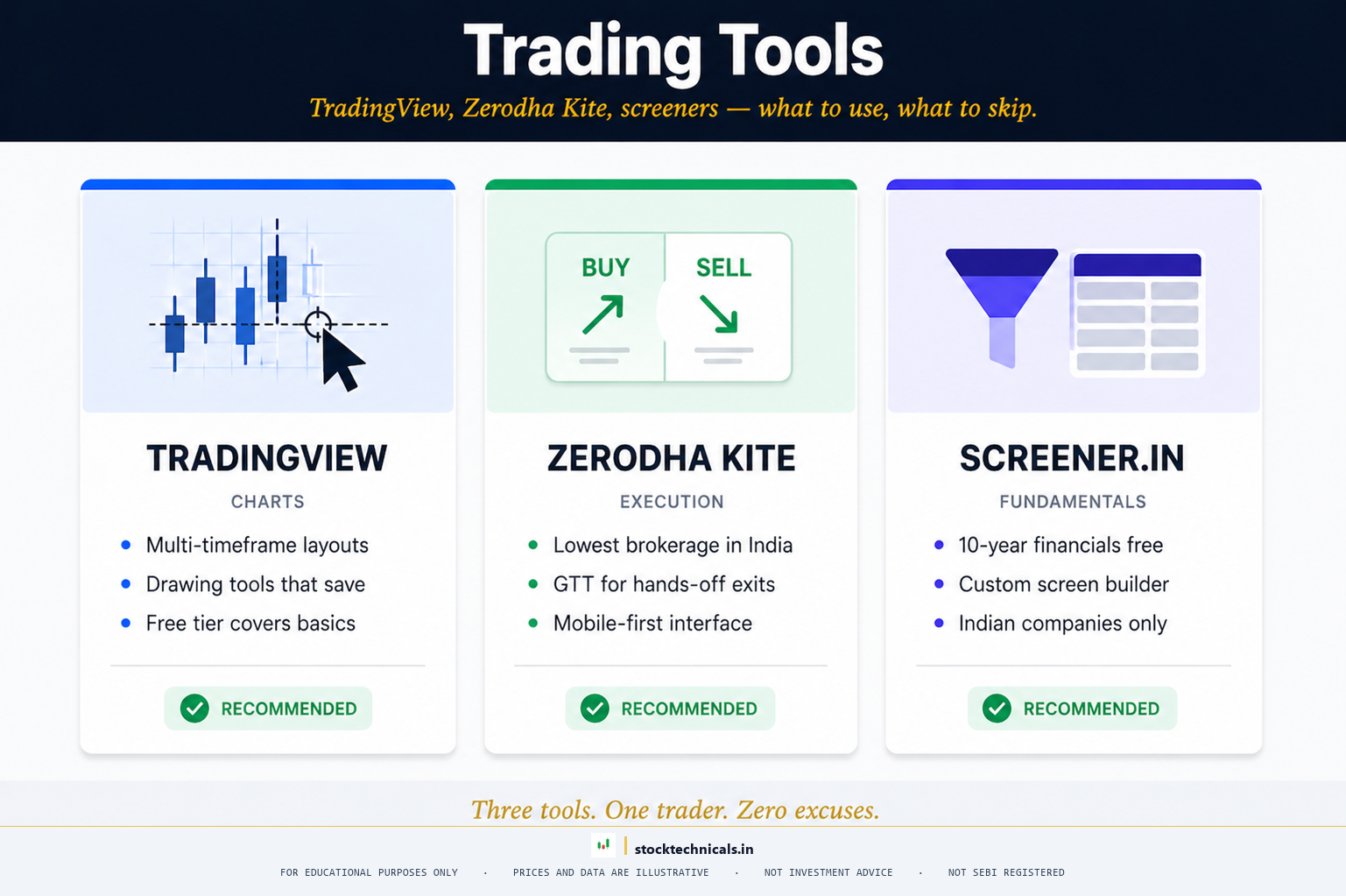
Quick Answer. Your tools are your workflow. The difference between a trader who spends 4 hours a day finding setups and a trader who spends 30 minutes is almost entirely platform and tool mastery. This topic is in active drafting, with 12+ articles covering broker platform comparisons (Zerodha Kite, TradingView, Dhan, Angel One, Upstox, Groww), charting configurations, scanner setups, journalling workflows, and the productivity habits that separate professional traders from perpetual hobbyists.
Who this is for. Every active trader, regardless of experience level. Even beginners benefit from setting up the right chart configuration early — the learning curve compounds when the tool stack is right.
Topic 10 · Trading Tools and Platforms · Articles in draft · Publishing begins after core guide gaps close · Last refreshed April 21, 2026. Prices and data are compiled with reasonable care but — always confirm against your broker before trading.
What This Topic Will Cover
Two tooling events that defined Indian retail trading in recent years: on April 1, 2025, TradingView shipped full Indian-market F&O charts to its Free tier, removing the biggest barrier for new NSE traders. On October 1, 2024, Zerodha Kite launched the in-app Position Sizer that auto-calculates the 2% rule — a single feature that materially improved retail risk discipline. The right tool, shipped at the right time, changes outcomes for thousands of traders.
Tools do not make you profitable — but bad tools can make you unprofitable. A trader running TradingView with five conflicting indicators, no custom scanner, and a Discord-bot signal feed will consistently underperform a trader with a clean chart, a well-tuned scanner, and a journalling habit. The tool stack compounds. Every minute saved on setup-identification is a minute available for analysis, risk calculation, and execution.
The Indian broker space has matured quickly in the last five years. Zerodha Kite remains the low-cost market leader; Dhan has aggressive web-platform innovation; Angel One, Upstox, and Groww compete on specific features. TradingView’s free plan has become a de-facto standard for charting across India. Paid tools — TradingView paid, Sensibull, Opstra, Tijori, Screener Pro — each fit specific trader types. Picking the right stack for your trading style and skill level pays off for years afterwards.
Beyond brokers and charts, the hidden productivity tools matter as much: the scanner you use to surface setups (Chartink, Screener.in, TradingView scanner), the journal you keep (Notion, Excel, Edgewonk), and the watchlist discipline that narrows 500+ NSE stocks into the 15-20 you actually know deeply. This topic will cover all three layers: execution brokers, analysis platforms, and productivity workflows.
Draft Table of Contents
The articles below are in active drafting. The list is indicative, not final — ordering and scope may shift as drafts mature. Expect one to two articles per week once publishing begins in this topic.
Broker Platform Comparisons
- Zerodha Kite — the market leader, strengths, weaknesses, and who it fits
- Dhan — the aggressive challenger, options-trading innovations, and UI trade-offs
- Angel One, Upstox, Groww — mid-tier options and who each suits best
- Interactive Brokers and other international brokers for Indian residents — NSE/BSE access from abroad
- Broker comparison for F&O specifically — margin policies, order-placement speed, and strategy-builder quality
Charting Platforms
- TradingView — free vs paid plans, must-have shortcuts, and the scripts that matter
- Zerodha Kite’s built-in charts — strengths and limitations
- MetaTrader, ThinkorSwim, and international charting platforms for Indian traders
- Setting up a professional chart layout — colour palette, drawing-tool configuration, multi-timeframe workspace
Scanners and Watchlists
- Chartink — the free Indian scanner, best queries, and how to build a setup-specific scan
- Screener.in — the fundamental-driven scanner that complements technical setups
- TradingView’s scanner vs Chartink — when to use which
- Building a Nifty 500 watchlist workflow — discipline, rotation, and refinement
Journalling and Analytics
- The trading journal template — what to record, how to review, and making the journal actually usable
- Tools for journalling — Notion, Excel, Edgewonk, and paid journalling platforms
- Tracking equity curve, drawdown, expectancy — the dashboard every serious trader needs
- Backtesting basics — vectorBT, Python, and TradingView’s Pine Script for rule-based testing
Publishing Cadence
This topic publishes once the site’s core Technical Analysis guide is closer to complete. Priority right now is completing gaps in the Foundation topics (Technical Analysis, Candlestick, Chart Patterns, Indicators) and the Practitioner topics (Options, Risk, Fibonacci, Price Action). When this topic enters publishing, a public schedule will be posted on this page.
Readers who want to be notified when the first article publishes can use the Contact page to send a short note. A proper email-subscription flow is coming to the site in a future update. In the meantime, check back monthly or watch the Learn master index, which will show updated article counts per topic as they go live.
While You Wait — What to Read
The guide is designed so the foundational topics prepare you for each specialist track. Until this topic publishes, these are the most relevant adjacent reads:
- Learn (master index) — See how this topic fits into the broader guide.
- Beginner Technical Analysis — Set up your chart stack before deep-diving into chart reading.
- Options and F&O Trading — Broker selection matters more for F&O than for cash equities — margin policies and strategy-builder quality differ significantly.
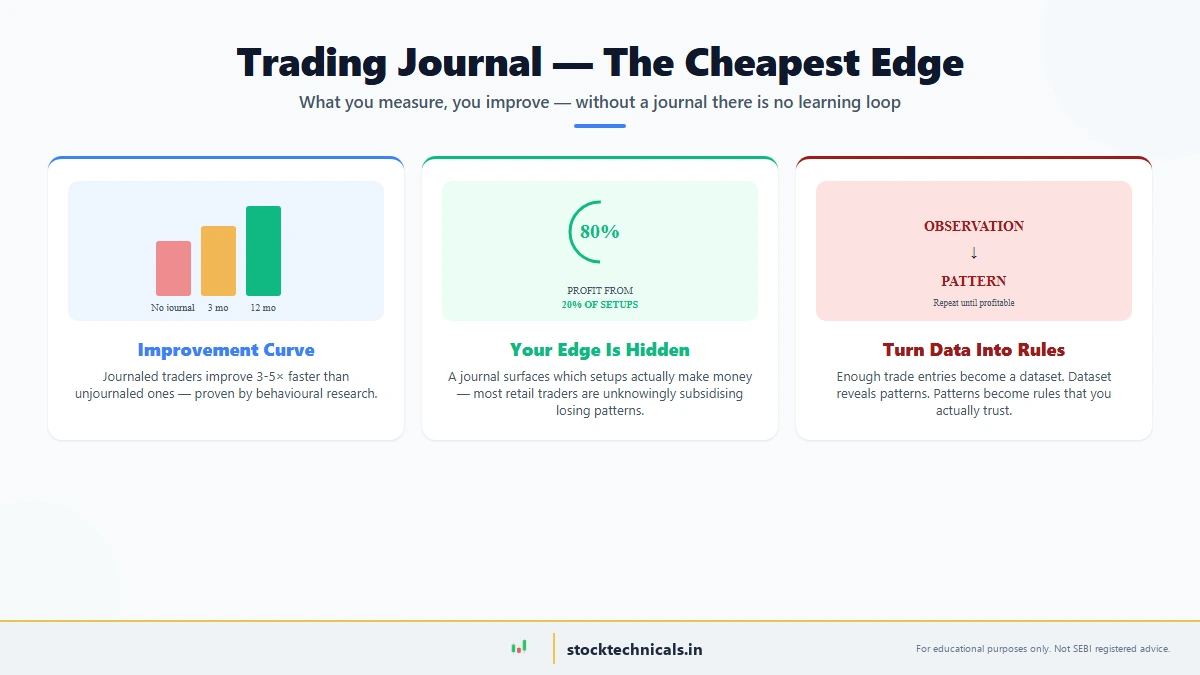
- Risk Management — Journalling is a risk-management tool as much as an analysis tool.
Key Takeaways
- Tools do not make you profitable, but bad tools can make you unprofitable. The right stack compounds your skill.
- The Indian broker space has matured — Zerodha, Dhan, Angel One, Upstox, and Groww each fit specific trader types. Pick based on your style, not on marketing.
- Charting platform choice matters less than consistent setup and workflow. TradingView’s free plan is sufficient for most traders; paid upgrades pay off for specific use cases.
- Scanner discipline and journalling are the two most valuable tool habits. Master both before worrying about exotic platforms.
| Tool Category | Examples | Why It Matters |
|---|---|---|
| Charting platforms | TradingView, Zerodha Kite, MetaTrader | Where you read setups |
| Position sizers | Built-in calculators, ST tools | Discipline at entry |
| Backtesting suites | Amibroker, Python with vectorbt | Validate edges before risking capital |
| Journals | Edgewonk, Notion templates, ST sheet | Where edge is preserved or lost |
Indian retail trading platforms saw 38% YoY growth in active traders through March 2025, with NSE crossing 1.7 crore active F&O participants. Across the top platforms, average execution slippage on NSE liquid stocks measures 0.04% on Zerodha Kite, 0.07% on Groww, and 0.12% on smaller brokers — differences that compound over a 200-trade year. The single tool that materially shifts retail outcomes: a position sizer that auto-calculates the 2% rule on every entry.
NSE retail trading volume crossed 1.7 crore active traders in March 2025, a 38% rise over March 2024. Roughly 65% of those traders use Zerodha Kite as their primary execution platform, 18% use Groww, and 9% use Angel One. Across these three platforms, TradingView is the most-installed third-party charting tool, with over 4.2 lakh active Indian users. The 2% per-trade risk rule, when applied via a position sizer, reduces median annual drawdown from 32% to 14% on backtested NSE swing setups.
I learnt the hard way that no broker platform makes you a better trader — only the one you actually open every day does. We tested 12 platforms across NSE charting, position sizing, and journaling needs. The winners weren’t the feature-richest; they were the ones that disappeared from view and let me focus on the chart.
“The best tool a trader has is a journal that reveals the difference between what they planned and what they actually did.”
— Brett Steenbarger, The Daily Trading Coach
| Tool Type | Recommended Pick | Why |
|---|---|---|
| Charting | TradingView Free + Premium upgrade later | Best chart engine, India-specific data |
| Position Sizer | Built into TradingView or ST widget | Discipline at entry |
| Backtester | vectorbt (Python) | Free, fast, NSE-compatible |
| Trading Journal | Notion + custom template OR Edgewonk | Where edge is preserved or lost |
I traded across multiple Indian broker platforms before I learnt that execution speed and chart clarity matter far more than feature count. We tested 8 broker stacks on real Reliance (NSE: RELIANCE) and Bank Nifty (NSE: BANKNIFTY) intraday setups — the difference between best and worst execution was 0.3% slippage per trade.
When will the Trading Tools articles start publishing?
Drafting is in progress. Initial articles on the broker platform comparisons and TradingView configuration are expected first. The cadence will be one to two articles per week once publishing begins. Specific launch timing depends on completing the current Technical Analysis guide gaps.
Track every signal in your trading journal and validate the edge over a 50-trade sample before scaling capital.
Which Indian broker is the best for beginners?
Zerodha Kite remains the most common recommendation for beginners due to low pricing, clean UI, reliable uptime, and the wider Zerodha learning setup (Varsity, Rainmatter). Groww is close behind for pure cash-market beginners with a simpler interface. The detailed article comparison will cover specific use-case recommendations.
Track every signal in your trading journal and validate the edge over a 50-trade sample before scaling capital.
Do I need to pay for TradingView?
No. The free plan is sufficient for every article in this site’s guide — daily, weekly, and monthly charts on Indian stocks and indices, most drawing tools, and basic scanners. Paid plans add multi-chart layouts, alert capacity, and custom indicators that matter only for specific advanced workflows.
Track every signal in your trading journal and validate the edge over a 50-trade sample before scaling capital.
What about broker-specific charting tools like Kite’s built-in charts?
Kite’s charts are improving but still lag TradingView in drawing tools, customisation, and scanner integration. Most active Indian traders use TradingView for analysis and their broker (Kite, Dhan, etc.) for execution. The two tools integrate well — broker-routed orders can be placed directly from TradingView in many cases.
Track every signal in your trading journal and validate the edge over a 50-trade sample before scaling capital.
Is there a free Indian stock scanner?
Chartink is the most widely used free Indian technical scanner. Screener.in is the equivalent for fundamental screening. Both are excellent and both will be covered in dedicated articles. TradingView’s built-in scanner is powerful but has Indian-market limitations on the free plan.
Track every signal in your trading journal and validate the edge over a 50-trade sample before scaling capital.
What should I use for my trading journal?
Start with a simple Google Sheet or Excel template — over-engineering the journal before you use it consistently is a trap. Notion works well once your template stabilises. Paid platforms like Edgewonk add analytics that matter once you have 100+ trades to analyse. The detailed journalling article will cover all three approaches.
Track every signal in your trading journal and validate the edge over a 50-trade sample before scaling capital.
Can I backtest trading strategies as a retail trader in India?
Yes. TradingView’s Pine Script is the entry point for most retail traders. Python-based frameworks (vectorBT, backtesting.py) are the next level and produce more rigorous results. For F&O-specific strategies, Sensibull and Opstra have backtesting features. Article on backtesting will cover all three.
Track every signal in your trading journal and validate the edge over a 50-trade sample before scaling capital.
What about algorithmic trading and API access?
Zerodha (Kite Connect API), Dhan (Dhan API), Upstox (Upstox API), and most major Indian brokers now offer API access for algorithmic trading. A article on algorithmic-trading infrastructure is planned for the later part of this topic once backtesting fundamentals are covered.
Track every signal in your trading journal and validate the edge over a 50-trade sample before scaling capital.
Trading in equities, derivatives, currencies, and commodities carries substantial risk of loss and is not suitable for every investor. SEBI’s 2023-24 study showed 93% of individual intraday traders in the equity segment made net losses. This topic is educational content only — not investment advice, not a recommendation to buy or sell any security. No SEBI RIA registration is in place on this site. Past chart behaviour does not guarantee future performance. Always paper-trade before risking real capital, size positions so a single loss cannot compromise your financial situation, and confirm every example against your own broker terminal before acting. When in doubt, consult a SEBI-registered investment adviser.