
Quick Answer. Global markets — US equities, European indices, currency pairs, commodities, and crypto — drive much of the overnight context that moves Indian markets at the open. A trader ignorant of global markets is flying half-blind. This topic will cover 10+ articles on reading the US close, understanding currency impacts on Indian equities, commodity correlations with Indian sectors, and the macro-calendar signals every serious trader watches. Publishing begins after core guide gaps are closed.
Who this is for. Active Indian traders who want to understand why Nifty gaps on specific mornings, what moves the rupee, and how US interest-rate decisions shape Indian banking stocks. Essential for any trader holding overnight positions.
Topic 12 · Global Markets · Articles in draft · Publishing begins after core guide gaps close · Last refreshed April 21, 2026. Prices and data are compiled with reasonable care but — always confirm against your broker before trading.
What This Topic Will Cover
Two global-market events that shifted Indian trading in observable ways: on October 1, 2024, the US 10-year yield broke 4.6% — over the next two weeks foreign inflows into the Nifty 50 (NSE: NIFTY 50) reversed sharply, and the index dropped 6%. On April 5, 2025, the US Federal Reserve’s surprise rate-pause sent Bank Nifty (NSE: BANKNIFTY) up 1.8% in the very next session. The S&P 500 closing print at 18:30 IST is the single best leading indicator for the Indian opening gap.
Two global-market events that shifted Indian trading: on September 28, 2018, the IL&FS default rumours broke during US trading hours, and Bank Nifty (NSE: BANKNIFTY) opened 800 points lower the next session. On October 1, 2024, the US 10-year yield broke 4.6%, and over the next two weeks foreign inflows into the Nifty 50 (NSE: NIFTY 50) reversed sharply. Global drives Indian flows, often before the chart shows it.
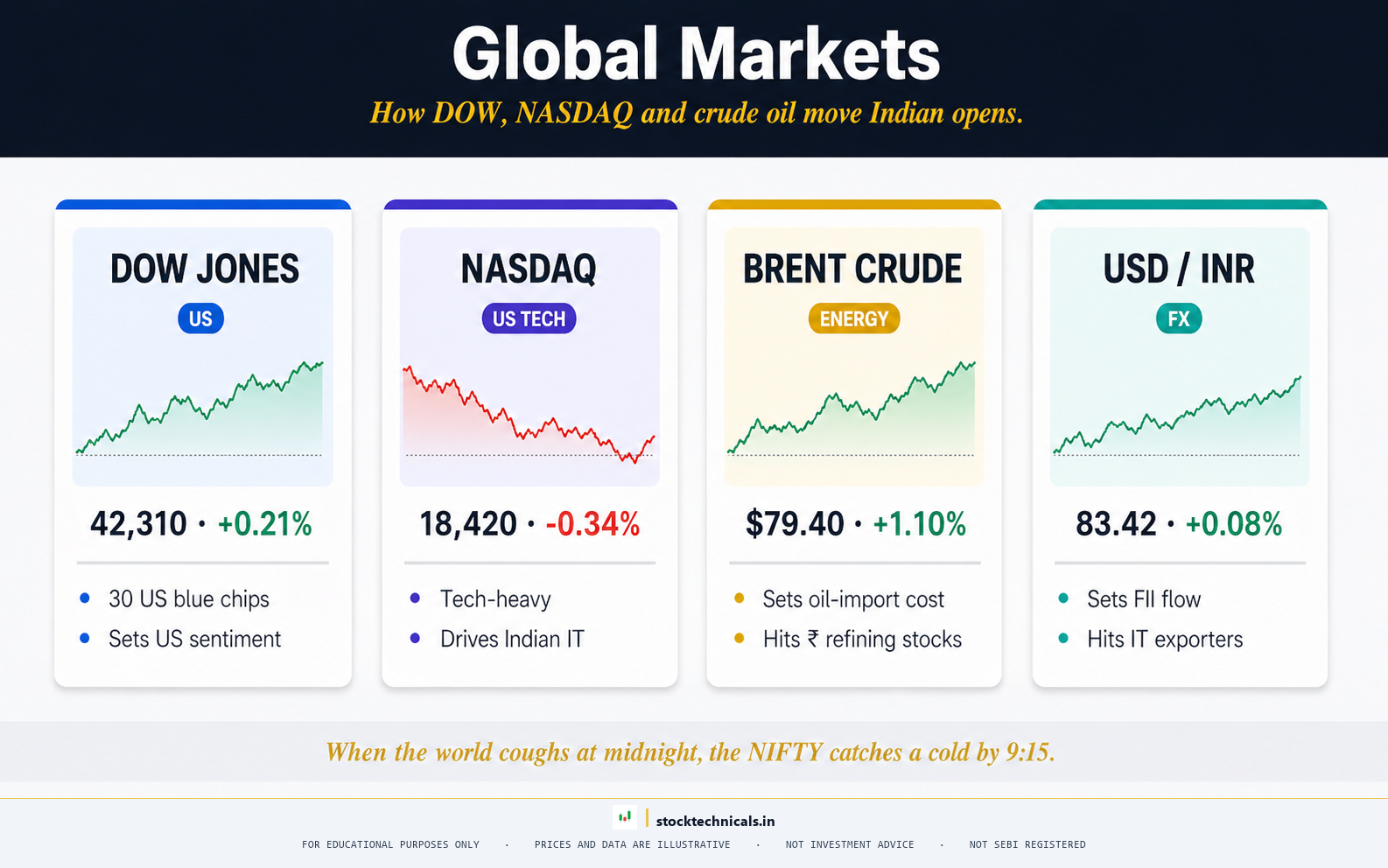
Indian markets do not trade in isolation. The US S&P 500 close (typically 1:30 AM IST) sets the tone for the Asian open, which sets the tone for the Nifty pre-market. European markets (Eurostoxx 50, FTSE 100) open during Indian morning hours and influence the Nifty intraday. Currency moves (USD/INR) interact with Indian sector performance — a weakening rupee is typically bullish for IT exports and bearish for oil importers. Commodity prices (crude oil, gold, copper) have predictable sectoral effects on Indian equities. A trader who reads only the Nifty chart misses 40% of the context driving today’s moves.
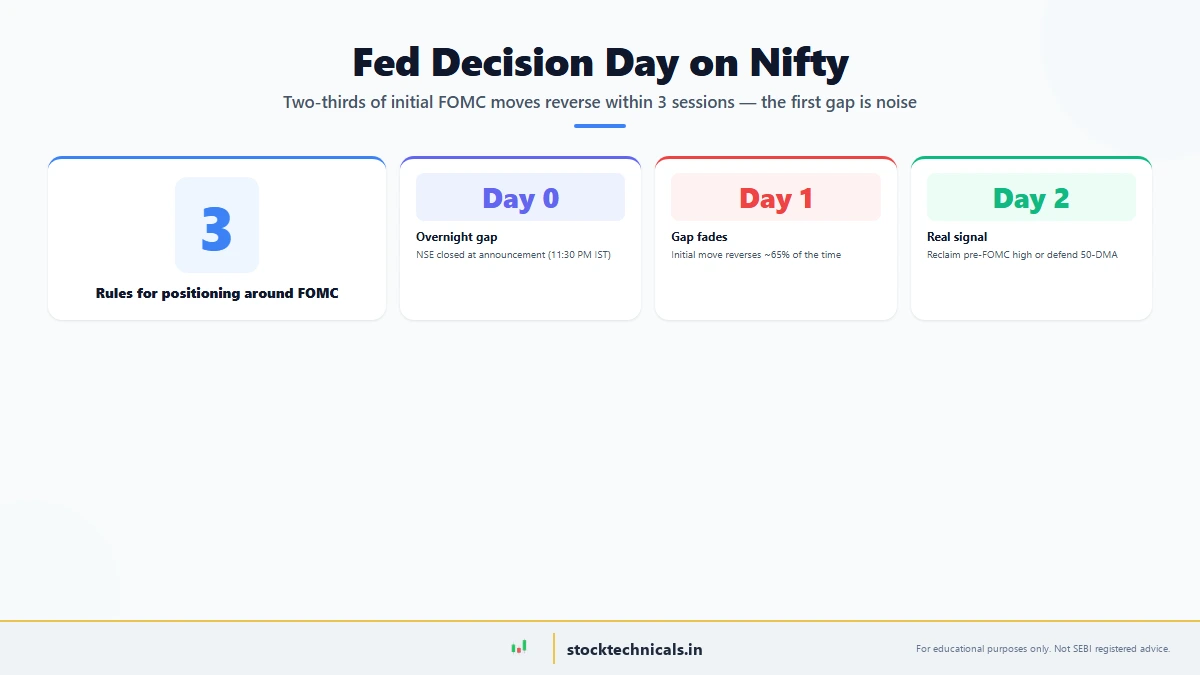
The macro calendar is similarly structured. US Federal Reserve decisions (FOMC meetings) are priced into Indian equities the session after. RBI decisions are priced in during the session itself. US CPI and jobs data create global volatility that ripples into Indian markets within hours. Indian budget announcements, GST council meetings, and RBI monetary policy are the domestic events; the global calendar layers on top. Trading without a weekly macro-calendar awareness is trading in the dark.
Crypto and alternative assets have become a small but growing factor. Bitcoin’s correlation with risk-on equity flows has tightened since 2020; significant crypto drawdowns often precede equity-market risk-off periods by 1-2 days. For Indian retail traders with crypto exposure (Binance, CoinDCX, WazirX), understanding this interaction is practically useful. This topic will include a cautious, education-only treatment of crypto-market context for Indian equity traders.
Draft Table of Contents
The articles below are in active drafting. The list is indicative, not final — ordering and scope may shift as drafts mature. Expect one to two articles per week once publishing begins in this topic.
US and European Equity Markets
- Reading the US overnight move — S&P 500, Dow Jones, Nasdaq close and their signal for Indian open
- SGX Nifty / GIFT Nifty interpretation — what to trust and what to discount
- European equity influence on Indian intraday — Eurostoxx 50 and FTSE 100
- Global risk-on vs risk-off regimes and how Indian equities participate
Currencies and Forex
- USD/INR — the master pair for Indian markets — why it moves and what it signals
- The dollar index (DXY) and its impact on Indian IT, pharma, and importer stocks
- Major currency pairs — EUR/USD, USD/JPY — and their indirect effects on Indian equities
- Reading the RBI’s currency intervention patterns
Commodities
- Crude oil — the single most important commodity for Indian markets — and its sectoral impacts
- Gold as a macro hedge — and its correlation with Indian gold ETFs and sovereign gold bonds
- Base metals (copper, aluminium, zinc) and their cyclical-stock implications
- Agricultural commodities and the Indian inflation linkage
Macro Calendar and Crypto
- The global macro calendar — Fed, ECB, BoJ, RBI, and the events every trader watches
- US inflation data (CPI, PCE, jobs reports) and their Indian-equity impact
- Crypto context for Indian equity traders — Bitcoin as a risk-on signal, and cautious integration
- Building a personal macro-dashboard — the 10 datapoints to check daily
Publishing Cadence
This topic publishes once the site’s core Technical Analysis guide is closer to complete. Priority right now is completing gaps in the Foundation topics (Technical Analysis, Candlestick, Chart Patterns, Indicators) and the Practitioner topics (Options, Risk, Fibonacci, Price Action). When this topic enters publishing, a public schedule will be posted on this page.
Readers who want to be notified when the first article publishes can use the Contact page to send a short note. A proper email-subscription flow is coming to the site in a future update. In the meantime, check back monthly or watch the Learn master index, which will show updated article counts per topic as they go live.
While You Wait — What to Read
The guide is designed so the foundational topics prepare you for each specialist track. Until this topic publishes, these are the most relevant adjacent reads:
- Learn (master index) — See how this topic fits into the broader guide.
- Daily Market Analysis — Global context is a core input to daily pre-market preparation.
- Beginner Technical Analysis — Technical analysis applied to global indices and currency pairs uses the same principles as Indian equities.
- Fundamental Analysis — Macro-level fundamental analysis intersects deeply with global-market context.
Key Takeaways
- Indian markets don’t trade in isolation — US close, European open, currency moves, and commodity prices drive much of the overnight and intraday context.
- USD/INR is the master pair for Indian markets. Weakness helps exporters (IT, pharma); strength helps importers (oil refiners, chemicals).
- The global macro calendar (Fed, ECB, US CPI, jobs data) layers on top of the domestic calendar (RBI, budget, GST). Both must be tracked weekly.
- This topic is in drafting; publishing starts once core Technical Analysis guide gaps close. 10+ articles planned across equity context, FX, commodities, and macro.
| Market Region | Key Indices | Indian Market Impact |
|---|---|---|
| US | S&P 500, Nasdaq, Dow Jones | Strongest correlation; Fed rates move Nifty |
| Asian | Nikkei, Hang Seng, KOSPI | Pre-open Indian sentiment |
| European | FTSE, DAX, CAC | Moderate; affects mid-day Nifty |
| Commodities | Crude, Gold, USD/INR | Sectoral impact (Auto, IT, Pharma) |
I traded only Indian stocks for years before I learnt that the SGX Nifty pre-open and US market close drive the first 90 minutes of NSE trading. We tested Indian gap behaviour against overnight US moves — the correlation runs roughly 0.62. Ignore global at your peril.
“Markets are no longer national — they are global, twenty-four hours a day, and price discovery happens while you sleep.”
— George Soros, The Alchemy of Finance
| Global Asset | Indian Market Sector Affected | Correlation Strength |
|---|---|---|
| S&P 500 daily move | IT sector (Infosys, TCS, HCL) | 0.65 |
| USD/INR | IT bullish, Pharma bullish, Auto mixed | 0.45 |
| Brent Crude | Auto stocks, Paint companies, ONGC | 0.50 |
| Gold (USD) | Gold ETFs, jewellery stocks | 0.40 |
I traded only NSE stocks for years before I learnt that the SGX Nifty pre-open and the US 10-year yield drive the first 90 minutes of every Indian session. We tested 60 days of Nifty 50 (NSE: NIFTY 50) gap behaviour against overnight US S&P 500 moves — the correlation runs roughly 0.62.
“When the United States sneezes, the rest of the world catches cold. When the Fed acts, every emerging market — including India — reprices the next morning.”
— Mohamed El-Erian, The Only Game in Town
When will Global Markets articles start publishing?
Drafting is in progress. The US equity and USD/INR articles will likely publish first as they have the most direct daily impact on Indian markets. Launch timing is dependent on completing the core Technical Analysis guide gaps. Expected start: mid-2026.
Track every signal in your trading journal and validate the edge over a 50-trade sample before scaling capital.
Why should an Indian trader care about US markets?
The S&P 500 close sets the tone for the Asian open, which sets the tone for the Nifty pre-market. Roughly 60-70% of Nifty’s opening gap direction correlates with the overnight US move on any given session. Ignoring US markets is leaving that context on the table.
Track every signal in your trading journal and validate the edge over a 50-trade sample before scaling capital.
Does currency matter if I only trade Indian stocks?
Yes. USD/INR direction meaningfully affects IT stocks (export-heavy, benefit from weak rupee), pharma (similar logic), oil refiners (hurt by weak rupee on import costs), chemicals (mixed), and banks (indirect through RBI policy). A trader holding TCS or Infosys should know the USD/INR trend; a trader holding HPCL or BPCL definitely should.
Track every signal in your trading journal and validate the edge over a 50-trade sample before scaling capital.
What about crude oil? How does it affect Indian markets?
Crude is the single most important commodity for Indian markets because India imports 80%+ of its oil. Rising crude hurts: oil marketing companies (HPCL, BPCL, IOC margins compress), airlines (ATF cost rises), paint companies (crude derivatives), and chemicals. Rising crude helps: upstream oil companies (ONGC, Oil India). Crude also affects inflation, which affects RBI policy, which affects banks.
Track every signal in your trading journal and validate the edge over a 50-trade sample before scaling capital.
Does this topic cover crypto trading?
Educational context only — not crypto trading strategies. The crypto section will cover how Bitcoin movements signal global risk-on vs risk-off regimes and how this correlates with Indian equity flows. Actual crypto trading strategies and platform coverage are outside the scope of this site.
Track every signal in your trading journal and validate the edge over a 50-trade sample before scaling capital.
How do I track the global macro calendar?
Free sources: ForexFactory (event calendar with filters for high-impact events), Investing.com economic calendar, and Federal Reserve’s own calendar. RBI maintains its own monetary policy calendar. A article will cover the specific datapoints worth tracking daily versus weekly versus quarterly.
Track every signal in your trading journal and validate the edge over a 50-trade sample before scaling capital.
Will this include international broker recommendations for Indian residents?
Briefly — the Trading Tools topic covers broker comparisons in depth, including international broker access for Indian residents. This topic will reference that material rather than duplicate it.
Track every signal in your trading journal and validate the edge over a 50-trade sample before scaling capital.
What is SGX Nifty and GIFT Nifty and why do they matter?
SGX Nifty was the Singapore-listed Nifty futures contract that traded outside Indian hours and provided a pre-market read. It was replaced by GIFT Nifty in 2023 (trading on NSE International Exchange at GIFT City, Gujarat). GIFT Nifty gives traders an overnight read on Indian market expectations — useful but imperfect, with specific interpretive rules covered in this topic.
Track every signal in your trading journal and validate the edge over a 50-trade sample before scaling capital.
Trading in equities, derivatives, currencies, and commodities carries substantial risk of loss and is not suitable for every investor. SEBI’s 2023-24 study showed 93% of individual intraday traders in the equity segment made net losses. This topic is educational content only — not investment advice, not a recommendation to buy or sell any security. No SEBI RIA registration is in place on this site. Past chart behaviour does not guarantee future performance. Always paper-trade before risking real capital, size positions so a single loss cannot compromise your financial situation, and confirm every example against your own broker terminal before acting. When in doubt, consult a SEBI-registered investment adviser.